CoachingNov 9, 20269 min read
Lire en français·Auf Deutsch lesen·Leer en español·Przeczytaj po polsku
Exercise Order: What Should You Do First in Your Workout?
The order you do your exercises in has a real, measurable effect on your results, and it follows one simple principle. Here's how to sequence your workout for what you actually want.
Reviewed by the HyperBody team

You walk into the gym with a list of exercises. Does it matter which one you do first? It turns out it does, more than most people realize. The sequence of your workout has a real, measurable effect on how much each exercise contributes to your progress. And happily, the research boils down to one clear, easy-to-apply principle.
The Golden Rule: First Gets the Most
Here's the single most important finding. Whatever exercise you do first benefits the most. A comprehensive review of exercise order found that strength increases are greatest for the exercise performed first in a sequence, and are inhibited for the exercise performed last1.
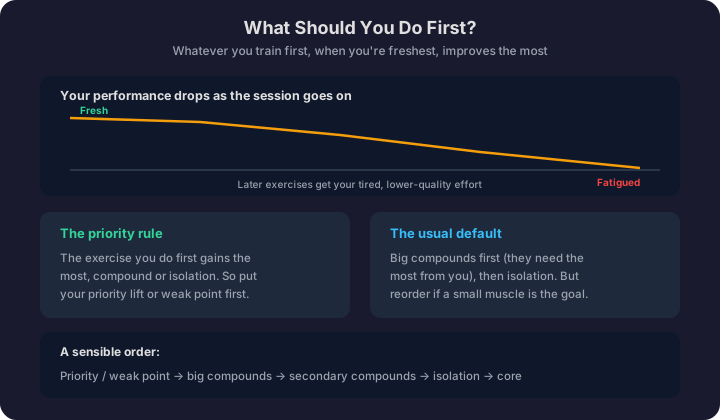
The reason is obvious once you say it: fatigue accumulates as your session goes on. Studies measuring this directly show that the number of reps you can complete on an exercise is consistently lower when it's placed later in the workout2. By your fourth or fifth exercise, you're tired, and your performance, and the quality of that training stimulus, drops12. The exercises you do while fresh get your best effort.
It's About Order, Not Exercise Type
There's an important subtlety here that overturns a common assumption. The priority effect is driven by order, not by whether an exercise is a compound or an isolation movement. A meta-analysis found that whatever you do first gains the most strength. Whether that's a multi-joint lift or a single-joint one3.
So if your biceps are lagging and building them is your priority, doing curls first, before your back work, will build more bicep strength than saving them for last, even though curls are an "isolation" exercise. The old rule isn't "compounds first because they're compounds." it's "your priority first because first wins."
Interestingly, for hypertrophy specifically, exercise order has a smaller effect. Muscle growth ends up fairly similar regardless of order3. The order effect is strongest for strength. But since fatigue still degrades the quality of your later work, sensible sequencing helps either way.
The Traditional Default (and When to Break It)
The classic recommendation, from the ACSM, is to perform large-muscle-group, multi-joint (compound) exercises before small-muscle-group, single-joint (isolation) exercises4. This is a sound default for most people, for two reasons:
- Compounds demand the most from you. Squats, deadlifts, presses, and rows are technically demanding and use the most muscle. You want to do them while fresh, both for performance and for safety.
- They drive the most overall progress. Prioritizing your biggest, most productive lifts makes sense for general strength and muscle.
But the priority principle tells you when to break the default: if a specific muscle or lift is your goal, train it first, even if it's an isolation movement13. Weak point you want to bring up? Put it at the front of the workout when you can give it your best.
What About Pre-Exhaustion?
You may have heard of "pre-exhaustion": doing an isolation exercise before a compound to "pre-fatigue" a muscle so it works harder during the big lift (say, leg extensions before squats to hit the quads more). It's a popular technique, but the evidence doesn't support the theory.
Research found that pre-exhaustion does not increase muscle activation in the target muscle during the following compound exercise5, and a review concluded that current evidence doesn't support pre-exhaustion over traditional ordering for strength or muscle gains6. It's not harmful, but it won't give you the special targeting effect it promises, and it means doing your big lift already fatigued.
How to Order Your Workout
Putting it all together, a sensible sequence for most sessions:
- Your priority or weak point first, whatever it is: this is the highest-leverage slot13.
- Big compound lifts next, while you're still fresh. They need it most4.
- Secondary compounds after that.
- Isolation and accessory work later, when fatigue matters less.
- Core at the end, so it doesn't compromise your big lifts.
For most people with general goals, this looks like the standard "compounds first, isolation last." But if you have a specific priority, promote it to the front.
The Bottom Line
- The exercise you do first benefits the most. fatigue degrades everything after it12.
- It's about order, not exercise type. put your priority first, compound or not3.
- Default to compounds first for general training. They demand the most and drive the most progress4.
- Break the default for weak points. train what matters most while you're fresh1.
- Skip pre-exhaustion as a targeting trick. the evidence doesn't back it56.
Exercise order is a small lever, but it's a free one. Just by sequencing your workout intelligently, priority first, big lifts while fresh, you get more out of the exact same exercises. A smart coaching plan orders your sessions around your goals automatically, so your most important work always comes first.
References
Footnotes
-
Simão R, de Salles BF, Figueiredo T, Dias I, Willardson JM (2012). Exercise order in resistance training. Sports Medicine, 42(3), 251-265. https://doi.org/10.2165/11597240-000000000-00000
-
Simão R, Farinatti PTV, Polito MD, Viveiros L, Fleck SJ (2007). Influence of exercise order on the number of repetitions performed and perceived exertion during resistance exercise in women. Journal of Strength and Conditioning Research, 21(1), 23-28. https://doi.org/10.1519/00124278-200702000-00005
-
Nunes JP, Grgic J, Cunha PM, et al. (2021). What influence does resistance exercise order have on muscular strength gains and muscle hypertrophy? A systematic review and meta-analysis. European Journal of Sport Science, 21(2), 149-157. https://doi.org/10.1080/17461391.2020.1733672
-
American College of Sports Medicine (2009). Progression models in resistance training for healthy adults (position stand). Medicine & Science in Sports & Exercise, 41(3), 687-708. https://doi.org/10.1249/MSS.0b013e3181915670
-
Fujita RA, Silva NRS, Bedo BLS, Gomes MM (2022). The pre-exhaustion method does not increase muscle activity in target muscle during strength training in untrained individuals. Journal of Human Kinetics, 82, 17-26. https://doi.org/10.2478/hukin-2022-0027
-
Trindade TB, Alves RC, de Castro BM, et al. (2022). Pre-exhaustion training, a narrative review of the acute responses and chronic adaptations. International Journal of Exercise Science, 15(3), 507-525. https://doi.org/10.70252/CEVS9112
More field notes.

Double Progression: The Simplest Way to Progress Your Lifts
Progressive overload is the rule that builds muscle, but 'add weight every session' falls apart fast. Double progression is the beginner-friendly method that makes steady progress almost automatic.

Online Fitness Coaching: Does Remote Coaching Actually Work?
Can a coach who isn't in the room really get you results? Here's what the research says about online coaching, in-person supervision, and why accountability matters more than location.

How to Coach Yourself: Building Your Own Training Program
You don't need to pay for a plan you could build yourself. Here's the exact framework a coach uses to write a program, broken into five decisions you can make today.
More on HyperBody