CoachingJul 3, 202610 min read
Lire en français·Auf Deutsch lesen·Leer en español·Przeczytaj po polsku
Online Fitness Coaching: Does Remote Coaching Actually Work?
Can a coach who isn't in the room really get you results? Here's what the research says about online coaching, in-person supervision, and why accountability matters more than location.
Reviewed by the HyperBody team

"How can a coach help me if they're not even there to watch me lift?" It's the most reasonable objection to online fitness coaching, and for years the honest answer was a shrug. But we now have real data comparing in-person supervision, online coaching, and going it alone, and the results are more encouraging for remote coaching than most skeptics expect.
The short version: a good coach helps mostly through two mechanisms, pushing your training intensity and holding you accountable, and both can travel down a phone line surprisingly well.
What the Head-to-Head Research Found
The most useful study on this question is a 2025 randomized controlled trial that put three approaches against each other: in-person supervised training, app-based online coaching, and self-guided training with no coach1. Everyone ran comparable programs. The difference was purely the coaching model.
Two findings stand out.
First, adherence tracked the level of support. In-person supervision produced the highest session attendance at 88.2%, online coaching was close behind at 81.2%, and self-guided training collapsed to 52.2%1. In other words, having a coach at all, even a remote one, kept people training far more consistently than being left to their own devices.
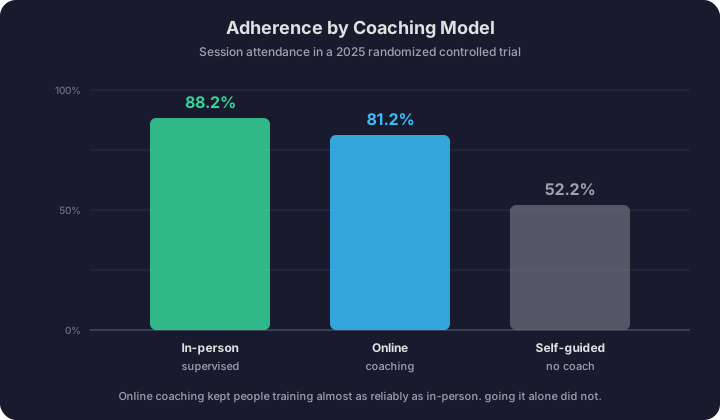
Second, in-person supervision still produced the largest strength and body-composition gains, but online coaching produced real, meaningful results well above self-guided training1. So the honest takeaway isn't "online is identical to in-person." It's "online coaching captures most of the benefit, and the gap between any coaching and no coaching is enormous."
Why Supervision Works in the First Place
To understand why remote coaching can work, you have to understand what a coach standing next to you is actually doing. And the research is clear: a lot of it comes down to intensity.
In a classic study, two groups ran the identical program: one directly supervised, one not. The supervised group increased their training loads faster and gained significantly more strength2. Not because the program was different, but because a coach nudges you to add weight when you're ready and not let yourself coast. A follow-up study found that even the ratio of supervision matters: a 1-to-5 coach-to-trainee ratio produced greater strength gains than 1-to-25, again driven by higher training intensity3.
The lesson: supervision works largely by keeping your intensity honest. That's a job a remote coach can do through programming and check-ins, by prescribing the right loads, reviewing your logs, and telling you when you're sandbagging.
The Tools That Make Remote Coaching Work
If a coach can't physically load your bar, how do they control intensity from a distance? Through a handful of well-validated tools.
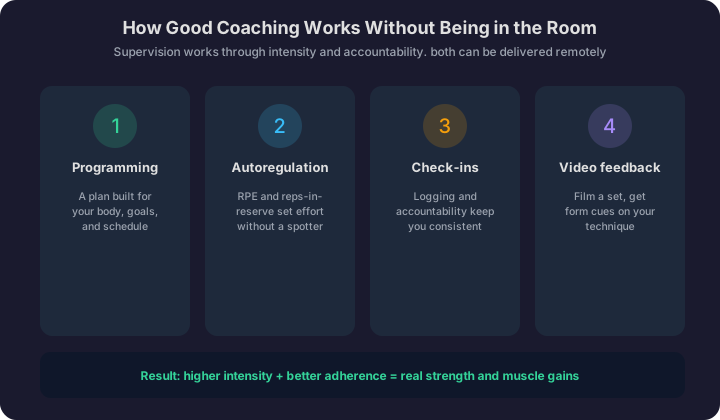
Autoregulation. Instead of dictating an exact weight the coach can't see, remote programming uses effort-based targets like RPE (rate of perceived exertion) and RIR (reps in reserve). Systematic reviews show that autoregulated load and volume prescription matches traditional percentage-based loading for strength and hypertrophy4, and that RPE/RIR-based autoregulation accounts for your day-to-day fluctuations and can equal or beat fixed percentages5. This is the mechanism that lets a coach program your effort without watching each set.
Accountability and self-monitoring. Behavior-change research is unambiguous here: interventions that include self-monitoring, logging your workouts and food, combined with at least one other self-regulation technique are significantly more effective at changing physical-activity behavior6. The weekly check-in and the training log aren't busywork. They're the evidence-based core of what makes coaching stick.
Goal-setting. A coach who helps you set and revise structured goals is using one of the most reliable tools in the behavior-change toolkit. A meta-analysis found multi-component goal-setting interventions produce a medium positive effect on physical-activity behavior (Cohen's d = 0.55)7, and that bundling goals with monitoring and feedback beats goal-setting alone.
Video form checks. Remote coaches correct technique by having you film your sets. The evidence here is positive but honest: video-based visual feedback can enhance motor-skill learning8, though the effect is modest and works best when paired with clear coaching cues rather than replacing them. It's a real tool, not a magic one.
Where In-Person Still Wins
It would be dishonest to pretend location never matters. In-person coaching still holds advantages: a spotter for true maximal efforts, instant hands-on cueing, and the hard-to-fake accountability of someone physically expecting you. The 2025 trial reflected this. In-person edged out online on raw results1. If you're chasing a competitive powerlifting total or you know you need someone literally standing over you, in-person is worth the premium.
For most people pursuing a better physique and consistent progress, though, that edge is small, and it comes at a large cost in money and scheduling.
What This Means for You
- Any coaching beats no coaching, by a lot. The biggest gap in the data isn't online vs in-person. It's coached vs self-guided1.
- The mechanism is intensity and accountability, both of which a good remote coach delivers through programming, autoregulation, and check-ins236.
- Effort-based programming is legit. RPE and RIR let a coach prescribe hard, productive training without being in the room45.
- Consistency is the real product. Coaching's largest measurable effect is keeping you training week after week167.
This is exactly the philosophy behind HyperBody's smart coaching: a plan built around your body and adjusted as you progress, paired with form check video analysis so your technique gets feedback even when no one's standing beside the rack. It's the accountability and intensity of coaching, delivered the way the research says actually works. And because it's anchored to a periodic physique analysis, your plan evolves with the body it's actually looking at.
References
Footnotes
-
Gavanda S, Held S, Schrey S, et al. (2025). Optimizing resistance training outcomes: comparing in-person supervision, online coaching, and self-guided approaches. A randomized controlled trial. Journal of Strength and Conditioning Research, 39(11), 1129-1137. https://doi.org/10.1519/JSC.0000000000005216
-
Mazzetti SA, Kraemer WJ, Volek JS, et al. (2000). The influence of direct supervision of resistance training on strength performance. Medicine & Science in Sports & Exercise, 32(6), 1175-1184. https://doi.org/10.1097/00005768-200006000-00023
-
Gentil P, Bottaro M (2010). Influence of supervision ratio on muscle adaptations to resistance training in nontrained subjects. Journal of Strength and Conditioning Research, 24(3), 639-643. https://doi.org/10.1519/JSC.0b013e3181ad3373
-
Hickmott LM, Chilibeck PD, Shaw KA, Butcher SJ (2022). The effect of load and volume autoregulation on muscular strength and hypertrophy: a systematic review and meta-analysis. Sports Medicine - Open, 8, 9. https://doi.org/10.1186/s40798-021-00404-9
-
Larsen S, Kristiansen E, van den Tillaar R (2021). Effects of subjective and objective autoregulation methods for intensity and volume on enhancing maximal strength during resistance-training interventions: a systematic review. PeerJ, 9, e10663. https://doi.org/10.7717/peerj.10663
-
Michie S, Abraham C, Whittington C, McAteer J, Gupta S (2009). Effective techniques in healthy eating and physical activity interventions: a meta-regression. Health Psychology, 28(6), 690-701. https://doi.org/10.1037/a0016136
-
McEwan D, Harden SM, Zumbo BD, et al. (2016). The effectiveness of multi-component goal setting interventions for changing physical activity behaviour: a systematic review and meta-analysis. Health Psychology Review, 10(1), 67-88. https://doi.org/10.1080/17437199.2015.1104258
-
Mödinger M, Woll A, Wagner I (2021). Video-based visual feedback to enhance motor learning in physical education: a systematic review. German Journal of Exercise and Sport Research, 52(3), 447-460. https://doi.org/10.1007/s12662-021-00782-y
More field notes.

AI Fitness Coach vs Personal Trainer: Which Is Right for You?
One costs a few dollars a month and never sleeps. The other stands beside you and adjusts your form in real time. Here's an honest, evidence-based look at what each does well and when to use which.

RPE and RIR: How to Gauge Training Effort Like a Coach
Percentages of your one-rep max look precise, but they ignore how you feel today. Here's how coaches use RPE and reps-in-reserve to autoregulate effort, and how to use them yourself.

Double Progression: The Simplest Way to Progress Your Lifts
Progressive overload is the rule that builds muscle, but 'add weight every session' falls apart fast. Double progression is the beginner-friendly method that makes steady progress almost automatic.
More on HyperBody