Body CompositionJul 1, 202610 min read
Lire en français·Auf Deutsch lesen·Leer en español·Przeczytaj po polsku
Body Types Explained: Ectomorph, Mesomorph, Endomorph. What the Science Says
You've been told you have a body type that dictates how you should train and eat. The truth is more useful: your type describes your starting point, not your ceiling. Here's what the research actually shows.
Reviewed by the HyperBody team

Somewhere along your fitness journey, someone probably told you that you're an ectomorph, a mesomorph, or an endomorph, and that your "type" determines how you should train, what you can build, and how you should eat. It's one of the most repeated ideas in fitness. It's also one of the most misunderstood.
Body types are real as a description. They're much weaker as a prescription. Let's separate the useful part from the myth, because getting this wrong quietly sabotages a lot of people's training.
Where the Three Body Types Come From
The classification most people know, endomorphy (relative fatness), mesomorphy (musculoskeletal robustness), and ectomorphy (linearity), comes from the Heath-Carter somatotype method, formalized by Barbara Heath and Lindsay Carter1. In their framework, a somatotype isn't a box you fall into. It's three numbers describing how much of each quality your physique currently expresses. Almost everyone is a blend.
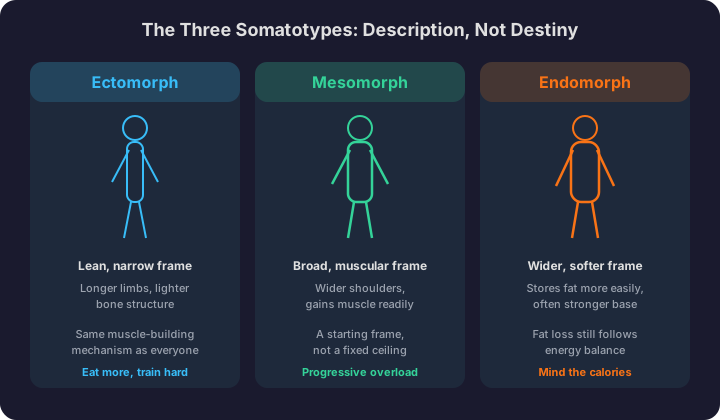
That descriptive origin matters, because the popular version of body types comes from somewhere much shakier.
The Part That's Been Debunked
The original body-type theory came from William Sheldon in the 1940s, and he didn't stop at describing physiques. He claimed your body type predicted your temperament and personality: that a rounder person was sociable, a muscular person assertive, a lean person intellectual and anxious. This "constitutional psychology" has been thoroughly rejected by modern science. It rested on subjective visual assessment and deeply questionable methods, and the personality claims never held up.
So when you see "eat for your body type" or "ectomorphs are meant to be skinny," you're looking at the discredited, deterministic version of the idea, not the careful descriptive tool sports scientists actually use. Modern research uses somatotype descriptively, for instance to profile the physiques typical of different sports, where gymnasts skew mesomorphic and distance runners ectomorphic2, but it treats it as a snapshot, never a destiny.
The Mechanism Is the Same for Everyone
Here's the part that actually changes how you should train: the way your body builds muscle and loses fat does not depend on your body type.
Muscle grows through the same mechanisms in every human: mechanical tension, metabolic stress, and muscle damage, all driven by progressive overload3. There is no separate pathway for ectomorphs. An "ectomorph" who lifts progressively heavier and eats enough will build muscle by the exact same process as everyone else.
Fat loss is the same story. Body-fat change is governed by energy balance, calories in versus calories out, for everyone, with no mechanism by which a body type overrides that fundamental4. An "endomorph" isn't cursed to stay soft; they simply need to mind their energy balance like anyone else.
So What Does Genetics Actually Control?
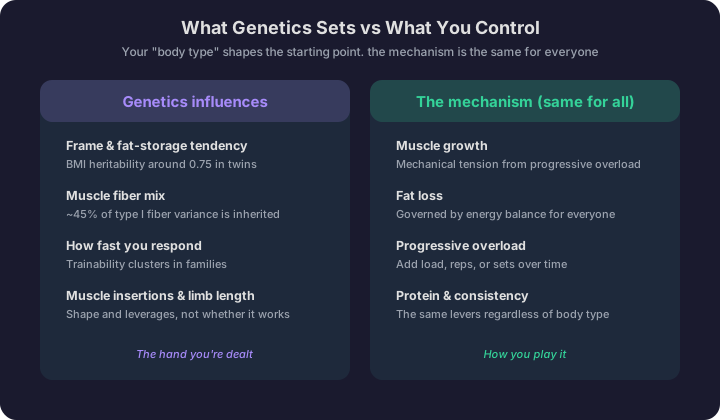
Genetics matters enormously, just not in the way body-type folklore claims. It shapes your starting point and your rate of progress, not the mechanism.
How fast you respond. In the largest study of its kind, 585 people ran an identical 12-week resistance-training program. The responses ranged from almost nothing to strength doubling and large gains in muscle size5. Same program, wildly different results. That variability is real, and it's largely genetic, but notice what it means: the training worked, the magnitude just varied.
How trainable you are. The HERITAGE Family Study showed that your response to a standardized program clusters within families, with the heritability of the training response reaching roughly 47%6. Some of your trainability is simply inherited.
Your muscle fiber mix. Roughly 45% of the variance in the proportion of slow-twitch (type I) muscle fibers is attributable to inherited factors7, which influences whether you lean more toward endurance or power.
Your frame and fat-storage tendency. Body composition is strongly heritable. Twin studies put the heritability of BMI around 0.758. This is the real kernel of truth behind "body types": your frame size and where you tend to store fat genuinely have a large genetic component.
Add in bone structure, limb lengths, and muscle insertions, and you get the honest picture: genetics deals the hand, but everyone plays it with the same rules.
How to Actually Use This
Stop asking "what should my body type do?" and start asking "what does my body respond to?" That's a question you answer with training and tracking, not a label.
- Ignore "eat for your body type" diets. Energy balance and adequate protein work for everyone4. Your type doesn't change the math.
- Everyone trains on the same principles. Progressive overload builds muscle regardless of your somatotype3. The "hardgainer" just needs to eat more and be patient; the "endomorph" just needs to watch calories.
- Use your frame as context, not a cage. A leaner frame may need more deliberate eating to grow; a wider frame may need tighter nutrition to lean out. That's a starting adjustment, not a different rulebook.
- Expect your own response. Because individual variation is huge5, the only way to know how you respond is to train consistently and measure, not to predict it from a label.
Your body type is a description of where you're starting from. It says nothing about where you can go. The people who make the most progress aren't the ones with the "right" type. They're the ones who apply the same fundamentals consistently and let the results, not a label, guide them. A periodic physique analysis shows you how your own body is actually responding, and smart coaching turns that into a plan built for the frame you have, not a stereotype.
References
Footnotes
-
Carter JEL, Heath BH (1990). Somatotyping: Development and Applications. Cambridge University Press (Cambridge Studies in Biological and Evolutionary Anthropology). ISBN 9780521351171.
-
Martínez-Mireles X, Nava-González EJ, López-Cabanillas Lomelí M, et al. (2025). The shape of success: a scoping review of somatotype in modern elite athletes across various sports. Sports, 13(2), 38. https://doi.org/10.3390/sports13020038
-
Schoenfeld BJ (2010). The mechanisms of muscle hypertrophy and their application to resistance training. Journal of Strength and Conditioning Research, 24(10), 2857-2872. https://doi.org/10.1519/JSC.0b013e3181e840f3
-
Hall KD, Guo J (2017). Obesity energetics: body weight regulation and the effects of diet composition. Gastroenterology, 152(7), 1718-1727.e3. https://doi.org/10.1053/j.gastro.2017.01.052
-
Hubal MJ, Gordish-Dressman H, Thompson PD, et al. (2005). Variability in muscle size and strength gain after unilateral resistance training. Medicine & Science in Sports & Exercise, 37(6), 964-972. https://pubmed.ncbi.nlm.nih.gov/15947721/
-
Bouchard C, An P, Rice T, et al. (1999). Familial aggregation of VO2max response to exercise training: results from the HERITAGE Family Study. Journal of Applied Physiology, 87(3), 1003-1008. https://doi.org/10.1152/jappl.1999.87.3.1003
-
Simoneau JA, Bouchard C (1995). Genetic determinism of fiber type proportion in human skeletal muscle. FASEB Journal, 9(11), 1091-1095. https://doi.org/10.1096/fasebj.9.11.7649409
-
Min J, Chiu DT, Wang Y (2013). Variation in the heritability of body mass index based on diverse twin studies: a systematic review. Obesity Reviews, 14(11), 871-882. https://doi.org/10.1111/obr.12065
More field notes.

Waist-to-Height Ratio: A Simple Health Metric That Beats BMI
BMI can't tell muscle from fat, and it ignores where you carry weight. There's a simpler number you can check with a tape measure that predicts health risk better. Keep your waist under half your height.

Spot Reduction: Can You Target Fat Loss in One Area?
Endless crunches for a flat stomach, arm exercises for toned arms. It feels intuitive, but the science says targeted fat loss doesn't work the way you'd hope. Here's what actually determines where you lose fat.

Water Weight: Why the Scale Fluctuates (and When Not to Worry)
You did everything right, and the scale jumped 1.5 kg overnight. Before you panic, understand this: day-to-day weight swings are almost entirely water and food, not fat. Here's the science.
More on HyperBody