EducationJun 28, 202610 min read
Lire en français·Auf Deutsch lesen·Leer en español·Przeczytaj po polsku
AI Fitness Apps in 2026: Choosing Between Physique Raters, Form Checkers, and Full Coaching Platforms
The AI fitness space has split into single-purpose tools and full coaching platforms. Here's a clear map of what each category does well, where each falls short, and how to pick for your goal.
Reviewed by the HyperBody team

Key takeaways
- What are the different types of AI fitness apps?
- The article splits AI fitness apps into four categories: physique raters that score your body from photos, form checkers that analyze lifts from video, plan generators that build programs from a questionnaire, and full coaching platforms that connect assessment, programming, form checking, and nutrition into one feedback loop.
- What is the limitation of AI physique rater apps?
- Physique raters give a body fat estimate or per-muscle scores from a few photos, but the article calls a rating a destination with no map: it comes with no programming, so it changes nothing about your training. Inconsistent photo conditions degrade trend value, and many free raters are sales funnels with immediate upsells.
- Do AI training plan generators actually look at your body?
- No. The article explains that plan generators skip assessment and work only from questionnaire answers, so the tool never sees your body. Two people with identical answers but completely different physiques get the same plan, and many generators produce a static document that never adapts to your logged performance.
- What makes a full AI coaching platform different from single-purpose tools?
- A coaching platform connects features so data flows between them: assessment shapes programming, logged performance reshapes the plan, and form checks verify execution. HyperBody's loop uses a five-photo analysis with muscle-by-muscle scores, adaptive plans running four to twenty weeks, video form checking across fifteen exercises, and macro-matched recipes.
Search for "best AI fitness app" and you'll find listicles ranking twenty apps against each other as if they were all competing for the same job. They aren't. Over the past few years, the AI fitness space has exploded, and in the process it has split into categories that solve genuinely different problems. An app that rates your physique from a photo, an app that analyzes your squat from a video, and an app that writes your training program are not three versions of the same product. They are three different products that happen to share the letters "AI" in their marketing.
That means the real decision you face is not between brands. It is between two architectures: single-purpose tools that do one thing and stop, and full coaching platforms where multiple features feed each other. Both architectures are legitimate. Single-purpose tools are often free, instant, and excellent at their one job. Platforms cost more and ask for more commitment, but they connect assessment to action in a way no standalone tool can.
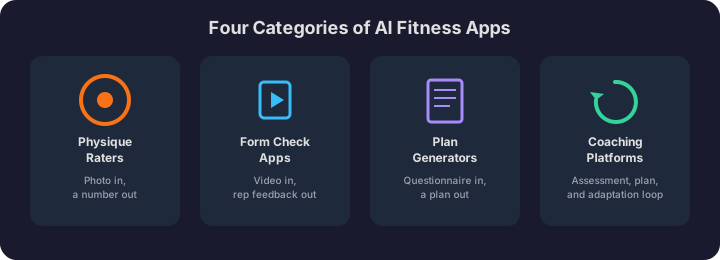
This guide maps the four categories you'll actually encounter: physique raters, form checkers, plan generators, and coaching platforms. For each one, we'll cover what it does well, where it falls short, and who it actually fits. By the end you should be able to place any app you come across into one of these buckets and know within a minute whether it matches your goal.
Single-Purpose Physique Raters
The first category is the simplest: apps and browser-based tools that take one or a few photos of your physique and return a verdict. Usually that verdict is a body fat estimate, sometimes a numeric rating of your overall physique, sometimes a breakdown of individual muscle groups with scores attached.
What they do well. Speed and accessibility. You upload a photo, and seconds later you have a number. Most offer a free rating with no account, no questionnaire, and no commitment. For pure curiosity, that's hard to beat. If you have never had any objective read on your physique, even a rough estimate is more information than you had before, and a starting number gives your future progress something to be measured against. There is real value in lowering the barrier to that first data point all the way to zero.
Where they fall short. The fundamental limit is that a rating is a destination with no map. You learn that your body fat sits somewhere in the high teens or that your back scores a six out of ten, and then the app's job is done. A number with no plan attached changes nothing about what you do in the gym tomorrow. Muscle ratings without programming are trivia: knowing your rear delts lag is only useful if something translates that into exercise selection, volume, and a progression scheme.
There are two quieter problems too. First, inconsistent photo conditions degrade trend value. If this month's photo is taken in different lighting, at a different angle, after a different meal than last month's, the change in your score may reflect the photo rather than your body. Tools that don't enforce standardized poses and conditions produce numbers that are hard to compare over time. Second, watch the business model. Many free raters are the top of a sales funnel: the rating costs nothing, and the upsell arrives immediately after. That isn't inherently wrong, but it's worth knowing that the free number is often the advertisement, not the product.
Who it fits. Anyone who wants a quick, zero-cost answer to "roughly where am I?" and doesn't need the answer to change their training.
Dedicated Form Check Apps
The second category points the camera at your lifting instead of your physique. You record a set, the app runs pose detection on the video, and you get feedback on your technique: bar path, depth, joint angles, tempo, asymmetries between sides.
What they do well. Depth on technique. The better tools in this category break a set down rep by rep, flagging exactly where your squat depth fell off or where your hips shot up out of the hole. For lifters chasing technique on the big barbell lifts, that level of detail is genuinely useful, and it's feedback most people otherwise only get from an in-person coach or a critical training partner. If your bench has plateaued and you suspect the problem is execution rather than programming, a rep-by-rep technical breakdown can find things you will never feel from inside the lift.
Where they fall short. Three limits show up consistently. First, the feedback is disconnected from your actual program. The app tells you your deadlift lockout is soft, but it has no idea what program you're running, so it can't adjust your volume, swap in an accessory, or schedule the fix. You receive a diagnosis and are left to write your own prescription. Second, coverage is often narrow. Many tools in this category go deep on a handful of lifts, frequently the squat, bench, and deadlift, and offer little or nothing for the other ninety percent of exercises in a typical hypertrophy program. Third, and this follows from the first two: you still have to decide what to do with the findings. Form feedback is an input to a training decision, not the decision itself.
Who it fits. Experienced lifters focused on barbell technique, especially strength athletes for whom execution on a few specific lifts is the whole game.
AI Training Plan Generators
The third category skips assessment entirely and goes straight to output. You fill in a questionnaire: goal, experience level, days per week, available equipment. The AI returns a structured program, often within seconds.
What they do well. Cheap, instant programming. A generated plan is usually more coherent than what a beginner would assemble from scattered internet advice: it covers the major movement patterns, distributes volume across the week, and gives you something concrete to follow on day one. For someone whose alternative is wandering the gym without a plan, that's a real upgrade, delivered at a price close to zero.
Where they fall short. The core problem is that without assessment data, these tools program blind. A questionnaire tells the AI what you say about yourself; it doesn't tell the AI anything about your actual body. A coach who has never seen you can still write you a sensible generic program, but they cannot prioritize your lagging muscle groups, address your asymmetries, or weigh your proportions, because they don't know about any of them. Plan generators have exactly that blindness. Two people with identical questionnaire answers and completely different physiques get the same plan.
The second weakness is progression. Many generators produce a static document: the plan you get in week one is the plan, full stop. Real programming responds to performance. If your pressing is moving fast and your squat is stalling, week six should not look like a photocopy of week one. Tools that generate once and never adapt put the entire burden of adjustment back on you, which is the part most people needed help with in the first place.
Who it fits. Beginners who need any structured plan immediately, and self-sufficient lifters who just want a starting template they intend to modify themselves.
Full Coaching Platforms
The fourth category is where HyperBody sits, so read this section knowing that. The defining property of a coaching platform is not having more features. It's that assessment, programming, form checking, and nutrition feed one loop instead of existing as four separate tools.
Here's what that loop looks like concretely. A physique analysis identifies your weak points: which muscle groups lag, where your proportions are off, what's visually holding your physique back. The training plan is generated from that analysis, so a lagging back gets more pulling volume, not a generic split. As you log your sets, the plan adapts: the next week's targets respond to what you actually lifted, not what a template assumed you would. A form check on the lifts that matter verifies you're executing the work the plan prescribed. And nutrition is built around the same goal the plan is pursuing, so a cut and a recomposition don't get the same macros. Each feature makes the others smarter, which is something no collection of standalone apps can replicate, because standalone apps don't share data.
In HyperBody's case, the loop is built from a five-photo physique analysis with muscle-by-muscle development scores, adaptive training plans running four to twenty weeks that adjust week to week based on your logged performance, video form checking across fifteen common exercises, and recipe generation matched to your macro targets. We've written before about why personalized programs beat generic plans; the platform model is that argument carried to its conclusion, where the personalization comes from measured data instead of questionnaire answers.
The honest trade-off: a single-purpose tool can absolutely be deeper on its one feature than a platform is. A dedicated form checker may analyze a powerlifting squat in more granular detail than a platform's form check does. The platform's advantage is not depth on any single feature. It's the data flowing between features, so that an assessment actually changes a program, and a program actually responds to performance.
Who it fits. Anyone whose goal is changing their physique over months, who wants assessment connected to action rather than delivered as a standalone number.
How to Choose
Strip away the marketing and the choice maps cleanly onto your goal.
If you just want a number, a free physique rater is enough. Don't pay for a platform to answer a question of curiosity. Get the free estimate, and if the number sparks a real goal, upgrade your tooling then.
If you're chasing technique on specific lifts, a dedicated form checker is the right tool. A powerlifter polishing a competition squat needs depth on that one movement more than they need a connected ecosystem.
If you want any structured plan today at minimal cost, a plan generator delivers. Just go in knowing the plan is generic to your questionnaire answers and probably won't adapt.
If you want the assessment to actually change your training, you need a platform, because that connection is the entire product. No standalone rater can adjust your program, and no standalone generator knows what your physique looks like.
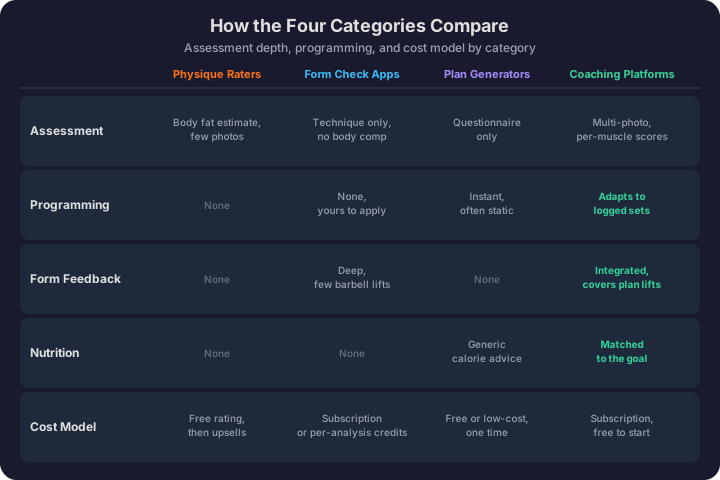
Here's how the four categories compare on the dimensions that matter:
Physique raters
- Assessment depth: body fat estimate, sometimes per-muscle ratings, from one or a few photos
- Programming: none
- Form feedback: none
- Nutrition: none, or generic calorie advice
- Typical cost model: free rating, then upsells
Form check apps
- Assessment depth: technique only; nothing on body composition
- Programming: none; feedback is yours to act on
- Form feedback: deep, rep-by-rep, but often limited to a few barbell lifts
- Nutrition: none
- Typical cost model: subscription, or pay-per-analysis credits
Plan generators
- Assessment depth: questionnaire answers only; the tool never sees your body
- Programming: instant structured plan; progression often static
- Form feedback: none
- Nutrition: sometimes a calorie target bolted on
- Typical cost model: free or low-cost one-time generation
Coaching platforms
- Assessment depth: standardized multi-photo analysis with regional muscle scoring
- Programming: generated from your assessment, adapting to logged performance
- Form feedback: integrated, covering the exercises in your plan
- Nutrition: matched to the same goal the plan pursues
- Typical cost model: subscription, free to start
One more filter worth applying to any app in any category: ask what happens to consistency over time. A tool you use once tells you where you were. A tool you use monthly under standardized conditions tells you where you're heading, and for training decisions the direction is worth more than any single reading. We made the same argument about clinical scans in our comparison of AI physique analysis and DEXA scans: the method you'll actually repeat beats the method that's marginally more precise on one day.
The Bottom Line
The AI fitness market isn't one race with one winner; it's four categories solving four different problems, and the right pick depends on whether you want a number, a technique fix, a template, or a system that connects assessment to action. Single-purpose tools earn their place by being free and instant. Platforms earn theirs when the goal is months of directed change rather than a moment of feedback. If you want to see what the platform approach looks like from the inside, HyperBody's AI physique rater is free to start, so you can begin in the cheapest category and decide for yourself whether the loop is worth it.
More field notes.

How an AI Form Check Actually Works, Rep by Rep
What happens between uploading a video of your set and getting form feedback: pose detection, rep segmentation, the joint angles that get measured, and what the technology honestly cannot see.

Golden Ratio Physique: Shoulder-to-Waist Ratio and the V-Taper, Explained
The golden ratio physique claims the ideal shoulder-to-waist ratio is 1.618. Here is what attractiveness research actually supports, how to measure your own ratio, and how to train toward a wider-looking frame.

The Beginner's Guide to Reading Your Body Composition Analysis
You just got your first body composition analysis and it's full of numbers, scores, and terms you don't recognize. Here's how to read it, understand it, and actually use it.
More on HyperBody