TrainingMar 4, 202611 min read
Lire en français·Auf Deutsch lesen·Leer en español·Przeczytaj po polsku
Training Volume: How Many Sets Do You Actually Need?
Is more always better? The relationship between training volume and muscle growth has a ceiling. Here's how to find your sweet spot.
Reviewed by the HyperBody team

Key takeaways
- How many sets per muscle group per week do I actually need to build muscle?
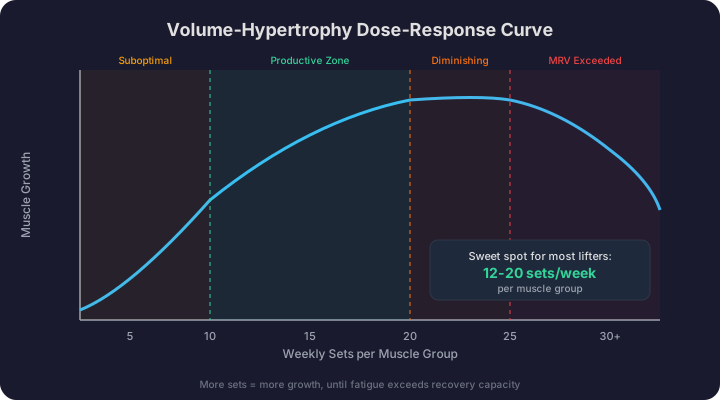
- For most lifters the productive zone is 12 to 20 hard working sets per muscle group per week, spread across two or more sessions. Below 10 sets growth is suboptimal, 10 to 20 sets is where each set meaningfully contributes, and beyond 20 sets diminishing returns accelerate sharply for most people.
- What counts as a hard working set for training volume?
- A hard working set is one performed within about 3 reps of failure, meaning intense enough to stimulate growth. A working-weight bench set for 8 reps at RIR 2 counts. It excludes warm-up sets, sets stopped far from failure at RIR 5 or more, and light feeder or activation sets.
- How many sets should a beginner versus an advanced lifter do?
- Volume scales with training experience. Beginners do best with 10 to 12 sets per muscle group per week, intermediates with 12 to 18 sets, and advanced lifters with 16 to 22 or more sets. Recovery capacity, training intensity, and muscle group size shift you toward the higher or lower end of each range.
- How do I know if I am doing too much training volume?
- Warning signs include declining performance despite consistent effort, soreness that never resolves, worsening sleep, new joint pain, workouts over 90 minutes of hard training, and dropping motivation. This suggests you have exceeded your Maximum Recoverable Volume. Reduce volume by 20 to 30 percent and reassess after 2 to 3 weeks.
"Just do more sets." It's the default advice for anyone who wants to grow. And to a point, it's correct. Training volume is the primary driver of hypertrophy. But there's a critical nuance that gets overlooked: more volume works until it doesn't.
Understanding the dose-response relationship between volume and growth is one of the most important things you can learn as a lifter.
What Counts as a "Set"?
First, let's define terms. When researchers talk about training volume, they typically mean hard working sets: sets performed with sufficient intensity (within about 3 reps of failure) to stimulate growth. This excludes:
- Warm-up sets
- Sets stopped far from failure (RIR 5+)
- Feeder sets or activation sets at very light loads
A set of bench press at your working weight for 8 reps at RIR 2 counts. Your warm-up with the empty bar does not.
The Dose-Response Relationship
Research consistently shows a dose-response relationship between weekly set volume per muscle group and hypertrophy1, but with diminishing returns:
Below 10 sets/week: Muscle growth occurs but is suboptimal. This is the minimum effective volume for most trained individuals.
10-20 sets/week: The "productive zone" for most people. Each additional set contributes meaningfully to growth, though the marginal benefit decreases as you approach 20 sets2.
20+ sets/week: Diminishing returns accelerate sharply. Some advanced lifters benefit from 20-25 sets per muscle group, but the additional growth from sets beyond 20 is minimal for most people3.
30+ sets/week: For most individuals, this exceeds Maximum Recoverable Volume (MRV), meaning the fatigue generated by additional sets outweighs the growth stimulus they provide. Performance declines, recovery suffers, and injury risk increases.
Finding Your Optimal Volume
The optimal volume for any individual depends on several factors:
Training Experience
- Beginners: 10-12 sets per muscle group per week
- Intermediate: 12-18 sets per muscle group per week
- Advanced: 16-22+ sets per muscle group per week
Recovery Capacity
- Good sleep, low stress, adequate nutrition → higher end of range
- Poor sleep, high stress, caloric deficit → lower end of range
Training Intensity
- If you train very close to failure (RIR 0-1), you need fewer sets because each set provides more stimulus
- If you train further from failure (RIR 2-3), you may benefit from more sets to compensate4
Muscle Group Size
- Large muscle groups (quads, back) generally tolerate and benefit from higher volumes
- Small muscle groups (biceps, triceps, rear delts) often grow well with 10-14 sets because they also receive indirect stimulus from compound movements
How to Count Volume Accurately
This is where most people get confused. Consider a typical "Push" day:
- Bench Press. 4 sets (chest, front delts, triceps)
- Incline Dumbbell Press. 3 sets (chest, front delts, triceps)
- Cable Fly. 3 sets (chest)
- Lateral Raise. 4 sets (side delts)
- Triceps Pushdown. 3 sets (triceps)
- Overhead Extension. 3 sets (triceps)
Volume count for this session:
- Chest: 10 sets (bench 4 + incline 3 + fly 3)
- Side delts: 4 sets (lateral raise only; bench/incline don't meaningfully target side delts)
- Front delts: ~7 sets (bench 4 + incline 3, though these are indirect)
- Triceps: 6 direct sets + ~7 indirect sets from pressing
If you do this twice per week, your chest gets approximately 20 sets, which is plenty. Your side delts get 8, which might be insufficient if they're a priority.
The key insight: Track volume per muscle group, not per exercise5.
Volume Landmarks
Dr. Mike Israetel popularized a useful framework with four volume landmarks:6
Minimum Effective Volume (MEV): The lowest volume that still produces measurable growth. Typically 6-8 sets per muscle group per week. Useful during deloads or maintenance phases.
Minimum Adaptive Volume (MAV): The volume at which you start seeing meaningful progress. Usually 10-14 sets for most muscle groups.
Maximum Adaptive Volume (MAV ceiling): The upper range where you're still benefiting from additional sets. Typically 18-22 sets for most people.
Maximum Recoverable Volume (MRV): The highest volume you can recover from. Beyond this, performance drops and injury risk increases. Varies widely by individual but is usually 22-30 sets.
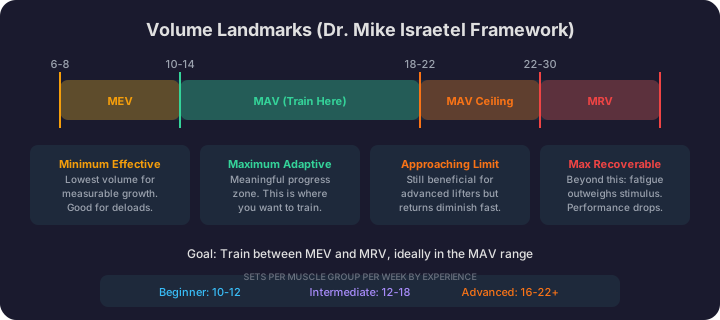
Your goal is to train in the MAV range: above MEV, below MRV.
How to Progress Volume Over Time
Volume progression is one of the most underused forms of progressive overload:
Week 1: 12 sets per muscle group Week 2: 14 sets per muscle group Week 3: 16 sets per muscle group Week 4: 18 sets per muscle group Week 5: Deload to 8-10 sets per muscle group
Each week, you add 1-2 sets to your exercises. Over 4 weeks, volume climbs from the bottom of your productive range to the top. Then you deload to clear fatigue and start a new progression.
This is called a volume accumulation block and it's one of the most effective training structures for intermediate and advanced lifters.
Signs You're Doing Too Much
- Performance is declining despite consistent effort
- Persistent soreness that doesn't resolve between sessions
- Sleep quality is worsening
- Joint pain that wasn't present at lower volumes
- Workouts take excessively long (90+ minutes of hard training)
- Motivation and enthusiasm for training drops
If you notice these signs, reduce volume by 20-30% and reassess after 2-3 weeks.
Signs You're Not Doing Enough
- You never feel challenged during workouts
- You recover fully within 24 hours with zero soreness
- Progress has been flat for 4+ weeks
- Your training sessions take 30-40 minutes
If this describes your training, add 2-4 sets per muscle group per week and monitor the response.
The Bottom Line
Training volume is the primary driver of hypertrophy, but it operates on a curve with diminishing returns. For most lifters, 12-20 hard working sets per muscle group per week, distributed across 2+ sessions, is the productive zone7. Track your volume by muscle group, progress it over training blocks, and respect the signals that indicate you've reached your current ceiling.
More isn't always better. But enough always matters.
References
Footnotes
-
Schoenfeld BJ et al. (2017). Dose-response relationship between weekly resistance training volume and increases in muscle mass: a systematic review and meta-analysis. Journal of Sports Sciences, 35(11), 1073-1082. https://doi.org/10.1080/02640414.2016.1210197
-
Baz-Valle E et al. (2022). A systematic review of the effects of different resistance training volumes on muscle hypertrophy. Journal of Human Kinetics, 81, 199-210. https://doi.org/10.2478/hukin-2022-0017
-
Schoenfeld BJ et al. (2019). Resistance training volume enhances muscle hypertrophy but not strength in trained men. Medicine & Science in Sports & Exercise, 51(1), 94-103. https://doi.org/10.1249/MSS.0000000000001764
-
Helms ER et al. (2018). Application of the repetitions in reserve-based rating of perceived exertion scale for resistance training. Strength and Conditioning Journal, 40(2), 33-39. https://doi.org/10.1519/SSC.0000000000000351
-
Schoenfeld BJ et al. (2016). Effects of resistance training frequency on measures of muscle hypertrophy: a systematic review and meta-analysis. Sports Medicine, 46(11), 1689-1697. https://doi.org/10.1007/s40279-016-0543-8
-
Israetel M et al. (2017). Scientific Principles of Hypertrophy Training. Renaissance Periodization. https://renaissanceperiodization.com/products/scientific-principles-of-hypertrophy-training
-
Schoenfeld BJ et al. (2020). Resistance training recommendations to maximize muscle hypertrophy in an athletic population: position stand of the IUSCA. International Journal of Strength and Conditioning, 1(1), 1-30. https://doi.org/10.47206/ijsc.v1i1.81
More field notes.

Training Frequency: How Many Days a Week Should You Lift?
Three days or six, full body or split: the frequency debate has filled more forum pages than any other programming question. The research answer is calmer than the argument, and it changes which question you should actually be asking.

Weak Point Training: How to Bring Up Lagging Muscle Groups
Every physique has a lagging muscle group, and most lifters attack theirs with more enthusiasm than strategy. Here is how to diagnose a true weak point objectively, and the programming playbook that actually brings it up.

Muscle Memory Is Real: The Science of Regaining Lost Gains
Took a few months off and watched your gains fade? Here's the reassuring science: rebuilding lost muscle is genuinely faster than building it the first time, and why that happens.
More on HyperBody