TrainingAug 9, 20269 min read
Lire en français·Auf Deutsch lesen·Leer en español·Przeczytaj po polsku
Weak Point Training: How to Bring Up Lagging Muscle Groups
Every physique has a lagging muscle group, and most lifters attack theirs with more enthusiasm than strategy. Here is how to diagnose a true weak point objectively, and the programming playbook that actually brings it up.
Reviewed by the HyperBody team

Every physique has a weak point. Arms that lag behind a strong chest, calves that ignore years of training, a back that disappears next to well-developed shoulders. This is not a personal failing; it is the default outcome of genetics, exercise preferences, and technique habits compounding over years. The difference between lifters who fix their weak points and lifters who complain about them for a decade comes down to two things: an honest diagnosis and a deliberate programming change. Most people skip the first and improvise the second.
Step One: Diagnose Honestly
Before you reprogram anything, confirm that the weak point you think you have is the weak point you actually have. This is harder than it sounds, because the mirror is a biased instrument.
You see yourself from the front, in your usual lighting, with years of accumulated self-perception layered on top. Lifters routinely obsess over a body part that is actually fine while completely missing the one that is genuinely behind, the classic case being a trainee fixated on arms while their entire posterior chain, which they never see, quietly lags. Mirror checks also happen most often after training the muscle you like training, when it is pumped and flattering.
Two tools cut through the bias. The first is standardized photos: the same five poses, same lighting, same camera position, taken monthly. The back poses matter most here, because they show you the half of your physique you never otherwise see. The second is objective scoring. HyperBody's physique analysis rates each major muscle group from the same five photos, which turns "I feel like my shoulders are small" into a per-muscle score you can compare against the rest of your physique. When your own impression and the scores disagree, trust the scores long enough to take new photos and look again. A weak point you can name and number is a weak point you can program for.
While you are diagnosing, distinguish a true developmental lag from an illusion. A muscle can look small because the one next to it is overdeveloped, and side-to-side asymmetries are a different problem from a whole region being behind. The fix below targets genuinely underdeveloped regions.
Why Muscles Lag in the First Place
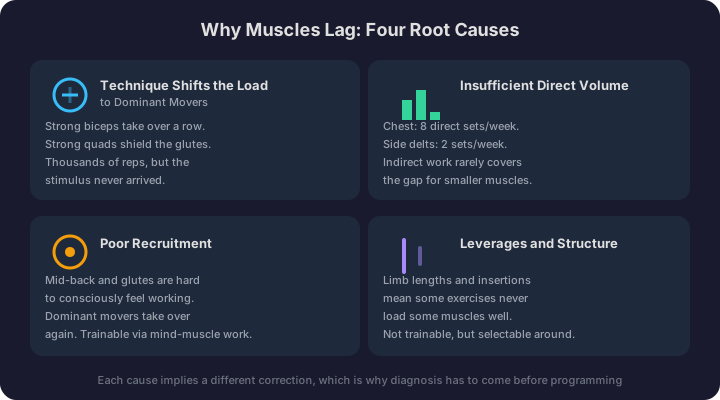
Knowing the cause matters, because each cause implies a different correction.
Technique shifts the load to dominant movers. This is the most common and least suspected cause. In a row, a strong set of biceps and forearms can do most of the pulling while the mid-back goes along for the ride. In a squat, strong quads or a strong lower back can shield the glutes. You performed thousands of reps "for" the muscle while a neighbor did the work. The volume was real; the stimulus never arrived.
Insufficient direct volume. Count your actual weekly sets for the lagging region and the mystery often dissolves. Chest gets eight direct sets per week while side delts get two, then surprise, the delts lag. Indirect work helps less than people assume, especially for smaller muscles at the end of the mechanical chain.
Poor recruitment. Some muscles are simply hard to feel, the mid-back and glutes being the usual suspects. If you cannot consciously contract a muscle, you will struggle to direct training stress at it, and the dominant movers take over again. Improving this is trainable; our guide to the mind-muscle connection covers how.
Leverages and structure. Limb lengths, muscle insertion points, and individual proportions mean some exercises will never load some muscles well for some bodies. Long femurs change what a squat trains. Genetics also deal everyone at least one stubborn muscle. You cannot change your structure, but you can change exercise selection around it, which is precisely why the playbook below includes it.
The Prioritization Playbook
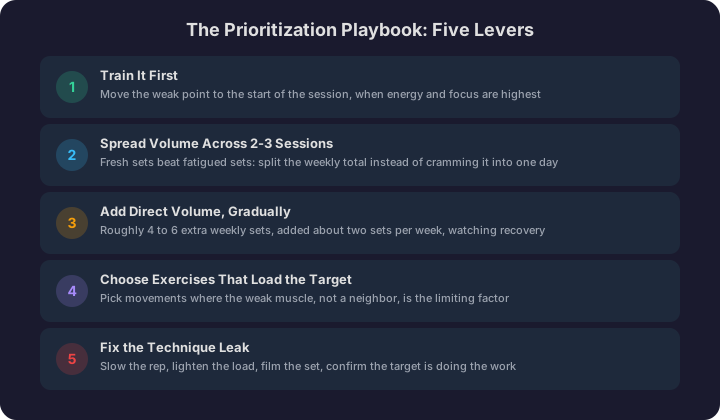
Bringing up a weak point is not a secret exercise; it is a redistribution of resources. Five levers, in order of importance.
1. Train it first, when you are fresh. Whatever you train at the start of a session gets your best energy, focus, and performance; whatever comes last gets leftovers. Most lagging muscles have spent years in the leftovers slot. Move the weak point to the front of the session, even if that means benching after your lateral raises for a while. The strong lifts will survive.
2. Spread its volume across two or three sessions. Ten sets crammed into one weekly session means the last several are done fatigued, at lower quality. The same ten sets split across two or three days are all performed fresh. Research supports training a muscle at least twice per week: a 2016 meta-analysis found greater hypertrophy with twice-weekly training of a muscle group compared with once weekly1. For a weak point, two to three exposures per week is the practical sweet spot.
3. Add direct volume, gradually. More growth generally follows more weekly sets, up to a point2, and most weak points are underfed rather than untrainable. Add roughly four to six weekly sets of direct work for the lagging region, and add them gradually, two or so sets per week over a few weeks, watching recovery as you go. Resist the urge to triple the volume overnight; volume you cannot recover from is volume wasted. For the full picture on counting sets and finding your productive range, see our guide on how many sets you should train.
4. Choose exercises that actually load the target. This is where the "why it lags" diagnosis pays off. If your structure makes an exercise a poor fit, swap it rather than forcing it. Pick movements where the target muscle is the limiting factor and where you feel it working: a chest-supported row takes the lower back and momentum out of the equation for the mid-back; a deficit push-up or a machine press might load a stubborn chest better than a barbell bench does for your build. Two or three well-chosen movements, progressed hard, beat a rotating buffet of six.
5. Fix the technique leak. If dominant movers have been stealing the load, more volume just feeds the thieves. Slow the rep down, lighten the weight, and confirm the target is doing the work. Filming your sets is the fastest way to see what is actually happening, and HyperBody's video form check will audit your execution on common lifts rep by rep, flagging exactly the kind of compensation patterns, shortened range, shifted positions, momentum, that quietly redirect stimulus away from the muscle you are trying to grow.
Hold Everything Else at Maintenance
The part most lifters refuse to do: while the weak point gets more, your strong points get less. Recovery capacity is a budget, and adding six sets for a lagging back while keeping every other muscle at full volume usually means something recovers poorly, often the new work you just added.
The good news is that maintaining muscle is cheap. A handful of hard weekly sets per muscle group is generally enough to hold existing size for a mesocycle or two, as long as those sets stay genuinely hard. Cut your strong points to maintenance volumes, keep the intensity honest, and reinvest the budget in the priority. Your chest will not vanish in eight weeks of maintenance. Your weak point will not grow without the reinvestment.
There is also a psychological benefit hiding here. Maintenance work on strong lifts is short and satisfying, which leaves both time and appetite for the priority work, and it removes the temptation to skip the lagging muscle at the end of a long session, because the session is no longer long.
Expectations: Mesocycles, Not Weeks
A genuinely lagging muscle took years to fall behind, and it will not catch up in three weeks. Plan in mesocycles: run the prioritization block for six to eight weeks, then re-assess with the same standardized photos and scoring you used to diagnose. Re-assessing every eight weeks gives the change enough time to be measurable while catching a failed approach before it eats half a year.
Judge the block on two signals: are the key lifts for the region progressing in load or reps, and did the photos or muscle scores move? Strength up and score up means keep going. Strength up but appearance flat may mean technique is still leaking; film and audit. Both flat after two honest blocks means change the exercises or the volume, not the goal. A noticeably improved muscle group is usually a two-to-three block project, which is to say four to six months. That sounds long until you remember the alternative was another decade of complaining.
Common Mistakes
Adding volume everywhere. The enthusiasm spillover: you decide to fix your back, and somehow the new program has more sets for everything. Now nothing is prioritized and recovery is split evenly across muscles that did not need it. Prioritization means a difference between the target and everything else.
Program hopping. Three weeks into the block, a new program promises faster results, and the restart erases the adaptation you were accruing. Weak point training only works across full mesocycles. Commit to the eight weeks, then judge.
Chasing soreness instead of progression. Novel exercises make a muscle sore without necessarily making it grow. The scoreboard is load and reps trending up on consistent exercises, plus photos, not how hard it is to sit down.
Skipping the diagnosis. Training a weak point you misidentified is the most expensive mistake on the list, because everything downstream is executed perfectly at the wrong target.
The Bottom Line
Bringing up a lagging muscle group is a resource allocation problem with a known solution. Diagnose objectively with standardized photos and per-muscle scoring rather than mirror impressions. Identify why it lags: stolen load, missing volume, poor recruitment, or mismatched exercises. Then redistribute: train it first, spread it across two or three sessions, add four to six weekly sets gradually, pick exercises that load it for your structure, and audit your technique on video. Pay for it by holding strong points at maintenance. Re-assess every eight weeks, and give it mesocycles, not weeks. Symmetry is not a genetic gift; it is a programming decision repeated for a few months.
References
Footnotes
-
Schoenfeld BJ, Ogborn D, Krieger JW (2016). Effects of resistance training frequency on measures of muscle hypertrophy: a systematic review and meta-analysis. Sports Medicine, 46(11), 1689-1697.
-
Schoenfeld BJ, Ogborn D, Krieger JW (2017). Dose-response relationship between weekly resistance training volume and increases in muscle mass: a systematic review and meta-analysis. Journal of Sports Sciences, 35(11), 1073-1082.
More field notes.

Training Frequency: How Many Days a Week Should You Lift?
Three days or six, full body or split: the frequency debate has filled more forum pages than any other programming question. The research answer is calmer than the argument, and it changes which question you should actually be asking.

How to Break Through a Strength Plateau
Stuck at the same weight for weeks? Strength plateaus are frustrating but solvable. Here are evidence-based strategies to get your lifts moving again.

Training Volume: How Many Sets Do You Actually Need?
Is more always better? The relationship between training volume and muscle growth has a ceiling. Here's how to find your sweet spot.
More on HyperBody