TrainingAug 23, 20269 min read
Lire en français·Auf Deutsch lesen·Leer en español·Przeczytaj po polsku
Training Frequency: How Many Days a Week Should You Lift?
Three days or six, full body or split: the frequency debate has filled more forum pages than any other programming question. The research answer is calmer than the argument, and it changes which question you should actually be asking.
Reviewed by the HyperBody team

Ask ten lifters how many days a week you should train and you will get ten confident answers, most of them autobiographies. The six-day lifter insists anything less leaves gains on the table. The three-day lifter calls everyone else overtrained. Full body, upper/lower, push/pull/legs: each approach has a tribe, and each tribe is certain.
The research is less tribal. Training frequency, meaning how often you train each muscle per week, turns out to matter mostly as a delivery system for volume, the total amount of hard work a muscle receives across the week. Once that clicks, "how many days should I lift?" stops being a fitness identity and becomes what it always was: a scheduling problem with a couple of physiological constraints. This article covers what the evidence actually shows, what training looks like at two through six days per week, and how to pick the number you will still be hitting in March.
What the Evidence Says About Frequency
The study most often quoted in this debate is a 2016 meta-analysis by Schoenfeld, Ogborn, and Krieger, which pooled the available research comparing different training frequencies and found that training a muscle twice per week produced greater hypertrophy than training it once per week1. The headline traveled fast: the classic bro split, one muscle per day hammered once a week, was suddenly suboptimal, and "hit everything twice" became the new default advice.
The headline was fair, but the detail underneath it matters more. In many of the pooled comparisons, weekly volume was not held equal between groups. When someone trains a muscle twice a week instead of once, they usually also end up doing more total sets for it. So was the extra growth caused by the higher frequency itself, or by the extra volume that came along for the ride?
A follow-up meta-analysis by Schoenfeld, Grgic, and Krieger in 2019 addressed exactly that question by examining studies where weekly volume was equated across frequency conditions. The finding: when total weekly sets were held constant, the differences between frequencies largely disappeared2. Ten hard sets for a muscle split across two sessions grew it about as well as ten sets split across three or four.
Read together, the two papers tell a coherent story. Weekly volume is the primary driver of muscle growth, and frequency is the packaging. Frequency still earns its keep for a practical reason rather than a magical one: it is hard to do twelve or fifteen quality sets for one muscle in a single session. By the eighth set of chest work in one workout, your output is dropping, your form is degrading, and the later sets deliver less stimulus per unit of fatigue. Splitting the same volume across two sessions keeps every set closer to full quality. How much weekly volume you actually need is its own question, covered in our guide on how many sets to train; this article assumes you have a target and asks how many days it takes to deliver it well.
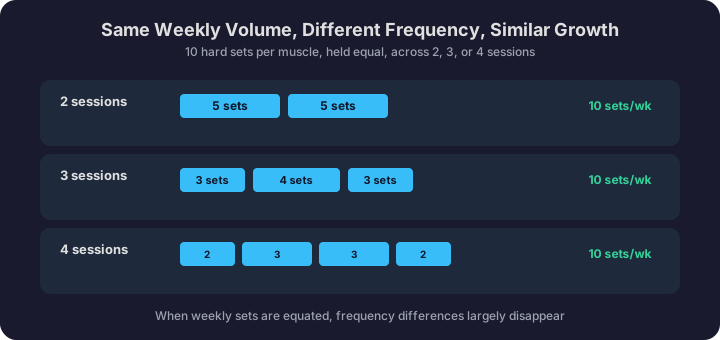
So the real question becomes: how many training days do you need to deliver your target volume in quality sets, touch each muscle roughly twice a week, and fit the rest of your life around it? Here is what each answer looks like in practice.
Two or Three Days: Full Body Earns Its Keep
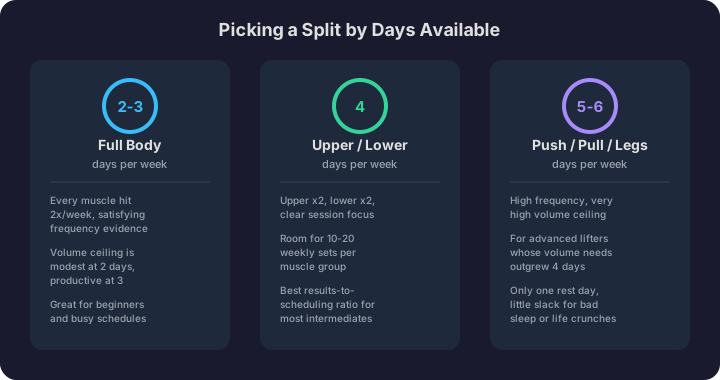
If you can train two or three days per week, full body sessions are the obvious play, and they are far better than their unglamorous reputation suggests. Each session is built around big compound movements: a squat pattern such as the back squat, a hinge such as the conventional deadlift or Romanian deadlift, a press, and a pull such as the barbell row or pull-up, with a small amount of direct arm or shoulder work if time allows.
At two days per week, every muscle gets trained twice, which already satisfies the frequency evidence. The limitation is volume: with only two sessions, total weekly sets per muscle stay modest, so this is a maintenance-to-slow-growth dose rather than a maximal one. It is also, for a beginner, completely sufficient to make consistent progress for a long time.
At three days, the classic alternating full body setup, you gain enough weekly slots to push volume into genuinely productive territory for most lifters. Sessions run 45 to 75 minutes, every muscle is hit two to three times per week, and you still have four rest days for recovery and for having a life. A very large share of lifters would be better served by three honest full body days than by the five-day plan they keep half-attending.
Four Days: The Upper/Lower Split
Four days per week is where the upper/lower split becomes the standard answer, and it is popular for good reasons. You train upper body twice and lower body twice, typically in an upper/lower/rest/upper/lower rhythm. Every muscle gets its two weekly exposures, each session has a clear focus, and the volume ceiling rises comfortably: four sessions give you room for 10 to 20 weekly sets per muscle group without any single workout turning into a two-hour grind.
The format is also forgiving. If life deletes one of your four days, you still trained every muscle at least once that week, which is not true of less redundant splits. For intermediate lifters who can reliably give four days, upper/lower is arguably the best ratio of results to scheduling cost in all of program design.
Five and Six Days: Push, Pull, Legs and Its Variants
Push/pull/legs divides training into pressing muscles, pulling muscles, and lower body. Run once through with repeats across five days, or twice through across six, it delivers high frequency and a very high volume ceiling: each muscle can receive a lot of weekly work without any session exceeding a reasonable length.
The honest framing is that five and six day programs are for people whose volume needs have outgrown four days, which mostly means advanced lifters, and for people who simply love being in the gym, which is a legitimate reason. The marginal return over a well-built four-day plan is small for everyone else, while the cost is real: six training days means one rest day, near-daily time commitment, and far less slack for bad sleep, work crunches, or a cold. A six-day plan does not make you advanced. Needing one does.
Choose by Schedule Honesty
Here is the selection rule that outperforms every spreadsheet: the best split is the one you will actually keep. A six-day program executed at 60 percent attendance is a randomized three-and-a-half-day program with extra guilt. A three-day program executed at 95 percent for a year beats it without trying.
So audit your calendar, not your ambition. Count the days you can train even on a bad week: the week with the deadline, the sick kid, the travel. That number, not your best week, is your training frequency. If the honest answer is three, run the best three-day program you can and let consistency do the compounding. There is also no rule that the answer is permanent: plenty of lifters run four days through quiet seasons and drop to three when work heats up, keeping the program intact and simply redistributing the volume.
One more honesty check worth running: session length. If four days means four 90-minute sessions you secretly dread, while three days of 60 focused minutes feels sustainable, the three-day plan wins on the only metric that compounds, which is attendance. Muscle growth is a months-and-years game, and the win condition is showing up, week after week, while the plan progresses underneath you. How that progression should actually be structured is its own topic, covered in our guide to building a training program that progresses.
Recovery Sets the Ceiling
Frequency is also bounded from above, and not by willpower. Training is a stimulus; growth happens during recovery, and recovery is funded by sleep, food, and the absence of crushing life stress. Every training day is a withdrawal from that account. Six withdrawals a week against five hours of sleep and a brutal job is how lifters end up flat, sore, and weaker in week eight than they were in week four.
The warning signs are consistent: lifts stalling or regressing across multiple sessions, soreness that no longer resolves between workouts, resting heart rate creeping up, and a growing dread of training that used to feel good. When those appear, the correct move is usually to cut a day or trim volume, not to push through. And when life load changes for a season, new job, new baby, exam period, dropping from five days to three is an adjustment, not a failure. The lifter who flexes down to three days for two months keeps nearly everything. The lifter who insists on five, misses half of them, and quits in frustration does not.
When the Plan Adjusts Itself
All of this is manageable by hand, but it is also exactly the kind of bookkeeping that software does better than discipline. HyperBody's adaptive training plans are built around the days you can actually give, anywhere from short blocks to twenty-week programs, and they distribute volume across that frequency rather than forcing you into someone else's template. As you log sets, reps, and effort, the plan responds to what your performance says about your recovery: progressing loads when you are moving well, backing off when the data says you are not. The frequency question gets answered once, honestly, and then re-answered automatically as your life changes.
The Bottom Line
The research, read carefully, says this: weekly volume per muscle is the primary driver of growth, training each muscle around twice a week is a sensible default because it packages that volume into higher-quality sessions, and beyond that, the specific number of days matters far less than the consistency with which you deliver them. Two or three days, run full body. Four, run upper/lower. Five or six, run push/pull/legs, but only if your volume needs and your calendar genuinely support it. Pick the frequency your worst realistic week can sustain, protect your recovery like it is part of the program, because it is, and let months of boring attendance do what no perfect split executed sporadically ever will.
References
Footnotes
-
Schoenfeld BJ, Ogborn D, Krieger JW (2016). Effects of resistance training frequency on measures of muscle hypertrophy: a systematic review and meta-analysis. Sports Medicine, 46(11), 1689-1697.
-
Schoenfeld BJ, Grgic J, Krieger JW (2019). How many times per week should a muscle be trained to maximize muscle hypertrophy? A systematic review and meta-analysis of studies examining the effects of resistance training frequency. Journal of Sports Sciences, 37(11), 1286-1295.
More field notes.

Training Volume: How Many Sets Do You Actually Need?
Is more always better? The relationship between training volume and muscle growth has a ceiling. Here's how to find your sweet spot.

Weak Point Training: How to Bring Up Lagging Muscle Groups
Every physique has a lagging muscle group, and most lifters attack theirs with more enthusiasm than strategy. Here is how to diagnose a true weak point objectively, and the programming playbook that actually brings it up.

Muscle Memory Is Real: The Science of Regaining Lost Gains
Took a few months off and watched your gains fade? Here's the reassuring science: rebuilding lost muscle is genuinely faster than building it the first time, and why that happens.
More on HyperBody