TrainingJul 20, 202610 min read
Lire en français·Auf Deutsch lesen·Leer en español·Przeczytaj po polsku
Muscle Memory Is Real: The Science of Regaining Lost Gains
Took a few months off and watched your gains fade? Here's the reassuring science: rebuilding lost muscle is genuinely faster than building it the first time, and why that happens.
Reviewed by the HyperBody team

Everyone who's trained seriously has felt the dread of a long layoff. An injury, a busy stretch of life, a move, and suddenly the muscle you worked years for looks like it's melting away. Here's the good news, backed by some fascinating cellular biology: getting it back is far easier than earning it the first time. This is "muscle memory," and unlike a lot of gym folklore, it's real.
Let's look at what actually happens in your muscle when you detrain and retrain, and why your body seems to remember.
First, What You Actually Lose
Detraining is real, and it follows a predictable course. The canonical reviews of detraining show that strength, muscle size, and performance decline in a time-dependent way when the training stimulus is removed. Short-term breaks cost you less, longer breaks cost you more1. Your fibers shrink, and some of your peak strength fades.
But here's the crucial part: shrinking is not the same as starting over. What you lose in size, you largely keep in the underlying machinery. And that machinery is the whole story of muscle memory.
The Cellular Reason: Myonuclei
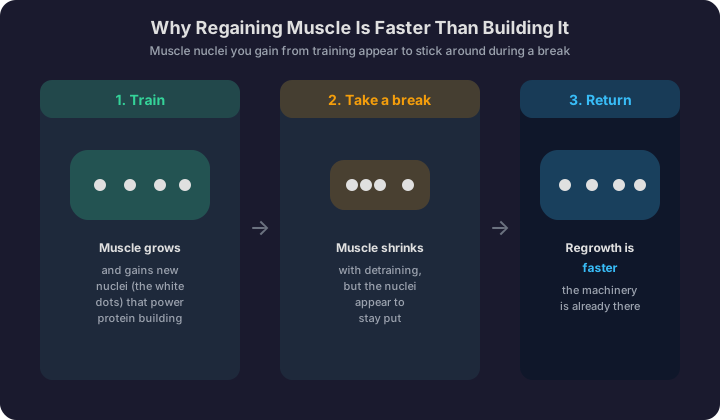
Muscle fibers are unusual cells. They contain many nuclei (myonuclei), and each nucleus governs a surrounding territory of the fiber. To grow a bigger fiber, you generally need more nuclei to run it, and those extra nuclei are donated by nearby satellite cells that activate when you train23.
The landmark finding came from careful animal work: when muscle is overloaded, new myonuclei are added before the fiber visibly grows. And, strikingly, those nuclei are not lost when the muscle later shrinks from detraining4. This led to a new model of muscle memory: a fiber that was once big keeps its elevated nucleus count even after atrophying, so when you train again it can rebuild quickly without having to re-acquire all that machinery from scratch5.
The most direct demonstration is almost unfair. In an experiment where muscles were briefly exposed to anabolic steroids, then left untrained for the human equivalent of years, those "memory" muscles grew about 30% in just six days of overload, while previously untreated muscles barely responded6. The nuclei banked earlier made retraining dramatically faster.
There's Also an Epigenetic Memory
Myonuclei aren't the only mechanism. Human research has found that your muscle also keeps an epigenetic memory. In a study of human subjects, DNA-methylation marks (chemical tags on your genes that influence how they're expressed) acquired during a period of muscle growth persisted through a period of detraining, and were amplified when the subjects trained again7. Your muscle, in effect, remembers at the level of gene regulation, not just cell structure.
More recent human work adds direct support: after a detraining period, fibers shrank but their myonuclei were maintained, and retraining then produced larger fibers, evidence that the permanence seen in animals also shows up in people8.
An Honest Note: The Science Is Still Debated
Good science reporting means telling you where the debate is. While the muscle-memory phenomenon is well accepted (everyone agrees retraining is faster), the exact mechanism is genuinely contested.
The "permanent myonuclei" idea rests heavily on animal studies and a handful of human ones. A 2022 systematic review and meta-analysis pushed back, concluding that myonuclei can in fact be lost during atrophy and aging, and arguing that epigenetic mechanisms may be the more robust explanation for muscle memory9. In other words: the fact that you regain muscle faster is not in dispute, but whether it's mainly permanent nuclei, epigenetic tags, retained neural adaptations, or a combination is still being worked out, and findings in mice don't always translate cleanly to humans.
What matters for you is the practical conclusion, which every camp agrees on: your prior training is not erased by a layoff.
What This Means for You
- A layoff is not back to square one. The size you lose sits on top of machinery (nuclei, gene expression, motor patterns) that largely stays457.
- Retraining is faster than the first time. You'll typically regain former muscle and strength much more quickly than it took to build originally68.
- Don't panic during forced breaks. Illness, injury, travel, or life getting in the way costs you less than it looks like in the mirror. The comeback is built in.
- Something beats nothing. Even minimal training during a busy stretch slows detraining1, but if you do have to stop completely, the memory is there when you return.
So if you've been away from the gym and you're intimidated to go back. Don't be. The person who trained hard a year ago and stopped is in a very different position from someone who never trained at all. Your muscle remembers, and it's waiting to come back faster than you'd think.
When you do return, a periodic physique analysis is a great way to see your comeback happen, often faster than the scale or the mirror suggests, and smart coaching can ramp your volume back up sensibly so you rebuild without overdoing it on day one.
References
Footnotes
-
Mujika I, Padilla S (2000). Detraining: loss of training-induced physiological and performance adaptations. Part II: long term insufficient training stimulus. Sports Medicine, 30(3), 145-154. https://doi.org/10.2165/00007256-200030030-00001
-
Blaauw B, Reggiani C (2014). The role of satellite cells in muscle hypertrophy. Journal of Muscle Research and Cell Motility, 35(1), 3-10. https://doi.org/10.1007/s10974-014-9376-y
-
Snijders T, Nederveen JP, McKay BR, et al. (2015). Satellite cells in human skeletal muscle plasticity. Frontiers in Physiology, 6, 283. https://doi.org/10.3389/fphys.2015.00283
-
Bruusgaard JC, Johansen IB, Egner IM, Rana ZA, Gundersen K (2010). Myonuclei acquired by overload exercise precede hypertrophy and are not lost on detraining. Proceedings of the National Academy of Sciences, 107(34), 15111-15116. https://doi.org/10.1073/pnas.0913935107
-
Gundersen K (2016). Muscle memory and a new cellular model for muscle atrophy and hypertrophy. Journal of Experimental Biology, 219(2), 235-242. https://doi.org/10.1242/jeb.124495
-
Egner IM, Bruusgaard JC, Eftestøl E, Gundersen K (2013). A cellular memory mechanism aids overload hypertrophy in muscle long after an episodic exposure to anabolic steroids. The Journal of Physiology, 591(24), 6221-6230. https://doi.org/10.1113/jphysiol.2013.264457
-
Seaborne RA, Strauss J, Cocks M, et al. (2018). Human skeletal muscle possesses an epigenetic memory of hypertrophy. Scientific Reports, 8, 1898. https://doi.org/10.1038/s41598-018-20287-3
-
Cumming KT, et al. (2024). Muscle memory in humans: evidence for myonuclear permanence and long-term transcriptional regulation after strength training. The Journal of Physiology, 602(17), 4171-4193. https://doi.org/10.1113/JP285675
-
Rahmati M, McCarthy JJ, Malakoutinia F (2022). Myonuclear permanence in skeletal muscle memory: a systematic review and meta-analysis of human and animal studies. Journal of Cachexia, Sarcopenia and Muscle, 13(5), 2276-2297. https://doi.org/10.1002/jcsm.13043
More field notes.

The Mind-Muscle Connection: Science or Bro Science?
Bodybuilders swear by it, skeptics dismiss it. Here's what the research actually says about the mind-muscle connection and how to use it effectively.

Training to Failure: When It Helps and When It Hurts
Going to failure on every set feels productive, but is it actually optimal? The science says it's complicated. Here's when to push to the limit and when to hold back.

Training Volume: How Many Sets Do You Actually Need?
Is more always better? The relationship between training volume and muscle growth has a ceiling. Here's how to find your sweet spot.
More on HyperBody