Body CompositionJun 29, 20267 min read
Lire en français·Auf Deutsch lesen·Leer en español·Przeczytaj po polsku
Body Fat Percentage Chart: Healthy Ranges by Age and Sex
What is a healthy body fat percentage? See the ranges for men and women, how they shift with age, how to measure yours, and how to lower it without losing muscle.
Reviewed by the HyperBody team

Key takeaways
- What is a healthy body fat percentage for men?
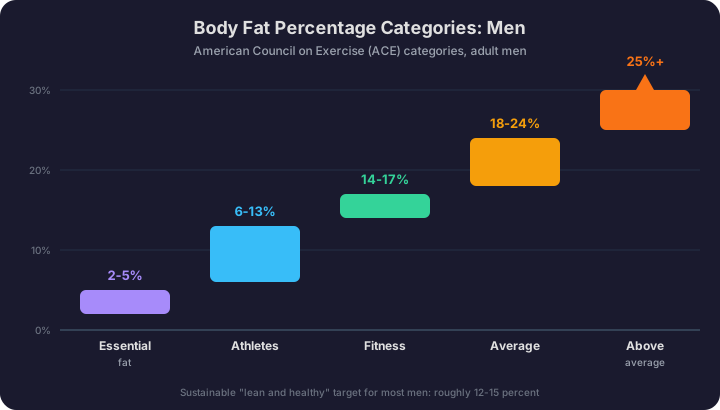
- Using American Council on Exercise categories for men: essential fat is 2 to 5 percent, athletes 6 to 13 percent, fitness 14 to 17 percent, average 18 to 24 percent, and 25 percent or above is above average with rising health risk. A realistic, sustainable lean target is roughly 12 to 15 percent.
- What is a healthy body fat percentage for women?
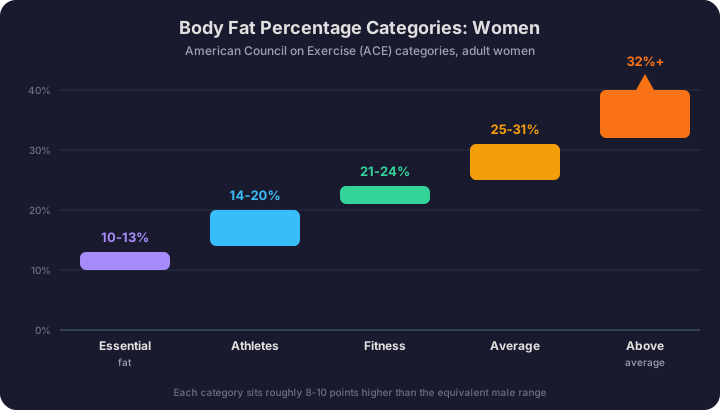
- Women carry more essential fat, so categories sit about 8 to 10 points higher: essential fat 10 to 13 percent, athletes 14 to 20 percent, fitness 21 to 24 percent, average 25 to 31 percent, and 32 percent or above is above average. A common sustainable target is around 20 to 24 percent.
- Does a healthy body fat percentage change as you get older?
- Yes. Body fat naturally rises with age because muscle mass declines through sarcopenia and activity drops. Healthy ranges drift upward by a few points per decade, so a reading that is average at 20 may count as fitness at 55. Resistance training is the strongest lever against age-related fat gain.
- How can I measure my body fat percentage at home?
- Options include the free US Navy tape-measure method, AI photo analysis from five uploaded photos, DEXA scans (the clinical gold standard but expensive), and BIA smart scales (convenient but swayed by hydration). No home method is perfect, so measure under the same conditions each time and track the trend, not one reading.
- What does a given body fat percentage look like?
- For men: 10 percent shows clear abs and sharp separation, 15 percent looks athletic and lean, 20 percent is healthy but soft, and 30 percent shows a prominent belly. For women: 18 percent is athlete lean, 22 percent fit and firm, 28 percent average with soft curves, and 35 percent above average.
"What body fat percentage should I be?" is one of the most searched questions in fitness, and most answers give you a single number with no context. The honest answer depends on your sex, your age, and your goal. This guide gives you the full picture: the standard ranges for men and women, how they change as you get older, how to measure yours for free, and how to actually move it in the right direction.
The quick answer, using American Council on Exercise (ACE) categories:
| Category | Men | Women |
|---|---|---|
| Essential fat | 2 to 5% | 10 to 13% |
| Athletes | 6 to 13% | 14 to 20% |
| Fitness | 14 to 17% | 21 to 24% |
| Average | 18 to 24% | 25 to 31% |
| Above average | 25% and up | 32% and up |
The rest of this guide explains what each range looks like, how age shifts it, and how to measure where you are.
What body fat percentage measures
Your body fat percentage is the share of your total weight that is fat, as opposed to lean mass (muscle, bone, organs, and water). A 90 kg person at 20 percent body fat carries 18 kg of fat and 72 kg of lean mass.
It is a far better progress metric than scale weight, because it separates the part you usually want to lose (fat) from the part you want to keep or build (muscle). Two people at the same weight can look completely different depending on this ratio. If you want the deeper version of this argument, see understanding body composition analysis.
Body fat percentage ranges for men
These are the widely used American Council on Exercise categories for men:
- Essential fat: 2 to 5 percent. The minimum your body needs to function. Stage-lean bodybuilders only, and not sustainable.
- Athletes: 6 to 13 percent. Visible abs, clear vascularity, defined muscle separation.
- Fitness: 14 to 17 percent. Lean and athletic looking, some ab definition.
- Average: 18 to 24 percent. Healthy, but little visible muscle definition.
- Above average: 25 percent and up. Associated with rising health risk as it climbs.
For most men, a realistic and sustainable "lean and healthy" target sits around 12 to 15 percent.
Body fat percentage ranges for women
Women carry more essential fat for hormonal and reproductive function, so every category sits roughly 8 to 10 points higher:
- Essential fat: 10 to 13 percent. The biological minimum.
- Athletes: 14 to 20 percent. Visible muscle tone and definition.
- Fitness: 21 to 24 percent. Lean, athletic, healthy.
- Average: 25 to 31 percent. Healthy range for many women.
- Above average: 32 percent and up. Health risk rises from here.
A common sustainable target for women is around 20 to 24 percent. Dropping far below the athlete range can disrupt hormones and menstrual health, so lower is not automatically better.
How body fat changes with age
Body fat naturally rises with age, mostly because muscle mass declines (a process called sarcopenia) and activity tends to drop. The same percentage is also "earned" differently at 50 than at 25.
As a rough guide, healthy ranges drift upward by a few points per decade. A body fat percentage that reads as "average" for a 20 year old may read as "fitness" for a 55 year old. The most powerful lever against age-related fat gain is resistance training: keeping muscle keeps your metabolism and your composition where you want them. See how long it takes to build muscle for realistic timelines.
Healthy body fat percentage by age: men
The table below anchors the ACE categories to age brackets, drifting a few points per decade the way the section above describes. Treat the boundaries as guides for interpreting your own number, not clinical cutoffs.
| Age | Lean/athletic | Fitness/healthy | Average | Above average |
|---|---|---|---|---|
| 20–29 | 6–13% | 14–17% | 18–24% | 25% and up |
| 30–39 | 8–15% | 16–19% | 20–25% | 26% and up |
| 40–49 | 10–17% | 18–21% | 22–27% | 28% and up |
| 50–59 | 12–19% | 20–23% | 24–28% | 29% and up |
| 60+ | 13–20% | 21–24% | 25–29% | 30% and up |
Healthy body fat percentage by age: women
The same age drift applies to the women's categories, starting from the higher baseline that essential fat requires:
| Age | Lean/athletic | Fitness/healthy | Average | Above average |
|---|---|---|---|---|
| 20–29 | 14–20% | 21–24% | 25–31% | 32% and up |
| 30–39 | 15–21% | 22–25% | 26–32% | 33% and up |
| 40–49 | 17–23% | 24–27% | 28–33% | 34% and up |
| 50–59 | 19–25% | 26–29% | 30–34% | 35% and up |
| 60+ | 20–26% | 27–30% | 31–35% | 36% and up |
What a given body fat percentage looks like
Percentages are abstract until you attach them to a mirror. Here is what the common lookup points typically look like in practice.
Men:
| Body fat | What it typically looks like |
|---|---|
| 10% | Clear abs, visible vascularity, sharp muscle separation. A physique people assume competes. |
| 15% | Athletic and lean. Ab outline in good lighting, defined arms and shoulders. The sustainable "fit" look. |
| 20% | Healthy but soft. Muscle shape shows through shirts, abs fully covered. |
| 25% | Noticeable belly, no visible definition. The start of the above-average range. |
| 30% | Waist clearly wider, belly prominent sitting and standing. Health risk is climbing. |
| 37% | Well into the obese range, with high visceral fat likely. Worth a conversation with a doctor, not just a training plan. |
Women:
| Body fat | What it typically looks like |
|---|---|
| 18% | Athlete lean. Visible muscle definition and some vascularity. Hard for many women to sustain. |
| 22% | Fit and firm. Flat stomach without full ab detail, toned arms and legs. |
| 28% | Middle of the average range. Soft curves, little visible muscle definition, healthy for many women. |
| 35% | Above-average range. Fat accumulates at the waist, hips, and upper back, and health risk rises from here. |
8 to 10 percent body fat (men)
Stage-lean territory. Abs stay sharp even relaxed, veins show on the arms and lower abs, and every muscle group has visible separation. Most men can hold this only for a photoshoot or a competition; hunger, sleep, and hormones usually suffer. If you are wondering whether 8 or 9 percent is sustainable year round, for most people the honest answer is no.
11 to 13 percent body fat (men)
The classic beach-lean look. Abs are clearly visible in normal lighting, shoulders and arms look defined, and the face is noticeably lean. This is the top of the ACE athlete range and a realistic peak condition for dedicated natural lifters. Around 12 percent, most men look their leanest without the constant hunger that single digits demand.
14 to 17 percent body fat (men)
The ACE fitness range. You look athletic in a t-shirt, the ab outline shows in good lighting, and definition is obvious during training. A 15 percent physique reads as clearly fit, and it is sustainable with consistent training and a reasonable diet, which is why this range is the most common year-round recommendation.
18 to 24 percent body fat (men)
The ACE average range. Healthy for many men, but muscle definition hides under a soft layer, and abs are fully covered from about 20 percent. The difference between 18 and 24 is mostly how soft the waist looks. From here, a modest calorie deficit plus lifting moves you into the fitness range within months.
25 to 30 percent body fat (men)
Above average. A noticeable belly at 25 percent becomes a clearly wider waist by 30, and health risk climbs with visceral fat. The upside: this is the range where body recomposition works best, building muscle and losing fat at the same time, because the fat reserve can fund muscle growth in a deficit.
16 to 19 percent body fat (women)
Athlete lean. Visible muscle definition, some vascularity, very little fat on the limbs. Many women cannot sustain the bottom of this range without hormonal disruption, since it sits just above essential fat. If you are here, lower is not better: performance and health are the goals, not further leanness.
20 to 24 percent body fat (women)
Fit and firm, the sustainable athletic look. A flat stomach without full ab detail, toned arms and legs. This covers the ACE fitness range plus the top of the athlete range, and it is the common recommendation for women who train: lean enough to see progress, high enough to keep hormones healthy.
25 to 31 percent body fat (women)
The ACE average range. Soft curves, little visible muscle definition, and healthy for many women. Where you sit inside the range shows mostly at the waist and hips. If your goal is more definition, a small deficit combined with resistance training brings muscle shape forward without a drastic diet.
32 percent and up (women)
Above the average range. Fat accumulates at the waist, hips, and upper back, and cardiometabolic risk rises from here. As with men at the equivalent point, this is where recomposition is most effective, and the first few percentage points of loss produce the most visible and most health-relevant change.
How to measure your body fat
No at-home method is perfect, but the goal is a consistent estimate you can track over time, not a lab-grade number.
- Tape measure (US Navy method). Free and surprisingly consistent. Our body fat calculator does the math from a few measurements.
- AI photo analysis. Upload five photos and let the AI physique rater estimate your body fat plus muscle-by-muscle development, no tape needed.
- DEXA scan. The clinical gold standard, but expensive and impractical for frequent tracking.
- Smart scales (BIA). Convenient but swing with hydration and meal timing, so treat the absolute number with caution.
Whatever method you pick, measure under the same conditions each time (same day of week, morning, before eating) and watch the trend rather than any single reading.
How to lower body fat without losing muscle
Body fat comes down through a calorie deficit, but doing it without losing hard-earned muscle takes a bit of structure:
- Set a moderate deficit. Around 20 percent below your maintenance calories targets roughly 0.5 to 0.7 kg of fat loss per week. Find your number with the TDEE calculator.
- Keep protein high. Around 2 g per kg of bodyweight protects muscle in a deficit. Our recipe generator builds meals around your macro targets.
- Keep lifting heavy. Resistance training tells your body to hold onto muscle while you lose fat. A structured plan helps; see smart coaching.
- Be patient. Crash diets cost muscle and rebound. Slower fat loss looks and lasts better.
For the full protocol, read nutrition for body recomposition.
The bottom line
There is no single "ideal" body fat percentage. For men, lean and healthy is roughly 12 to 15 percent; for women, roughly 20 to 24 percent, with both ranges drifting up with age. Measure consistently, judge the trend, and remember that the number only tells half the story. Where your muscle sits matters just as much, which is exactly what a full physique analysis is built to show you.
More field notes.

Body Fat Percentage From a Photo: How It Works and How Accurate It Is
AI can estimate your body fat percentage from photos. Here is what the estimate is based on, how it compares to DEXA, calipers, and smart scales, and how to take photos that make the number trustworthy.

Waist-to-Height Ratio: A Simple Health Metric That Beats BMI
BMI can't tell muscle from fat, and it ignores where you carry weight. There's a simpler number you can check with a tape measure that predicts health risk better. Keep your waist under half your height.

Spot Reduction: Can You Target Fat Loss in One Area?
Endless crunches for a flat stomach, arm exercises for toned arms. It feels intuitive, but the science says targeted fat loss doesn't work the way you'd hope. Here's what actually determines where you lose fat.
More on HyperBody