EducationAug 2, 20268 min read
Lire en français·Auf Deutsch lesen·Leer en español·Przeczytaj po polsku
How Long Does It Take to Build Noticeable Muscle?
Muscle growth runs on a timeline that no amount of motivation can compress, and most lifters quit during the exact weeks it is quietly working. Here is what actually changes in your first weeks, months, and years of training, and how to see progress the mirror hides.
Reviewed by the HyperBody team

"How long until I see results?" is the first question almost every new lifter asks, and it is the question the fitness industry answers worst, because the honest answer does not sell programs. Six-week transformation challenges, thirty-day arm specials, and before-and-after photos taken an hour apart have trained people to expect visible muscle in about the time it takes to finish a Netflix season.
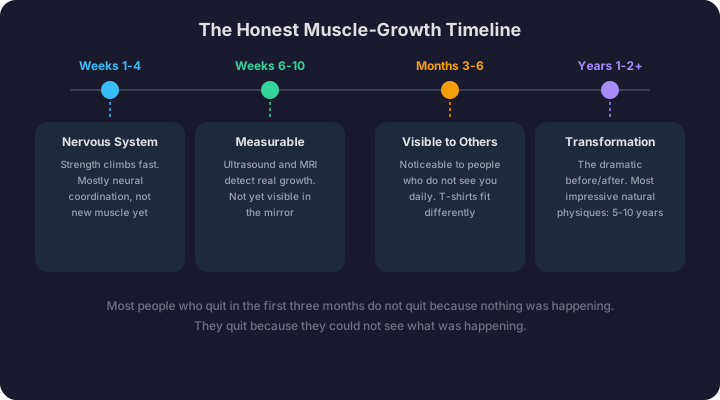
The real timeline is slower than the marketing and faster than the cynics claim. More importantly, it has distinct phases, and knowing which phase you are in changes how you interpret what you see in the mirror. Most people who quit lifting in the first three months do not quit because nothing was happening. They quit because they could not see what was happening.
The Honest Timeline
Weeks 1 to 4: your nervous system, not your muscles. Strength climbs surprisingly fast in the first month of training. Your squat goes up, your dumbbells get heavier, and it feels like growth. Most of it is not. Early strength gain is dominated by neural adaptation: your brain learns to coordinate the movement, recruit more of the muscle fibers you already own, and fire them more efficiently. This was demonstrated decades ago in classic work by Moritani and deVries, who showed that neural factors account for the bulk of early strength improvement, with hypertrophy contributing progressively more over time1. You are becoming a better operator of existing machinery before the machinery itself gets bigger.
Weeks 6 to 10: measurable, not yet obvious. With sensitive laboratory tools like ultrasound and MRI, research can typically detect genuine muscle growth somewhere in the six to ten week range of consistent training. There is an important catch here. A 2016 review by Damas and colleagues argued that the elevated muscle protein synthesis seen in the very first sessions largely goes toward repairing muscle damage rather than adding new size, and that protein synthesis only translates efficiently into measurable hypertrophy once that damage response settles down after the first few weeks2. Early on, some of what looks like growth on a tape measure is swelling. The real, contractile tissue arrives a little later and a lot more quietly.
Months 3 to 6: visible to people who do not see you every day. This is the window where changes typically become noticeable to others. T-shirts fit differently across the shoulders. Someone you have not seen since spring asks if you have been working out. Note the wording: people who do not see you every day. The people you live with, and you yourself, are the worst possible judges, because you watch the change happen one invisible day at a time.
Years 1 to 2 and beyond: the transformation. The dramatic before-and-after, the version of you that looks like a different person in old photos, is a one-to-two-year project at minimum, and the most impressive natural physiques you see represent five to ten years of consistent work. That sounds discouraging until you flip it: the years pass anyway. The only question is whether you are training through them.
Realistic Rates of Gain by Training Age
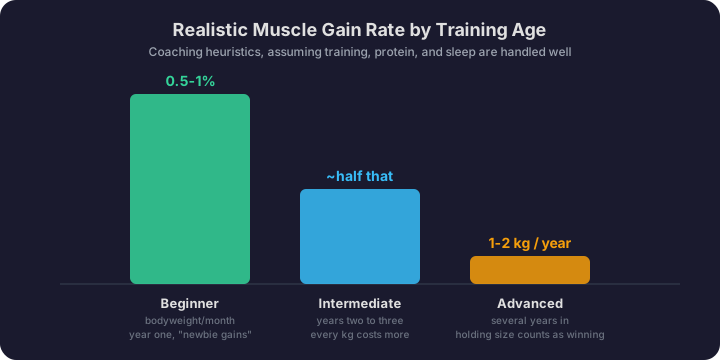
How fast can you actually add muscle? The ranges below are commonly used coaching heuristics, not study findings, and they assume training, protein, and sleep are all handled well.
Beginners in their first year can often gain muscle at roughly 0.5 to 1 percent of bodyweight per month. For a 70 kilogram lifter, that is around 0.35 to 0.7 kilograms of actual muscle monthly, which is why the first year is often called the newbie gains window. It is the fastest you will ever grow.
Intermediate lifters, somewhere in years two and three, typically see around half that rate. Progress is still steady, but every kilogram costs more work than the last one did.
Advanced lifters, several years in, fight for one or two kilograms of new muscle in a good year. At this stage, holding what you have through a hard season of life already counts as winning.
Women generally gain at similar relative rates to their starting muscle mass, which means smaller absolute numbers but a comparable trajectory. And everyone slows down for the same reason: the closer you get to your genetic ceiling, the smaller the adaptation each session can trigger. The biology behind that diminishing response is covered in our guide to the science of muscle hypertrophy.
One more honest note: these rates are not refundable. A month of missed training does not pause the clock, it rewinds part of it. Which leads directly to what actually controls your timeline.
What Speeds It Up
Four things move the needle. Everything else is decoration.
Consistency. The timeline above assumes roughly uninterrupted training. Three weeks on and two weeks off does not give you sixty percent of the results; the repeated stops cost adaptation and momentum both. Consistency is the least glamorous factor and the one that separates the people who transform from the people who restart.
Progressive overload. Muscle grows in response to demands it cannot yet meet comfortably. If your weights, reps, or quality of sets are not gradually trending up over months, you are maintaining, not building, regardless of how sweaty the sessions feel.
Protein. Roughly 1.6 to 2.2 grams per kilogram of bodyweight per day gives the construction project its raw material. Chronically low protein quietly caps your rate of gain even when training is excellent.
Sleep. Seven to nine hours. Growth happens during recovery, not during the workout, and short sleep blunts the adaptation you trained so hard to trigger.
Supplements, training frequency debates, and exercise selection details all matter far less than these four. Get them right for six months before worrying about anything fancier.
What Fakes It
Just as real growth hides, fake growth advertises. Three impostors are worth knowing by name.
The pump. During and right after training, blood and fluid flood the working muscle and it can look dramatically fuller. It is real tissue expansion, but it is temporary plumbing, gone within hours. Judging progress by your post-workout mirror check is measuring the tide and calling it sea level rise.
Glycogen and water. Each gram of stored carbohydrate holds water with it. Start creatine, or refeed after a diet, and you can gain a kilogram or two of scale weight in days with fuller-looking muscles to match. Pleasant, but it is hydration, not new contractile tissue, and it arrives far too fast to be growth.
Lighting and angles. Overhead gym lighting carves shadows that make you look a category leaner and more muscular than the flat light of your bathroom. Same body, ten minutes apart, two different physiques. Anyone who has flexed in a gym mirror and then caught a glimpse in an elevator knows the whiplash.
None of these are bad. The pump feels great and glycogen fuels training. They just cannot be allowed to vote on whether you are actually growing.
Why the Mirror Lies, and What to Use Instead
Here is the core measurement problem: noticeable muscle growth for a beginner might be half a kilogram per month, spread across your whole body. That is invisible day to day by definition. Meanwhile, daily fluctuations in water, food, sodium, and lighting can swing your appearance more in twelve hours than real growth changes it in a month. Checking the mirror daily means reading signal that is one tenth the size of the noise. Your perception also adapts to slow change, the same way you do not notice your own hair growing.
The fix is to standardize and to slow down the sampling rate. Photos taken monthly, in the same poses, same lighting, same time of day, and same camera position, remove the noise and let the month-sized signal show. Our companion guide on how to take physique progress photos covers the exact setup.
If you want numbers on top of the visuals, the same five standardized photos can be run through HyperBody's AI physique rater, which returns muscle-by-muscle development scores and a body fat estimate from each monthly session. The value for a timeline question like this one is specific: scores move in increments your eyes cannot resolve. A shoulder score creeping up two months in a row is exactly the kind of six-week-scale evidence that research detects with ultrasound and that mirrors miss entirely. It answers "is anything actually happening?" during the phase when that question is most likely to make you quit.
If You Started Today
Put it all together and here is the realistic preview. In month one your lifts climb fast while your body changes little; that is your nervous system cashing in first, and it is normal. By months two and three a tape measure and standardized photos start registering changes you still cannot see in the mirror. Somewhere between months three and six, a friend who has not seen you in a while says something, and it will land strangely, because you see yourself daily and feel unchanged. By the end of year one you are visibly someone who trains. By year two, old photos start to surprise you.
The lifters who get there are not the ones who grew fastest. They are the ones who kept showing up through the stretch where progress was real but invisible, because they had measurements that proved it.
The Bottom Line
Noticeable muscle takes longer than the marketing promises: strength comes in weeks, measurable growth in roughly six to ten, visible-to-others change in three to six months, and a transformation in one to two years or more. Beginners can gain around 0.5 to 1 percent of bodyweight per month under good conditions, with the rate halving as training age climbs. Consistency, progressive overload, protein, and sleep set your speed; the pump, glycogen, and lighting fake it; and the daily mirror is the least reliable instrument you own. Standardize monthly photos, track scores instead of impressions, and let the timeline work. It is slower than you hoped and far more certain than you fear.
References
Footnotes
-
Moritani T & deVries HA (1979). Neural factors versus hypertrophy in the time course of muscle strength gain. American Journal of Physical Medicine, 58(3), 115-130.
-
Damas F, Phillips S, Vechin FC, Ugrinowitsch C (2016). A review of resistance training-induced changes in skeletal muscle protein synthesis and their contribution to hypertrophy. Sports Medicine, 46(5), 671-685.
More field notes.

Newbie Gains: Why Beginners Build Muscle Faster (And How to Make the Most of It)
Your first year of lifting is the fastest muscle growth you will ever experience, and it only happens once. Here is why newbie gains exist, how long they honestly last, and how to extract everything the window has to offer.

The Science of Muscle Hypertrophy: What Actually Drives Growth
Mechanical tension, metabolic stress, muscle damage, which one actually matters most? A deep dive into the three mechanisms of muscle growth.

Smart Scales and BIA: How Accurate Are They Really?
Your smart scale says 18 percent body fat on Monday and 22 percent on Thursday, and you have not changed. Here is how bioelectrical impedance actually works, what the research says about its accuracy, and the narrow job it can still do well.
More on HyperBody