EducationOct 4, 20268 min read
Lire en français·Auf Deutsch lesen·Leer en español·Przeczytaj po polsku
Newbie Gains: Why Beginners Build Muscle Faster (And How to Make the Most of It)
Your first year of lifting is the fastest muscle growth you will ever experience, and it only happens once. Here is why newbie gains exist, how long they honestly last, and how to extract everything the window has to offer.
Reviewed by the HyperBody team

If you have just started lifting, you are standing inside the most productive training window of your life. The muscle and strength you gain over the next year will come faster than at any point afterward, and the window does not reopen. Lifters call this period newbie gains, and it is one of the few pieces of gym folklore the research fully supports.
It is also one of the most wasted opportunities in fitness. Most beginners spend their first year hopping between programs, eating badly in one direction or the other, and learning sloppy technique that takes years to unlearn. The gains still come, because untrained muscle is that forgiving, but they come at half the rate they could have.
This article explains what newbie gains actually are, why untrained muscle responds so dramatically, how long the window honestly lasts, the handful of habits that maximize it, and the mistakes that quietly burn it down.
What Newbie Gains Actually Are
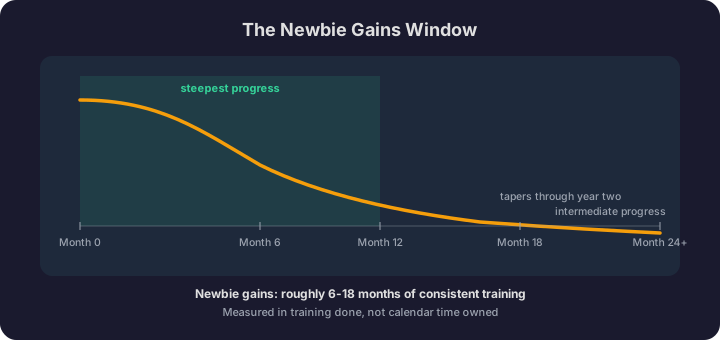
Newbie gains are the unusually rapid strength and muscle improvements that occur during roughly the first six to eighteen months of consistent resistance training. During this period, a beginner can add weight to the bar almost every session, visibly change their physique within months, and recover from workouts that would leave them wrecked two years later.
The pattern is universal. It does not depend on the program being clever, the supplements being right, or the lifter being gifted. Any halfway sensible routine, done consistently with enough food and sleep, produces results in a beginner that an advanced lifter would trade a limb for. A trained lifter fighting for one or two kilograms of new muscle in a year was once a beginner who gained that much in a few months.
That asymmetry is not unfair. It is biology, and understanding why it happens tells you exactly how to use it.
Why Beginners Respond So Fast
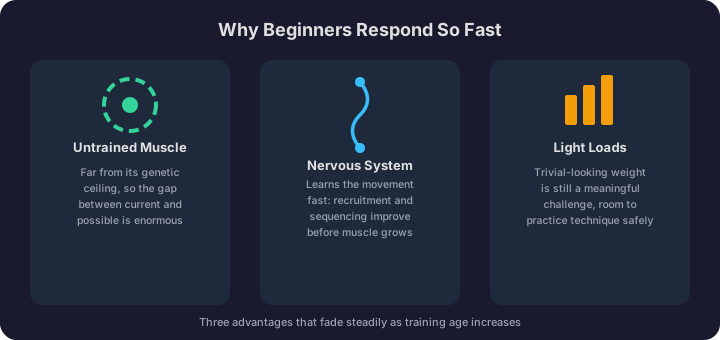
Three mechanisms stack on top of each other in the first year.
Untrained muscle is maximally responsive. Adaptation is driven by the gap between what your body can currently handle and what you ask of it. For a beginner, that gap is enormous. Every set is a novel stress, every session a clear signal to adapt, and your muscle is as far from its genetic ceiling as it will ever be. The closer you get to that ceiling over the years, the harder your body makes you work for each additional gram of tissue. At the start, the door is wide open.
Your nervous system learns fast. A large share of early strength gain is not muscle at all. It is your brain learning to run the movement: recruiting more of the muscle fibers you already own, firing them in better sequence, and switching off the opposing muscles that fight the lift. Classic work by Moritani and deVries showed that neural factors account for the bulk of strength improvement in the first weeks of training, with hypertrophy contributing progressively more as time goes on1. This is why your squat can climb week after week before your legs look any different. The skill arrives first; the tissue follows.
Light loads are a big relative stimulus. An advanced lifter needs carefully managed volume, intensity, and progression to keep growing, because their body has seen it all. Your body has seen nothing. Loads that look trivial on paper are a meaningful challenge to untrained muscle, which means you can grow from work that is light enough to practice safely. That combination, growth from manageable loads, exists only now, and it is precisely what makes this the right time to build technique.
How Long Do Newbie Gains Last?
The honest answer: there is no switch that flips off on a fixed date. The window fades gradually, and how fast it fades depends mostly on how consistently you train through it.
For most people training three to four times a week with reasonable effort, the steepest progress lasts six to twelve months, then tapers through the back half of the second year. By that point you have transitioned to intermediate progress: still steady, but measured in months instead of weeks.
Two clarifications matter. First, the window is measured in training done, not calendar time owned. If you train sporadically for two years, you have not used up two years of newbie gains; you have used up however much consistent stimulus you actually delivered. Slow, interrupted training stretches the window but also wastes its steepest section. Second, the rate is individual. Genetics, sleep, food, and stress all move the numbers, so treat any timeline as a range, not a contract.
What is not individual is the direction: every month of the first year buys more progress than the same month will buy in year three. That is the entire argument for taking this period seriously.
How to Maximize the Window
The recipe is boring, which is exactly why it works.
Run one simple program and stay on it. A beginner program needs three things: compound lifts, a sensible weekly structure, and a rule for adding weight or reps over time. That is it. Squat or leg press, a hinge, a press, a row or pulldown, three to four days a week, small load increases whenever you hit your rep targets. Progressive overload does the heavy lifting; your job is to show up and not interfere.
Learn technique now, while the loads are light. This is the most undervalued part of the window. Right now you can grow from weights light enough to practice with, which means you can groove correct movement patterns at zero cost. In two years, fixing a flawed squat will mean stripping weight off the bar and swallowing your ego for months. Film your main lifts from the side and front and review them against what the movement should look like; a tool like HyperBody's video form check will flag faults rep by rep, things like depth, bar path, and knee position, that you cannot feel from inside the set. Every fault you fix at 40 kilograms is a fault you never have to fix at 100.
Eat enough protein, every day. Muscle is built from raw material, and beginners chronically underestimate how much they need. Aim for roughly 1.6 to 2.2 grams per kilogram of body weight per day, spread across your meals. The full reasoning and the practical details are in our guide on how much protein you need to build muscle.
Sleep like it is part of the program. It is. Growth happens between sessions, and short sleep blunts recovery, training quality, and appetite regulation all at once. Seven to nine hours is not a luxury during the fastest-growing year of your life.
Mistakes That Waste the Window
Three errors account for most squandered first years.
Program hopping. Beginners change programs the way they change playlists, usually because some video promised a better split. Every switch resets the learning curve and breaks the progression that was driving growth. During newbie gains, almost any structured program works, which means the difference between programs is tiny and the cost of switching is real. Pick one, run it for six months minimum, and judge it by your training log, not by your mood.
Dirty bulking. Yes, you grow best with a calorie surplus. No, that does not mean eating everything in sight. The muscle-building machinery of a beginner is fast, but it is not fast enough to use a 1,000-calorie surplus; the excess becomes body fat that you will spend months dieting off later, losing training quality while you do. A modest surplus of 200 to 400 calories above maintenance captures essentially all the growth with a fraction of the fat.
Ego lifting. Loading beyond your technique converts the cheapest learning period of your career into an injury lottery. Heavy sloppy reps build bad patterns at the exact moment your body is most eagerly memorizing patterns. The lifter adding five kilograms a month with clean reps passes the ego lifter within a year, and does it with intact shoulders.
The Muscle Memory Consolation
One genuinely comforting note: the work of your first year is never fully lost. If life forces a long break, retraining brings muscle back substantially faster than it took to build the first time. The adaptations your muscle makes during growth appear to persist long after the size itself fades, which is part of why regains feel so quick. You cannot bank the window, but you can bank the muscle. Train hard now and a future comeback starts from a higher floor.
What Comes After
At some point, and you will feel it, the easy progress ends. Weights stop climbing every session. Visible change slows from monthly to quarterly. This is the moment many lifters conclude they are doing something wrong, change everything, and make it worse.
Nothing is wrong. Slower gains after the first year are not failure; they are the normal trajectory of training, and every lifter who has ever gotten big has walked through the same gate. What changes is the toolkit: progression gets more deliberate, volume gets managed rather than maximized, and patience becomes a skill. For a realistic map of what progress looks like across the years, read how long it takes to build muscle.
Document Your Starting Point
One last thing, and do it this week: capture your baseline. You only get one before. A year from now, the day-to-day mirror will have hidden your progress from you, because you saw every increment as it happened, and nothing kills motivation in month nine like the false belief that nothing has changed.
Take standardized photos: same spot, same lighting, same time of day, front, back, and side. Better still, make them measurable. HyperBody's AI physique rater scores your physique muscle group by muscle group from five photos, which turns your starting point into numbers you can compare against month six and month twelve. The beginner who can see the trend line keeps training. The one who relies on memory usually quits right before the photos would have proven them wrong.
The Bottom Line
Newbie gains are real, fast, and finite. They happen because untrained muscle sits far from its ceiling, because your nervous system learns lifts quickly, and because light loads are still a real stimulus, three advantages that fade as you advance. The window lasts roughly six to eighteen months of consistent training, and you maximize it with embarrassingly simple inputs: one program held for months, technique learned while the bar is light, 1.6 to 2.2 grams of protein per kilogram, a modest surplus, and real sleep. Avoid the three classic ways to waste it, program hopping, dirty bulking, and ego lifting. Photograph your starting point so the progress is provable. And when the fast gains end, do not mourn them; they were the opening chapter, not the whole book.
References
Footnotes
More field notes.

How Long Does It Take to Build Noticeable Muscle?
Muscle growth runs on a timeline that no amount of motivation can compress, and most lifters quit during the exact weeks it is quietly working. Here is what actually changes in your first weeks, months, and years of training, and how to see progress the mirror hides.

The Science of Muscle Hypertrophy: What Actually Drives Growth
Mechanical tension, metabolic stress, muscle damage, which one actually matters most? A deep dive into the three mechanisms of muscle growth.

Walking for Fitness: Do You Really Need 10,000 Steps?
The 10,000-step goal is everywhere, baked into every fitness tracker. It's also not based on science. Here's where the number came from, and how many steps actually move the needle on your health.
More on HyperBody