NutritionAug 16, 20269 min read
Lire en français·Auf Deutsch lesen·Leer en español·Przeczytaj po polsku
How Much Protein Do You Actually Need to Build Muscle?
Protein advice ranges from a modest government minimum to a chicken breast with every meal, and the arguing hides how clear the research actually is. Here is the number, where it comes from, and how to hit it without turning eating into a second job.
Reviewed by the HyperBody team

Key takeaways
- How much protein do you actually need to build muscle?
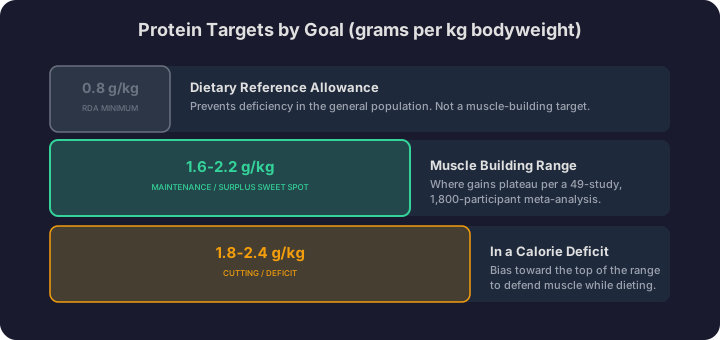
- Aim for 1.6 to 2.2 grams of protein per kilogram of bodyweight per day. A 2018 Morton meta-analysis of 49 studies and over 1,800 participants found gains in lean mass plateau around 1.6 grams per kilogram, with the range reaching about 2.2. An 80 kilogram lifter needs roughly 130 to 175 grams daily.
- How should you split protein across the day to build muscle?
- Spread it across three to five meals of roughly 20 to 40 grams each so every meal triggers muscle protein synthesis. A 2018 Schoenfeld and Aragon review recommended about four meals at roughly 0.4 grams per kilogram each, which is about 32 grams per meal for an 80 kilogram lifter.
- Do you need more protein when dieting or cutting?
- Yes. In a calorie deficit, protein defends existing muscle, so bias toward the top of the range, roughly 1.8 to 2.4 grams per kilogram, and the leaner you are the more the higher end helps. A 2016 Longland trial showed 2.4 grams per kilogram preserved and even added lean mass during a severe deficit.
- Does high protein damage your kidneys?
- For healthy people, no. A 2018 meta-analysis of controlled trials found higher protein intakes did not adversely affect kidney function in healthy adults compared with lower intakes. The caveat: anyone with existing kidney disease or risk factors processes protein differently and should set intake with a doctor or dietitian.
No nutrition question generates more confident, contradictory answers than this one. The official dietary reference says 0.8 grams per kilogram of bodyweight. The guy at your gym says you need your bodyweight in pounds, in grams, every day, or your workout was wasted. Supplement marketing implies the answer is always "more."
The research is considerably calmer than the argument. For muscle building, the evidence points to a specific, achievable range, and the interesting questions are the practical ones underneath it: how to split it across the day, what changes when you are dieting, and how much of the folklore around protein deserves to be retired. This article goes through each, with the caveat up front that general nutrition information is not individual advice, and anyone with a medical condition should involve a professional before changing their diet.
The Evidence-Based Range
First, clear up the 0.8 grams per kilogram figure. That is the recommended dietary allowance, a number designed to prevent deficiency in the general population. It is the protein equivalent of the minimum wage: enough to get by, not a target for anyone trying to build something.
For muscle growth, the most useful single piece of evidence is a 2018 meta-analysis by Morton and colleagues, which pooled 49 studies with over 1,800 participants to ask how protein intake affects gains in lean mass during resistance training1. Two findings matter for your kitchen. Protein supplementation reliably increased muscle and strength gains from training. And the benefit plateaued: beyond roughly 1.6 grams per kilogram of bodyweight per day, eating more protein produced no further measurable gain in lean mass. Because that plateau point is an estimate with uncertainty around it, the upper end of its confidence range sat near 2.2 grams per kilogram, which is why careful coaches quote the working range as 1.6 to 2.2 rather than a single number.
In practical terms: an 80 kilogram lifter is looking at roughly 130 to 175 grams of protein per day. Eating at the top of the range is insurance, not extra credit. Eating beyond it is not dangerous for healthy people, as we will get to, but the muscle-building return on those extra grams is approximately zero.
It is worth pausing on how good this news is. The range is reachable with normal food and a normal appetite. The difference between the physique you have and the physique you want is far more likely to live in your training quality and consistency than in the gap between 1.8 and 2.4 grams per kilogram.
How to Split It Across the Day
Total daily protein is the headline; distribution is the supporting detail. Each time you eat a meaningful dose of protein, you trigger a temporary rise in muscle protein synthesis, the process that builds new muscle tissue. The trigger has a threshold: the rise is switched on largely by one amino acid, leucine, and a meal needs enough total protein, roughly 20 to 40 grams from quality sources, to deliver a leucine dose that flips the switch properly. Very small protein servings, a splash of milk in coffee, a handful of nuts, contribute to your daily total but do not individually trigger much building.
The old gym claim was that anything beyond 20 to 30 grams in one sitting is wasted. A 2018 review by Schoenfeld and Aragon examined this directly and concluded the body makes use of larger doses than the folklore allowed, while still finding that distribution matters: their practical recommendation was to spread intake across roughly four meals at about 0.4 grams per kilogram of bodyweight each to maximize the anabolic response2. For our 80 kilogram lifter, that is about 32 grams per meal, four times per day.
The takeaway is reassuringly boring. Hit your daily total with three to five protein-containing meals of 20 to 40 grams each, and you have captured nearly everything distribution has to offer. Eating your whole day's protein in one enormous dinner is measurably worse than spreading it out, but agonizing over whether a meal had 28 or 36 grams is precision the physiology does not reward. The same review's evidence also softened the famous post-workout "anabolic window" into something more like an anabolic afternoon: getting a normal protein meal within a few hours of training is plenty.
In a Deficit, You Need More
The 1.6 to 2.2 range comes mostly from people eating at maintenance or in a surplus. Dieting changes the math. In a calorie deficit, your body is more inclined to break down muscle for fuel, and protein's job expands from supplying growth to actively defending existing tissue.
The clearest demonstration is a 2016 randomized trial by Longland and colleagues, in which young men trained intensely during a severe four-week energy deficit while eating either 2.4 or 1.2 grams of protein per kilogram per day. The higher protein group gained lean mass while losing substantial fat; the lower protein group merely held their lean mass3. The protocol was extreme and closely supervised, so treat it as proof of principle rather than a meal plan, but the principle is exactly the point: when calories drop, higher protein is what keeps the loss coming from fat instead of muscle.
The practical adjustment is to bias toward the top of the range, roughly 1.8 to 2.4 grams per kilogram, whenever you are eating below maintenance, and the leaner you are, the more the higher end earns its keep. Protein also helps a deficit feel survivable, since it is the most satiating macronutrient. If you are trying to lose fat and build muscle simultaneously, the full strategy, including who can realistically expect it to work, is covered in our guide to body recomposition.
Food First, Supplements as Convenience
Protein powder enjoys an aura it has not entirely earned. It is not more anabolic than chicken, eggs, fish, dairy, beans, or tofu; it is the same macronutrient with a longer shelf life and better marketing. The case for whole food first is simple: it arrives packaged with micronutrients, fiber, and satiety that a shake does not provide, and satiety is worth real money when you are managing calories.
The honest case for powder is logistics. If your day makes a 30 gram protein lunch difficult, a shake solves a scheduling problem, not a nutrition problem. Treat supplements as exactly that, a convenience for the meals where food is impractical, rather than the foundation. Vegetarians and vegans can hit every number in this article with plant sources; it mostly takes slightly larger portions and a bit more variety across legumes, soy, grains, and, if desired, a plant-based powder for convenience.
A Practical Day of Eating
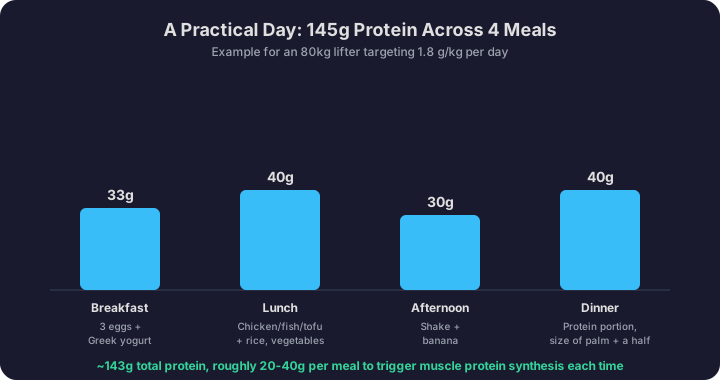
Numbers become real when they turn into meals, so take an example: a lifter weighing about 80 kilograms, targeting about 1.8 grams per kilogram, needs roughly 145 grams of protein per day, which divides neatly into four meals of around 35 grams.
Breakfast might be three eggs with a serving of Greek yogurt, about 30 to 35 grams. Lunch, a palm-and-a-half of chicken, fish, or tofu with rice and vegetables, about 40. An afternoon meal or post-training shake with a banana, about 30. Dinner, another protein portion the size of your palm and a half with whatever the household is eating, about 40. No tracking app heroics, no chicken from a plastic container at a family birthday. A kitchen scale and two weeks of paying attention will calibrate your eye; after that, portions become automatic.
If the constraint is ideas rather than willpower, HyperBody can generate recipes matched to your macro targets, so hitting 35 grams per meal stops being the same four foods on rotation and starts being food you would cook anyway.
Myths Worth Retiring, Carefully
"High protein damages your kidneys." For healthy people, the evidence does not support this. A 2018 meta-analysis of controlled trials found that higher protein intakes did not adversely affect kidney function in healthy adults compared with lower intakes4. The careful part: that conclusion applies to people with healthy kidneys. Anyone with existing kidney disease, or risk factors for it, processes protein differently and should set their intake with a doctor or dietitian, full stop. "Safe for healthy people" and "safe for everyone" are different claims, and this article only makes the first.
"More is always better." The Morton meta-analysis is the polite rebuttal: gains plateau around 1.6 grams per kilogram, with 2.2 as the cautious ceiling. Protein beyond that point displaces carbohydrate and fat that would fund your training, costs more, and builds nothing extra.
"Miss the post-workout window and the session is wasted." Retired above. Eat a proper protein meal within a few hours of training and move on with your life.
"Plant protein cannot build muscle." It can. Plant sources tend to be somewhat lower in leucine per gram, which is an argument for slightly larger servings and variety, not a disqualification.
The Bottom Line
Aim for 1.6 to 2.2 grams of protein per kilogram of bodyweight per day, the range where a 49-study meta-analysis found gains plateau. Split it across three to five meals of roughly 20 to 40 grams so each one triggers muscle protein synthesis properly, with around 0.4 grams per kilogram per meal as the tidy heuristic. Push toward the higher end, up to about 2.4, when dieting, because in a deficit protein is defense as much as construction. Build the day from food, use powder for logistics, and ignore the folklore at both extremes: protein is neither a magic anabolic lever to maximize without limit nor a kidney hazard for healthy people. It is a target to hit boringly, every day, for years, while training does the part that actually demands effort.
References
Footnotes
-
Morton RW, Murphy KT, McKellar SR, Schoenfeld BJ, Henselmans M, Helms E, Aragon AA, Devries MC, Banfield L, Krieger JW, Phillips SM (2018). A systematic review, meta-analysis and meta-regression of the effect of protein supplementation on resistance training-induced gains in muscle mass and strength in healthy adults. British Journal of Sports Medicine, 52(6), 376-384.
-
Schoenfeld BJ & Aragon AA (2018). How much protein can the body use in a single meal for muscle-building? Implications for daily protein distribution. Journal of the International Society of Sports Nutrition, 15, 10.
-
Longland TM, Oikawa SY, Mitchell CJ, Devries MC, Phillips SM (2016). Higher compared with lower dietary protein during an energy deficit combined with intense exercise promotes greater lean mass gain and fat mass loss: a randomized trial. The American Journal of Clinical Nutrition, 103(3), 738-746.
-
Devries MC, Sithamparapillai A, Brimble KS, Banfield L, Morton RW, Phillips SM (2018). Changes in kidney function do not differ between healthy adults consuming higher- compared with lower- or normal-protein diets: a systematic review and meta-analysis. The Journal of Nutrition, 148(11), 1760-1775.
More field notes.

Protein Timing: Does the Anabolic Window Really Matter?
You've been told to slam a shake within 30 minutes of training or lose your gains. The research tells a much more relaxed story. Here's what actually matters about when you eat protein.

Nutrition for Body Recomposition: A Practical Guide
Training builds the stimulus. Nutrition builds the body. Learn how to dial in your nutrition to support fat loss, muscle gain, and long-term body recomposition.

Body Recomposition: Can You Build Muscle and Lose Fat at the Same Time?
Building muscle while losing fat sounds like having it both ways, but for several groups of lifters it is well documented. Here is who can realistically recomp, why it works, and how to tell it is working when the scale refuses to move.
More on HyperBody