NutritionJul 26, 20269 min read
Lire en français·Auf Deutsch lesen·Leer en español·Przeczytaj po polsku
Body Recomposition: Can You Build Muscle and Lose Fat at the Same Time?
Building muscle while losing fat sounds like having it both ways, but for several groups of lifters it is well documented. Here is who can realistically recomp, why it works, and how to tell it is working when the scale refuses to move.
Reviewed by the HyperBody team

Key takeaways
- Can you build muscle and lose fat at the same time?
- Yes, for four groups: beginners, returning lifters with muscle memory, people at higher body fat around 25 to 30 percent, and anyone upgrading from a poor training or protein setup. Lean, advanced lifters mostly cannot recomp efficiently and are better off with dedicated bulk and cut phases.
- How do you set up a body recomposition diet and training plan?
- Eat a small deficit of 10 to 20 percent below maintenance, not 40 percent. If maintenance is 2,600 calories, that is roughly 2,100 to 2,350. Keep protein high at 1.6 to 2.2 grams per kilogram of bodyweight daily, do three to five progressive resistance sessions weekly, and sleep seven to nine hours.
- What does research say about building muscle in a calorie deficit?
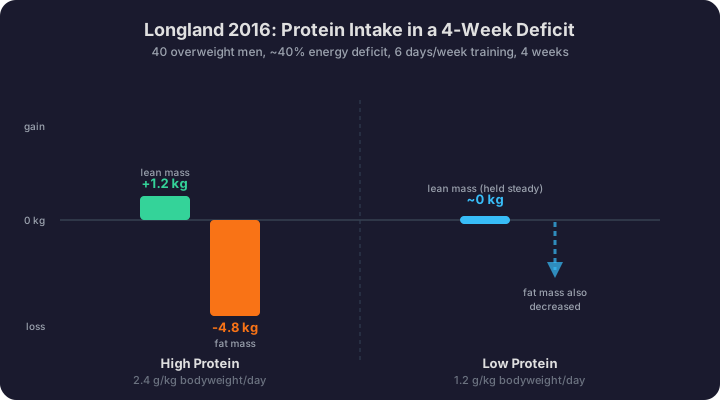
- A 2016 Longland trial had overweight men train six days weekly in a roughly 40 percent deficit for four weeks. The group eating 2.4 grams per kilogram of protein gained about 1.2 kilograms of lean mass while losing about 4.8 kilograms of fat. The 1.2 grams per kilogram group held lean mass steady.
- How do you know body recomposition is working if the scale barely moves?
- Do not rely on the scale, since muscle gain and fat loss cancel out. Instead track a shrinking waist measured at the navel, climbing lifts in your training log, standardized progress photos every four to eight weeks, and body fat versus muscle scores. Give any verdict eight to twelve weeks.
The traditional answer is a flat no. Building muscle needs a calorie surplus, losing fat needs a deficit, you cannot be in both at once, so pick a lane: bulk or cut. It is clean logic, it is repeated everywhere, and it is wrong often enough to matter.
Body recomposition, gaining muscle and losing fat over the same stretch of time, is well documented in research and routine in practice for specific groups of people. It is also genuinely difficult to near impossible for others. This article is about the who and the whether: who can realistically expect to recomp, why it works when it works, what to expect, and how to tell it is happening when your scale weight barely moves. For the detailed calorie and macro mechanics, our companion piece on nutrition for body recomposition covers the setup in depth; here we stay on the strategy level.
The Short Answer: Yes, for Some People
Recomposition works reliably for four groups.
Beginners. New lifters respond to training so strongly that muscle growth proceeds even in a calorie deficit. The first year of proper training is the single best recomp window most people ever get, and many beginners waste it by bulking aggressively or crash dieting instead.
Returning lifters. If you were muscular once and detrained, muscle memory is on your side. Regaining lost muscle happens far faster than building it the first time, fast enough to run alongside fat loss without much conflict.
Trainees at higher body fat. Stored fat is stored energy. Someone carrying 25 or 30 percent body fat has a large onboard fuel reserve that can help cover the cost of training and recovery while food intake sits below maintenance.
Anyone upgrading from a poor setup. If your training was unstructured or your protein chronically low, fixing those creates a surge of adaptation that behaves like beginner gains, regardless of how long you have technically been lifting.
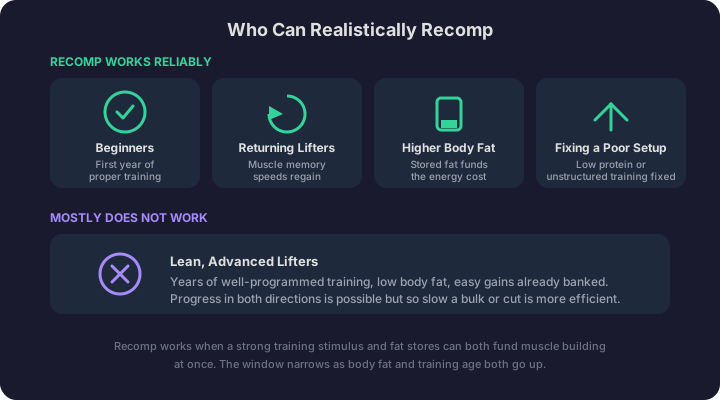
And the group for whom recomp mostly does not work: lean, advanced lifters. If you are several years into well-programmed training, sitting at low body fat, with most of your easy gains banked, the conditions that make recomposition possible have largely expired. You can still inch both directions at once, but progress is so slow that dedicated bulk and cut phases are simply more efficient. Recomp is not a myth for this group, just a poor deal.
Why It Works: The Physiology in Plain Language
The bulk-or-cut logic treats the body as one bank account: surplus means deposits, deficit means withdrawals. The body is closer to two accounts with a transfer line between them.
Building muscle requires three things: a training stimulus strong enough to trigger adaptation, enough protein to supply the raw material, and enough energy to fund the construction. The first two have nothing to do with your calorie balance. Muscle protein synthesis responds to hard training and adequate protein whether you ate at a surplus or not.
The third, energy, is where the trick lives. Energy for the build can come from food, but it can also come from body fat. A person in a modest deficit who carries meaningful fat stores is not energy-deprived in any real sense; they are simply paying part of the bill from savings. Fat mass shrinks to cover the gap while the training stimulus and protein supply keep muscle construction running. Both happen at once because they are not actually competing for the same dollar.
The same logic explains who the window closes on. As you get leaner, the savings account shrinks and the body defends it harder. As you get more trained, each session triggers a smaller adaptive response. A lean, advanced lifter has both a depleted reserve and a weakened stimulus, which is precisely why the people most eager to recomp are usually the least able to.
What the Evidence Shows
This is not just a mechanistic story. A 2020 review by Barakat and colleagues examined the question directly in trained populations and concluded that simultaneous muscle gain and fat loss is documented even in experienced lifters under the right conditions, with high protein intake and the quality of the training program among the recurring ingredients1.
The more dramatic demonstration comes from a 2016 randomized trial by Longland and colleagues2. Forty overweight young men spent four weeks in a steep energy deficit, around 40 percent below maintenance, while training intensely six days per week. Half ate a high protein diet at 2.4 grams per kilogram of body weight daily; half ate 1.2 grams per kilogram. The higher protein group gained roughly 1.2 kilograms of lean mass while losing roughly 4.8 kilograms of fat, in four weeks, in a hard deficit. The lower protein group held their lean mass steady while losing fat, which is itself a respectable outcome.
Two honest notes on that study. The protocol was brutal and fully supervised, closer to a boot camp than a sustainable lifestyle, and the subjects were overweight and new to that style of training, exactly the profile the previous section predicts should respond. Do not read it as a template. Read it as an existence proof: even in a severe deficit, with the stimulus and protein in place, the body can build muscle and burn fat simultaneously.
How to Set Up a Recomp
The practical recipe has four levers, and none of them is exotic.
A small deficit. Eat 10 to 20 percent below maintenance, not 40. The Longland protocol worked under supervision on a specific population; for self-managed training, a modest deficit protects performance, recovery, and adherence. If your maintenance is 2,600 calories, that means roughly 2,100 to 2,350.
Protein high. Aim for 1.6 to 2.2 grams per kilogram of body weight per day. Protein supplies the building material and protects existing muscle while energy is scarce. This lever matters more in a deficit than at any other time.
Progressive training. Recomposition runs on the training stimulus. Three to five resistance sessions per week, built around compound movements, with loads or reps progressing over time and every session logged. If the stimulus is weak, the deficit just becomes a slow cut.
Sleep. Seven to nine hours. Recovery is when the building actually happens, and short sleep blunts it while making the deficit feel twice as hard.
Cardio is an optional tool for health and for nudging the deficit, not a requirement. The full food-level detail, calorie math, macro splits, and meal structure, lives in the nutrition for body recomposition guide.
How to Know It Is Working When the Scale Barely Moves
A successful recomp is nearly invisible to the scale by definition: muscle coming in, fat going out, total weight drifting slowly or not at all. If the scale is your only instrument, you will conclude nothing is happening and quit during the exact weeks it is working. You need instruments that see the two halves separately.
The tape. A shrinking waist at a stable body weight is close to diagnostic on its own. Measure your waist at the navel every couple of weeks, same time of morning, and watch the trend.
The training log. If your lifts are climbing while your waist is shrinking, recomposition is happening. Strength gain in a deficit is a strong signal that lean mass is being added or at minimum fully preserved.
Photos. Standardized progress photos every four to eight weeks, same poses, same lighting, same camera position, capture the change in shape that defines a recomp.
Photo-based analysis. This is where a monthly check with HyperBody's AI physique rater is genuinely useful for this goal specifically: it returns a body fat estimate and muscle-by-muscle development scores from the same five photos. Body fat estimate trending down while muscle scores trend up is the recomp signal made explicit, the two halves of the process reported separately, which is exactly what the scale cannot do. For the full measurement stack and how often to check each layer, see our guide on how to track physique progress.
Give any verdict eight to twelve weeks. Recomposition is slower than a dedicated bulk or cut in each individual direction; the appeal is that both directions move at once.
When to Switch to a Dedicated Bulk or Cut
Recomposition is a phase, not an identity, and it has a natural expiry. The window narrows as you get leaner and more trained, which means a successful recomp eventually ends itself.
Switch to a dedicated phase when the signals flatten: eight or more weeks where strength is not climbing, the waist is not shrinking, and photos and analysis scores look static despite honest training and consistent food. At that point, choose by body fat and goal. If you are reasonably lean and want more size, move into a small surplus and run a proper lean gaining phase. If body fat is still higher than you want and fat loss has stalled, shift to a clear, modest cut with a defined end point.
Outgrowing recomposition is success, not failure. It means you banked the easy simultaneous progress and graduated to the part of training where focus beats multitasking.
The Bottom Line
Can you build muscle and lose fat at the same time? Yes, if you are a beginner, a returning lifter, carrying higher body fat, or finally training and eating properly for the first time. Probably not meaningfully, if you are lean and advanced. The mechanism is straightforward: a strong training stimulus plus high protein keeps construction running while a modest deficit makes body fat pay the energy bill. Set a 10 to 20 percent deficit, eat 1.6 to 2.2 grams of protein per kilogram, train progressively, sleep, and judge the result by waist, lifts, photos, and composition trends rather than the scale. Then, when both needles stop moving, pick a lane and push.
References
Footnotes
-
Barakat C, Pearson J, Escalante G, Campbell B, De Souza EO (2020). Body recomposition: can trained individuals build muscle and lose fat at the same time? Strength and Conditioning Journal, 42(5), 7-21.
-
Longland TM, Oikawa SY, Mitchell CJ, Devries MC, Phillips SM (2016). Higher compared with lower dietary protein during an energy deficit combined with intense exercise promotes greater lean mass gain and fat mass loss: a randomized trial. The American Journal of Clinical Nutrition, 103(3), 738-746.
More field notes.

How Much Protein Do You Actually Need to Build Muscle?
Protein advice ranges from a modest government minimum to a chicken breast with every meal, and the arguing hides how clear the research actually is. Here is the number, where it comes from, and how to hit it without turning eating into a second job.

Protein Timing: Does the Anabolic Window Really Matter?
You've been told to slam a shake within 30 minutes of training or lose your gains. The research tells a much more relaxed story. Here's what actually matters about when you eat protein.

Nutrition for Body Recomposition: A Practical Guide
Training builds the stimulus. Nutrition builds the body. Learn how to dial in your nutrition to support fat loss, muscle gain, and long-term body recomposition.
More on HyperBody