NutritionAug 6, 20269 min read
Lire en français·Auf Deutsch lesen·Leer en español·Przeczytaj po polsku
Protein Timing: Does the Anabolic Window Really Matter?
You've been told to slam a shake within 30 minutes of training or lose your gains. The research tells a much more relaxed story. Here's what actually matters about when you eat protein.
Reviewed by the HyperBody team

Few gym beliefs are as sticky as the "anabolic window", the idea that you have a narrow 30 to 60 minute slot after training to get protein in, or your session is wasted. It's spawned a whole industry of fast-digesting shakes and a lot of gym-bag anxiety. It's also, according to the research, mostly overblown.
The reassuring truth: your body is far more forgiving than the supplement marketing suggests. Let's separate what actually matters about protein timing from what doesn't.
The Window Is a Barn Door, Not a Keyhole
The strict post-workout window doesn't hold up. A detailed review of the evidence concluded that the anabolic window is likely much wider than the fabled 45 to 60 minutes, more like several hours on either side of your session1.
The reason is physiological. After a resistance-training session, your muscles become more sensitive to protein, and that heightened sensitivity and elevated muscle protein synthesis persists for up to 24 hours2. You're not racing a stopwatch; you're operating within a day-long building period.
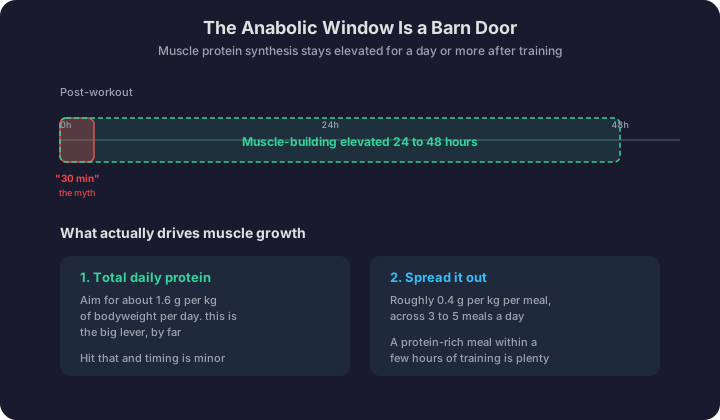
This is confirmed directly: when researchers compared consuming protein before versus after training, the muscle and strength adaptations were essentially the same3. If you ate a protein-rich meal a couple of hours before you trained, that meal is still working for you afterward, which further shrinks any urgency to eat immediately post-workout13.
What Actually Matters: Total Daily Protein
If timing is a minor variable, what's the major one? Your total daily protein intake. This is the finding that reframes the whole conversation.
A meta-analysis on protein timing found a small apparent benefit to eating protein around workouts, but that benefit essentially disappeared once total daily protein intake was accounted for. In other words, the "timing" groups mostly just ended up eating more protein overall, and that was what drove their results4. Timing was a proxy for total intake, not an independent factor.
So how much total protein? The evidence points to about 1.6 grams per kilogram of bodyweight per day as the target where muscle and strength gains plateau5. The International Society of Sports Nutrition's position stand recommends a range of roughly 1.4 to 2.0 g/kg/day for building and maintaining muscle in active people6. Hit that daily number, and the exact minute you eat becomes almost irrelevant.
The One Timing Rule Worth Following
There is one timing-adjacent principle with real support, and it's about distribution, not the post-workout window. Spreading your protein across the day appears to be better than cramming it into one or two meals.
The practical guidance is to aim for roughly 0.4 grams per kilogram of bodyweight per meal, across at least four meals, to comfortably reach your daily target7. This gives your muscles a steady supply of amino acids rather than one big dump and long gaps.
Notice what this means in practice: if you're eating protein-rich meals every few hours anyway, you'll naturally have protein in your system around your workout. No special shake required. The system takes care of the "window" automatically.
Putting It Into Practice
- Hit your daily protein target first. Aim for about 1.6 g/kg/day; this is the lever that actually moves muscle growth56.
- Spread it across the day. Roughly 0.4 g/kg per meal over four or more meals7.
- Don't stress the post-workout clock. A protein-containing meal within a few hours of training, before or after, is completely sufficient13.
- Skip the panic shake if you don't want it. A whole-food meal works just as well; the 30-minute rule is a myth1.
The anabolic window isn't something to fear missing. If you're eating enough protein and spreading it sensibly across your day, you're already inside it, all day long. Spend your energy on hitting your daily total consistently, not on watching a stopwatch after your last set.
Getting daily protein right is one piece of the nutrition puzzle; if you want meals built around your protein target and goals, HyperBody's recipes generate options that make hitting these numbers far easier.
References
Footnotes
-
Aragon AA, Schoenfeld BJ (2013). Nutrient timing revisited: is there a post-exercise anabolic window? Journal of the International Society of Sports Nutrition, 10, 5. https://doi.org/10.1186/1550-2783-10-5
-
Burd NA, West DWD, Moore DR, et al. (2011). Enhanced amino acid sensitivity of myofibrillar protein synthesis persists for up to 24 h after resistance exercise in young men. The Journal of Nutrition, 141(4), 568-573. https://doi.org/10.3945/jn.110.135038
-
Schoenfeld BJ, Aragon A, Wilborn C, Urbina SL, Hayward SE, Krieger J (2017). Pre- versus post-exercise protein intake has similar effects on muscular adaptations. PeerJ, 5, e2825. https://doi.org/10.7717/peerj.2825
-
Schoenfeld BJ, Aragon AA, Krieger JW (2013). The effect of protein timing on muscle strength and hypertrophy: a meta-analysis. Journal of the International Society of Sports Nutrition, 10, 53. https://doi.org/10.1186/1550-2783-10-53
-
Morton RW, Murphy KT, McKellar SR, et al. (2018). A systematic review, meta-analysis and meta-regression of the effect of protein supplementation on resistance training-induced gains in muscle mass and strength in healthy adults. British Journal of Sports Medicine, 52(6), 376-384. https://doi.org/10.1136/bjsports-2017-097608
-
Jäger R, Kerksick CM, Campbell BI, et al. (2017). International Society of Sports Nutrition position stand: protein and exercise. Journal of the International Society of Sports Nutrition, 14, 20. https://doi.org/10.1186/s12970-017-0177-8
-
Schoenfeld BJ, Aragon AA (2018). How much protein can the body use in a single meal for muscle-building? Implications for daily protein distribution. Journal of the International Society of Sports Nutrition, 15, 10. https://doi.org/10.1186/s12970-018-0215-1
More field notes.

How Much Protein Do You Actually Need to Build Muscle?
Protein advice ranges from a modest government minimum to a chicken breast with every meal, and the arguing hides how clear the research actually is. Here is the number, where it comes from, and how to hit it without turning eating into a second job.

Body Recomposition: Can You Build Muscle and Lose Fat at the Same Time?
Building muscle while losing fat sounds like having it both ways, but for several groups of lifters it is well documented. Here is who can realistically recomp, why it works, and how to tell it is working when the scale refuses to move.

Nutrition for Body Recomposition: A Practical Guide
Training builds the stimulus. Nutrition builds the body. Learn how to dial in your nutrition to support fat loss, muscle gain, and long-term body recomposition.
More on HyperBody