EducationJun 12, 20269 min read
Lire en français·Auf Deutsch lesen·Leer en español·Przeczytaj po polsku
AI Physique Analysis vs DEXA Scan: Accuracy, Cost, and When Each Makes Sense
DEXA is the clinical gold standard. AI photo analysis costs nothing to start and you can run it monthly. Here's an honest comparison of accuracy, price, and what each one actually tells you.
Reviewed by the HyperBody team

Key takeaways
- Is a DEXA scan more accurate than AI photo analysis for body fat?
- For absolute body fat on a single day, yes. DEXA is repeatable to within roughly 1 to 2 percentage points, while AI photo analysis typically lands within 3 to 5 points. DEXA wins on precision, but AI wins on muscle development assessment and on tracking trends month to month.
- How much does a DEXA scan cost compared to AI physique analysis?
- A DEXA scan costs $50 to $150 per reading in the US and requires a clinic visit, so most people do it only once or twice a year. Monthly scans would run $600 to $1,800 annually. HyperBody's AI photo analysis is free to start, runs at home in about ten minutes, and costs far less per month.
- What does a DEXA scan measure that AI photo analysis cannot?
- DEXA passes two X-ray beams through your body to separate fat mass, lean soft tissue, and bone mineral content. It reports measured body fat percentage, regional breakdowns, bone mineral density, and visceral fat on newer machines. AI reads only what is visible, so it cannot see bone density, visceral fat, or anything beneath the surface.
- Should I use DEXA or AI photo analysis to track my training progress?
- Choose AI photo analysis for training questions like which muscle groups lag and whether your program is working, using standardized poses monthly. Choose DEXA for medical needs, bone density, or a rigorous baseline. The strongest play combines both: one DEXA scan per year to anchor absolute numbers, plus monthly AI analysis between scans.
Search for "DEXA scan vs AI body fat" and you'll find two camps. One insists that nothing short of a clinical scan is worth your time. The other claims a phone camera has made the clinic obsolete. Both are selling a simple story, and neither story is accurate.
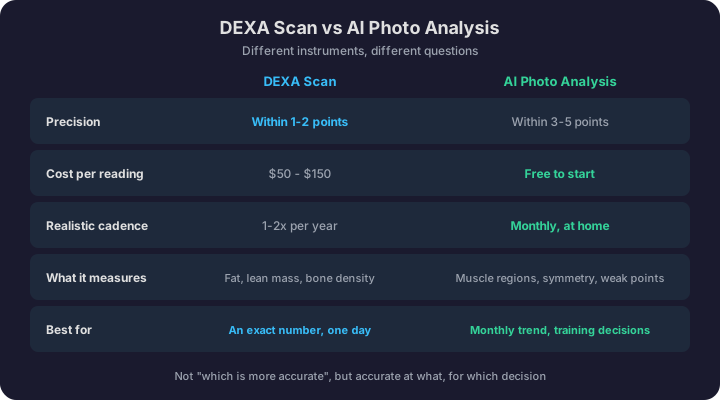
Here's the honest version. DEXA is the clinical reference standard for body composition, and there are situations where nothing else will do. AI photo analysis measures different things, costs far less, and can be repeated every month without leaving your house. The two are not interchangeable, and the right question is not "which one is more accurate" but "accurate at what, and for which decision". This article walks through what each method actually measures, where each one clearly wins, what a year of real tracking costs with each, and how to decide which one fits your situation. Including the cases where DEXA is unambiguously the right call.
What a DEXA Scan Measures
DEXA stands for dual-energy X-ray absorptiometry. The machine passes two low-dose X-ray beams through your body, and because fat, lean tissue, and bone attenuate those beams differently, it can separate you into three compartments: fat mass, lean soft tissue, and bone mineral content1. That three-compartment model is the reason DEXA is treated as the clinical gold standard while two-compartment methods like skinfold calipers and smart scales are not.
A DEXA report gives you:
- Total body fat percentage, measured rather than estimated from a formula
- Regional breakdown of fat and lean mass across your arms, legs, and trunk, including left versus right comparisons
- Bone mineral density, the same measurement used to screen for osteoporosis
- Visceral fat estimates on newer machines, meaning the fat stored around your organs
Under controlled conditions, DEXA's precision is roughly plus or minus 1 to 2 percentage points for body fat. That is genuinely excellent, and no photo-based method can match it. The radiation dose is tiny, a fraction of a standard chest X-ray, so safety is not a practical concern for occasional scans.
The fine print still matters. "Controlled conditions" means consistent hydration, fasting state, and time of day; a large meal, heavy creatine loading, or a hard training session before your scan can shift the numbers. Results also vary between machines and manufacturers, so if you scan twice a year, do it at the same facility on the same machine. And in the US, a scan typically costs $50 to $150 and requires booking a visit at a clinic, university lab, or dedicated body composition facility.
One more point worth stating precisely: DEXA measures lean mass, not muscle. Lean soft tissue includes water, organs, and everything else that is neither fat nor bone. Gaining two pounds of lean mass between scans does not tell you whether your shoulders grew or you simply drank more water that morning.
What AI Photo Analysis Measures
AI photo analysis works the way an experienced coach's eye works, just systematically and repeatably. You take standardized photos in fixed poses, HyperBody uses five: front relaxed, front flexed, back relaxed, back flexed, and a side profile, and the model evaluates what is visible in them.
What you get:
- A body fat estimate as a range. Visual estimation typically lands within 3 to 5 percentage points of your true value. It will not tell you whether you are 14.2% or 16.8%; it will tell you that you sit in the mid-teens and whether you are leaner than last month.
- Muscle development by region. Shoulders, chest, back, arms, core, and legs, each assessed for how developed it actually appears relative to the rest of your frame.
- Proportions and symmetry. Shoulder-to-waist ratio, left versus right imbalances, upper versus lower body balance.
- Posture and weak points. The things a coach would flag in person: rounded shoulders, a narrow-looking back, legs lagging behind your upper body.
The honest framing is this: AI reads what is visible. It cannot see bone density, visceral fat, or anything beneath the surface. What it can do is judge the thing most lifters actually care about, how your physique looks and where it needs work, and judge it the same way every single time. If you want a deeper tour of what photo-based assessment covers, we've written a full guide to body composition analysis beyond the scale.
That consistency is not a side note. It is the core of the accuracy argument that comes next.
Accuracy Head to Head
Absolute body fat precision: DEXA wins, clearly. If you need to know your body fat percentage to within a point or two on one specific day, there is no contest. An estimate within 3 to 5 points cannot compete with a measurement that is repeatable to 1 to 2 points1. Anyone claiming photos match DEXA on this axis is overselling.
Muscle assessment: AI wins, and this surprises people. DEXA tells you how many grams of lean mass sit in your left arm. It does not tell you whether your biceps look developed, whether your rear delts lag behind your front delts, or whether your back is wide enough for your waist. Quantity is not development quality. A trained eye looking at your physique extracts information that a DEXA printout simply does not contain, and that is exactly the information that drives training decisions: what to prioritize, what to maintain, and what is visually holding your physique back.
Trend accuracy: this is where the comparison gets interesting. Every body composition method carries measurement error; the classic review of assessment techniques is blunt that even laboratory methods rest on assumptions and error margins2. For training decisions, what matters most is not one perfect reading but whether repeated readings reliably show direction. A consistent estimator, re-run monthly under the same conditions, same poses, same lighting, same time of day, will reliably tell you whether you are getting leaner, whether a lagging muscle group is responding, and whether your proportions are moving the right way. That is trend accuracy, and for most lifters it is worth more than one precise number per year.
Compare that to the alternative most people actually use between scans: the bioimpedance smart scale, where hydration, meal timing, and even skin temperature can swing readings by several points from day to day3. A method with a stable, consistent bias beats a method with random noise, because a stable bias cancels out when you compare this month against last month.
So the head-to-head verdict depends entirely on the question. "What is my exact body fat percentage today?" DEXA, no argument. "Is my training working, and what should I change?" That is a question about regions, proportions, and trends, and photo analysis answers it better, more often, and for far less money.
Cost and Frequency
Accuracy debates usually skip the variable that decides real-world behavior: what tracking costs and how often you will actually do it. Run the numbers on a full year.
DEXA scan
- Cost per reading: $50 to $150 in the US, depending on city and facility
- Realistic cadence: once or twice a year. Monthly DEXA would run $600 to $1,800 per year plus twelve facility visits, and almost nobody sustains that
- What each reading gives you: measured body fat percentage, regional fat and lean mass, bone mineral density
AI photo analysis
- Cost per reading: HyperBody is free to start, and an ongoing subscription costs less per month than a single scan
- Realistic cadence: monthly, at home, in about ten minutes
- What each reading gives you: a body fat range, muscle development scores by region, symmetry and proportion analysis, weak point identification, and recommendations that feed directly into your training plan
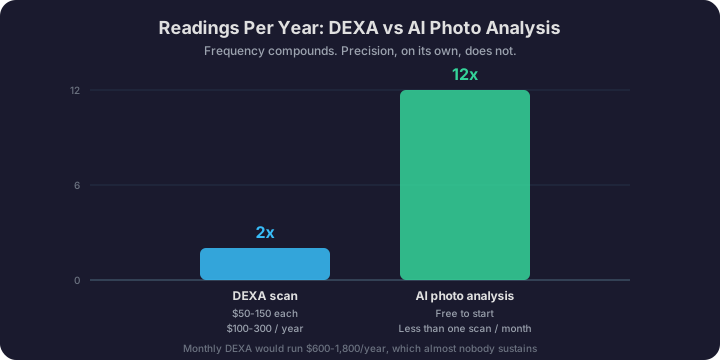
The frequency gap is the real story here. A method you use twice a year gives you two data points and months of guessing in between. A method you use every month gives you a trajectory: twelve snapshots showing whether your cut is preserving muscle, whether your weak points are responding, and whether your current program has earned another block or needs a rewrite. Frequency compounds. Precision, on its own, does not.
When to Choose Which
Choose DEXA when the question is medical, or when the stakes demand measured numbers.
- You need bone density data, whether for osteoporosis screening or because you are in an at-risk population
- A physician, dietitian, or researcher needs clinically validated body composition values
- You are tracking visceral fat for health reasons
- You want a rigorous baseline, or an annual audit to check your other tracking methods against
Choose AI photo analysis when the question is about training.
- You want to know which muscle groups are lagging and what to prioritize next block
- You want monthly feedback on whether your program and diet are actually working
- You care about proportions, symmetry, and how your physique reads visually
- You want a method you will sustain, because the tracking habit you keep beats the one you abandon
The combo is the strongest play of all. Get a DEXA scan once a year as your calibration point: a measured body fat percentage and a bone density baseline. Then run AI photo analysis monthly to steer your training between scans. The DEXA anchors your absolute numbers; the photos drive your month-to-month decisions. For less than the price of three scans a year, you get clinical anchoring and continuous direction at the same time.
The Bottom Line
DEXA is the more precise instrument; AI photo analysis is the more useful habit. If you need exact body fat numbers, bone density, or medically valid data, book a DEXA scan and do not let anyone talk you out of it. If you need to know what to train, which weak points to attack, and whether this month's work moved you forward, photo analysis answers those questions twelve times a year for a fraction of the cost. The scale alone tells you almost nothing4, an annual scan tells you a lot about two days of the year, and consistent monthly analysis tells you where you are actually heading. If you want to see what photo-based assessment says about your physique, you can start free with HyperBody's AI physique rater, no clinic visit required.
References
Footnotes
-
Plank LD (2005). Dual-energy X-ray absorptiometry and body composition. Current Opinion in Clinical Nutrition and Metabolic Care, 8(3), 305-309. https://doi.org/10.1097/01.mco.0000165010.31826.3d
-
Wagner DR & Heyward VH (1999). Techniques of body composition assessment: a review of laboratory and field methods. Research Quarterly for Exercise and Sport, 70(2), 135-149. https://doi.org/10.1080/02701367.1999.10608031
-
Kyle UG et al. (2004). Bioelectrical impedance analysis - part I: review of principles and methods. Clinical Nutrition, 23(5), 1226-1243. https://doi.org/10.1016/j.clnu.2004.06.004
-
Prentice AM & Jebb SA (2001). Beyond body mass index. Obesity Reviews, 2(3), 141-147. https://doi.org/10.1046/j.1467-789x.2001.00031.x
More field notes.

Smart Scales and BIA: How Accurate Are They Really?
Your smart scale says 18 percent body fat on Monday and 22 percent on Thursday, and you have not changed. Here is how bioelectrical impedance actually works, what the research says about its accuracy, and the narrow job it can still do well.

What Body Fat Percentage Actually Looks Like (Male & Female)
Everyone talks about body fat percentage, but few people know what different levels actually look like. Here's a realistic, no-BS guide to what each range means for your physique.

FFMI Explained: How Much Muscle Can You Build Naturally?
FFMI puts a number on how much muscle you carry for your height, and it is the metric behind the famous claim that natural lifters top out around 25. Here is what it actually measures, what the research really showed, and how to estimate yours.
More on HyperBody