EducationOct 18, 20269 min read
Lire en français·Auf Deutsch lesen·Leer en español·Przeczytaj po polsku
Genetics and Muscle Building: What You Can Change and What You Can't
Genetics set the frame, the insertions, and the speed of your gains, but they decide far less about your final physique than most lifters believe. Here is what your DNA actually controls, what it does not excuse, and how to train for the structure you have.
Reviewed by the HyperBody team

Put two lifters on the same program, the same diet, the same sleep schedule, and twelve weeks later one has visibly new arms while the other is squinting at the mirror. Both trained honestly. The difference is genetic, it is real, and pretending otherwise helps nobody.
But here is the other half of the truth, the half that matters more: genetics decide far less about your final physique than the average frustrated lifter believes. Most of what gets blamed on DNA is actually under-eating, under-training, or impatience wearing a lab coat. This article sorts the two piles honestly: what your genes actually control, what they absolutely do not excuse, and how to train intelligently for the body you were dealt.
What Genetics Actually Determines
Five things, mostly, and it is worth knowing each one because they call for different responses.
Frame and skeletal proportions. Clavicle width, hip width, ribcage depth, limb lengths relative to torso. These are fixed in adulthood, and they matter enormously for aesthetics: wide clavicles and narrow hips produce the V-taper at lower muscle levels, while a narrower frame needs more deltoid and lat mass to create the same illusion. Bone structure also changes lift mechanics, which we will come back to.
Muscle belly lengths and insertions. Where a muscle attaches and how far its belly extends before becoming tendon determine its shape. A short-bellied bicep produces a tall peak with a visible gap at the elbow; a long-bellied one looks full but flatter. High calf insertions, long abdominal segments, a pec that ties in low or high: all set before you ever touched a weight, and no exercise changes them. Insertions are why two equally muscular arms can look completely different.
Fiber type tendencies. People differ in their mix of fast and slow twitch fibers, which nudges natural aptitude toward explosiveness or endurance and may flavor how muscles respond to different rep ranges. A nudge, though, not a destiny: every fiber type grows with progressive overload.
Hormonal milieu. Natural testosterone, growth factors, and how your tissues respond to them vary between individuals within the normal range, and that variation influences both the ceiling and the rate of muscle gain.
Responder variability. The big one: people fed the identical training stimulus grow at genuinely different rates. This deserves its own section, because the evidence is striking.
The Famous Study: Same Program, Wildly Different Results
In 2005, Hubal and colleagues put 585 men and women through twelve weeks of identical, supervised resistance training of the elbow flexors, then measured what happened1. The spread was enormous. Changes in upper-arm muscle cross-sectional area ranged from roughly zero, a few subjects even measured slightly smaller, to gains approaching 60 percent. Strength gains scattered even more widely, from negligible to gains of more than 200 percent. Same exercises, same sets, same supervision, same twelve weeks.
This is the cleanest demonstration we have that responder variability is real. The person who grew dramatically and the person who barely moved did nothing differently. If you have ever watched a training partner outgrow you on the same routine, you were not imagining it, and neither of you was necessarily doing anything wrong.
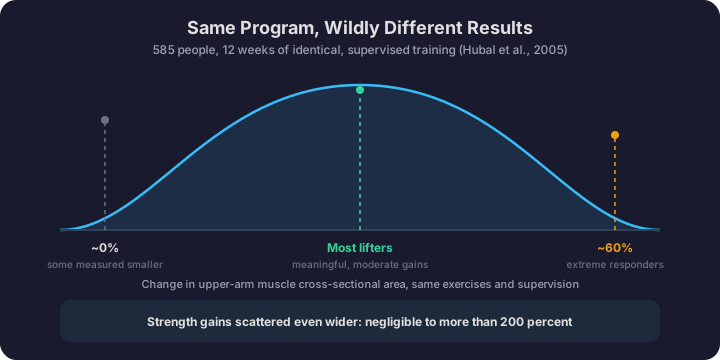
Three honest caveats before you adopt the study as your excuse. Twelve weeks is a snapshot, and slower responders still accumulate substantial muscle over years. A single arm measure does not capture how your whole body responds; many people respond better in some muscle groups than others. And nearly everyone in the middle of that distribution, which is most people by definition, gained meaningful size and strength. Variability in rate is not variability in whether.
What Genetics Does Not Excuse
Now the kind but plain part.
The lifter who concludes from all this that they are a hardgainer is usually wrong about the diagnosis. When self-described hardgainers are actually audited, the same findings come up over and over: they eat far less than they think, especially on busy days that never make it into memory; their training is inconsistent across months even when individual weeks look good; their sessions lack progressive overload, drifting through the same weights for a year; and their sleep is an afterthought. None of that is genetic.
The test is simple, and it is the same two-step audit every time. Track your food honestly for two weeks: every meal, every oil, every weekend. Track your training for three months: loads, reps, and whether they actually climbed. If you are genuinely eating in a surplus, genuinely adding load or reps over time, and genuinely sleeping, and growth is still slow, then yes, you may sit left of center on the responder curve, and your timeline is longer than your friend's. That is a reason for patience, not for quitting. Slow responders in the research still grew. What the data never shows is a healthy person who trains progressively, eats sufficiently, and builds nothing.
Genetics set your rate and your ceiling. They do not grant exemptions from the inputs.
Train With Your Structure, Not Against It
Where genetic knowledge becomes genuinely useful is exercise selection, because your skeleton changes which movements fit you.
Long femurs relative to your torso make deep back squats fold you forward; that is geometry, not weakness. Such lifters often get more quad growth, with less back stress, from high-bar squats with heel elevation, hack squats, or leg presses. Long arms make you a natural deadlifter and a frustrated bench presser; the bar travels further to your chest, so dumbbells, slight declines, or dips may load your pecs better than chasing a barbell bench number ever will. Short arms reverse the trade.
The same logic runs through the rest of the program. A lifter with a long torso and short legs may find conventional deadlifts comfortable while sumo feels cramped; a long-legged lifter often experiences the opposite. Narrow clavicles can make very wide-grip pressing irritate the shoulders, in which case a closer grip or neutral-grip dumbbell work keeps the stimulus and drops the complaint. None of these adjustments is cheating or a downgrade. The muscle does not know which implement is loading it; it only registers tension and range.
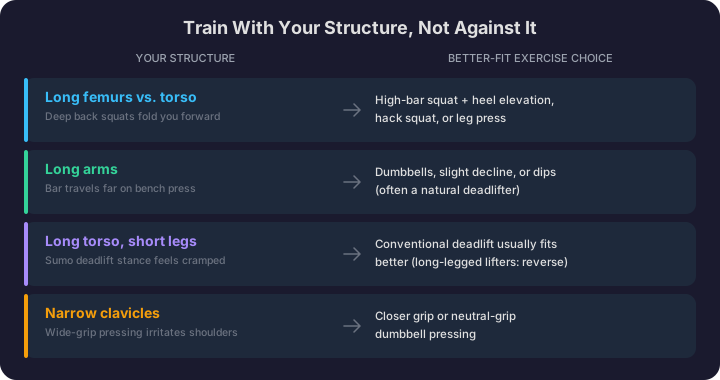
The principle: the best exercise for a muscle is the one that lets you load it progressively, through a long range of motion, pain-free, with your proportions. Stop treating any specific barbell lift as a moral obligation. Powerlifters need the competition lifts; a physique-focused lifter needs the stimulus, by whatever movement delivers it best to their frame.
What About DNA Fitness Tests?
A quick word on the consumer genetic tests that promise to reveal your fiber type, your ideal training style, or your muscle-building potential from a cheek swab. The honest summary: muscle growth is influenced by a very large number of genetic variants, each with a tiny individual effect, and the handful of genes these kits report on explain only a sliver of the variation between people. Two lifters with the same result on such a test can still respond very differently to the same program.
There is a cheaper and far more accurate genetic test available: training. Run a sensible program for twelve weeks with honest food and sleep, measure your response with standardized photos and a training log, and you have read your own genetics at the only resolution that matters, the whole-body, real-world one. The swab tells you about a few variants; the twelve weeks tell you about you.
And one liberating clarification about insertions: they change aesthetics, not trainability. A high calf insertion means less visual calf mass, not calves that refuse to grow; a short bicep belly changes the shape of the muscle you build, not your ability to build it. Train the muscle hard either way, and let the shape be what it is, because everyone's shape is non-negotiable anyway.
Know Your Own Starting Point
All of this becomes practical only when you can see your own structure clearly, and the mirror is a poor instrument for it: it shows you everything at once, filtered through whatever you dislike most that day.
An objective assessment separates the layers. HyperBody's AI physique rater analyzes five standardized photos and scores each muscle group individually, alongside an assessment of frame, proportions, and genetic potential indicators like shoulder-to-waist structure and insertions. That gives you the two things this article has been circling: an honest map of which weaknesses are muscle (trainable, so prioritize them) versus structure (fixed, so plan around them), and a baseline so that next quarter's comparison is against your own starting point, measured under identical conditions, rather than against a memory or a stranger.
If you want the numbers companion to this article, our guide to FFMI and natural muscle potential covers how far natural lifters can realistically take total muscle mass, with the math.
The Comparison Trap
A closing warning about where your expectations come from.
The physiques you scroll past daily are a triple-filtered sample: outliers selected for response (the top sliver of the Hubal distribution, because extreme responders disproportionately become fitness content), presented at their best (lighting, pumps, angles, peak condition), and, more often than anyone admits, pharmacologically enhanced while marketing routines as the cause. Measuring your year-one progress against that sample is not motivation; it is calibrated discouragement. You are comparing your raw footage to a stranger's highlight reel drawn from a different genetic and sometimes chemical distribution.
The only comparison with information in it is you versus you, under standardized conditions, across months. Everything else is entertainment.
Control the Controllables
Here is the full honest ledger. Fixed: your frame, your insertions, your muscle belly lengths, your fiber type tendencies, your hormonal baseline, and your position on the responder curve. Yours to control: training stimulus and its progression, exercise selection that fits your levers, calories, protein, sleep, and the years of consistency that compound all of it. The science of how muscle actually grows, mechanical tension, progressive overload, sufficient volume, applies identically across the entire genetic spectrum; we break it down in the science of muscle hypertrophy.
The uncomfortable truth is that genetics matter. The more useful truth is that almost nobody reading this is anywhere near their genetic ceiling, and the distance between an untrained body and a near-ceiling natural physique is enormous for every genotype. The lifter who spends that distance training, eating, and sleeping beats the one who spends it diagnosing their DNA, every single time. Control the controllables. They are bigger than you think.
References
Footnotes
-
Hubal MJ et al. (2005). Variability in muscle size and strength gain after unilateral resistance training. Medicine and Science in Sports and Exercise, 37(6), 964-972. https://doi.org/10.1249/01.mss.0000170469.90461.5f
More field notes.

FFMI Explained: How Much Muscle Can You Build Naturally?
FFMI puts a number on how much muscle you carry for your height, and it is the metric behind the famous claim that natural lifters top out around 25. Here is what it actually measures, what the research really showed, and how to estimate yours.

How Long Does It Take to Build Noticeable Muscle?
Muscle growth runs on a timeline that no amount of motivation can compress, and most lifters quit during the exact weeks it is quietly working. Here is what actually changes in your first weeks, months, and years of training, and how to see progress the mirror hides.

Newbie Gains: Why Beginners Build Muscle Faster (And How to Make the Most of It)
Your first year of lifting is the fastest muscle growth you will ever experience, and it only happens once. Here is why newbie gains exist, how long they honestly last, and how to extract everything the window has to offer.
More on HyperBody