EducationJul 19, 20269 min read
Lire en français·Auf Deutsch lesen·Leer en español·Przeczytaj po polsku
FFMI Explained: How Much Muscle Can You Build Naturally?
FFMI puts a number on how much muscle you carry for your height, and it is the metric behind the famous claim that natural lifters top out around 25. Here is what it actually measures, what the research really showed, and how to estimate yours.
Reviewed by the HyperBody team

Key takeaways
- What is FFMI and how is it calculated?
- FFMI stands for fat-free mass index. You take your fat-free mass in kilograms and divide it by your height in meters squared. The article's example: an 80 kilogram person at 15 percent body fat has 68 kilograms of fat-free mass, and at 1.78 meters that gives an FFMI of roughly 21.5.
- Where does the FFMI natural limit of 25 come from?
- It comes from a 1995 study by Kouri and colleagues that measured 157 male athletes, 83 steroid users and 74 non-users. Non-users averaged an FFMI around 22 and extended up to roughly 25 before stopping, while steroid users averaged around 25 and many landed well beyond it.
- What is a normal FFMI range for men?
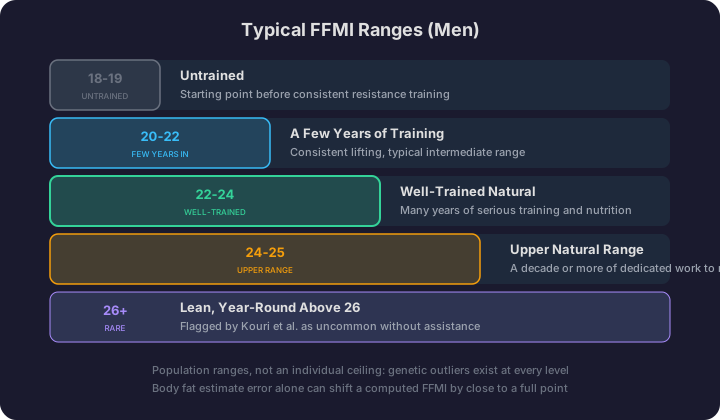
- The article gives rough ranges for men: untrained around 18 to 19, a few years of training 20 to 22, well-trained natural lifters 22 to 24, and 24 to 25 as the upper end most naturals reach after a decade or more. Lean year-round values above 26 are uncommon without assistance.
- How much muscle can you realistically build naturally each year?
- The article cites coaching rules of thumb: a man might gain roughly 8 to 11 kilograms of muscle in his first year of proper training, about half that in the second year, and half again in the third. Beyond that, progress is measured in fractions of a kilogram. Women follow the same curve at roughly half the amounts.
How much muscle can you build without drugs? It is one of the oldest questions in lifting, and FFMI is the most cited attempt at an answer. One study, one threshold, the number 25, repeated endlessly across forums and videos, and misunderstood in most of those repetitions.
This article explains what FFMI actually is, where the famous natural limit came from, what the original research can and cannot support, and how to estimate your own number. More usefully, it covers what actually determines your personal ceiling, because the honest answer is that no population statistic can tell you where yours sits.
What FFMI Is
FFMI stands for fat-free mass index. In words: take your fat-free mass in kilograms, then divide it by your height in meters squared. It is the structural sibling of BMI, with one critical difference. BMI counts all of your weight, so it penalizes muscular people by classifying them alongside the genuinely overweight. FFMI strips the fat out first and indexes only what remains: muscle, bone, organs, and water.
A worked example. Say you weigh 80 kilograms at 15 percent body fat. Fifteen percent of 80 is 12 kilograms of fat, leaving 68 kilograms of fat-free mass. At a height of 1.78 meters, you divide 68 by 1.78 squared, which is about 3.17. The result is an FFMI of roughly 21.5.
There is one refinement worth knowing. Because lean mass scales with height a little faster than height squared, taller people get a small built-in advantage on the raw number. The standard correction normalizes everyone to a height of 1.8 meters: add 6.1 points for every full meter you are below 1.8 meters tall, or subtract at the same rate if you are above it. Since almost nobody is a full meter away from 1.8, in practice this shifts most people's score by a few tenths of a point. Calculators that report "normalized FFMI" or "adjusted FFMI" are applying exactly this correction.
The Study Behind the Number 25
The famous threshold comes from a 1995 study by Kouri and colleagues1. The researchers measured 157 male athletes: 83 who reported using anabolic-androgenic steroids and 74 who reported never using them. The pattern was striking. The non-users averaged an FFMI around 22, and their scores extended up to approximately 25 and then essentially stopped. The steroid users averaged around 25, and many of them landed well beyond it.
The authors also looked backward at champion bodybuilders from the era before steroids were available, and estimated that the winners of that period averaged an FFMI close to 25 as well. Two independent lines of evidence pointing at the same neighborhood made the number stick: an FFMI much above 25, the reasoning goes, is unusual without pharmacological help.
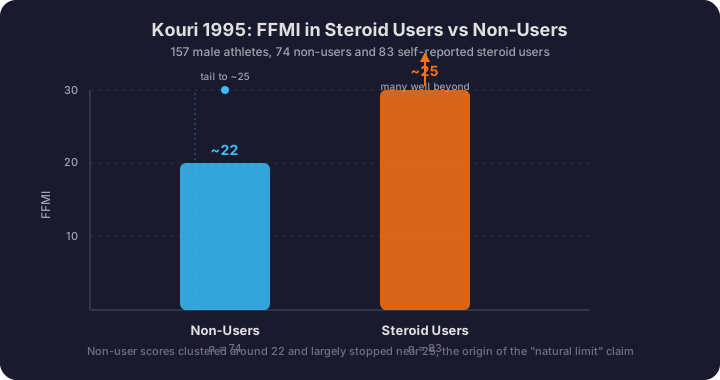
That is the legitimate version of the claim. The internet version, that 25 is a hard wall no natural lifter can pass, is not what the study showed, and the differences matter.
The Honest Caveats
It was a small sample. Seventy-four non-users, recruited from gyms in one region of the United States, with drug-free status established by self-report rather than testing. That is a useful sample and a thin foundation for a universal law of human physiology.
It is a population statistic, not an individual ceiling. The study describes where the right tail of one group of natural lifters ended. It does not say that the tail ends there for every human alive. Genetic outliers exist for every trait, and muscle-building potential is no exception. Some drug-tested competitors have presented physiques that plausibly sit above 25, and the pre-steroid-era champions in the study itself averaged near it, meaning the most gifted of them were above it.
The measurement is fuzzy. FFMI depends on a body fat estimate, and every body fat estimate carries error, often several percentage points. An error of three points in body fat moves a typical lifter's FFMI by the better part of a full point. Two people with identical bodies can compute meaningfully different FFMIs just by using different measurement methods.
So the fair summary reads like this: sustained, lean FFMI values much above 25 are rare among verified natural lifters, common among enhanced ones, and the boundary is a statistical observation with fuzzy edges, not a law.
Typical FFMI Ranges
With those caveats in place, the rough landscape for men looks like this. Untrained men usually sit around 18 to 19. A few years of consistent training typically lands between 20 and 22. Well-trained natural lifters who have taken training and nutrition seriously for many years commonly reach 22 to 24. Values of 24 to 25 represent the upper end of what most natural trainees ever touch, usually after a decade or more of dedicated work. Lean, year-round values above 26 are the territory the original study flagged as uncommon without assistance.
Most published FFMI reference data comes from men. Women carry less lean mass at every height, so their values run several points lower across the board, and the male thresholds above should not be applied to them directly.
Notice what these ranges imply: the gap between an untrained person and a near-ceiling natural is only about six or seven FFMI points, accumulated over years. Each point represents several kilograms of lean mass. This is a slow game, and the numbers say so plainly.
How to Estimate Your FFMI
You need three inputs: weight, height, and a body fat estimate. The first two are trivial. The third is the weak link, because consumer methods disagree with each other. Smart scale bioimpedance readings swing with hydration and meal timing, and calipers depend heavily on the skill of whoever is pinching.
A photo-based estimate is one practical option. HyperBody's AI physique rater generates a body fat estimate from five standardized physique photos, along with muscle-by-muscle development scores, so you get the input FFMI needs plus a view of where that lean mass actually sits. Whatever method you use, the rule is the same: keep the method constant and treat the result as a trend, not a truth. An FFMI of 21.4 versus 21.9 is measurement noise. An FFMI that climbs from 20 to 22 over two years under the same method is real progress.
The arithmetic, once you have the inputs: convert body fat percent to kilograms of fat, subtract from total weight to get fat-free mass, divide by height in meters squared, then apply the small height normalization if you want to compare against published ranges.
Run the full example once so the steps are concrete. A lifter weighs 90 kilograms at an estimated 18 percent body fat and stands 1.75 meters tall. Eighteen percent of 90 is 16.2 kilograms of fat, leaving 73.8 kilograms of fat-free mass. Height squared is 1.75 times 1.75, or about 3.06. Dividing 73.8 by 3.06 gives a raw FFMI of roughly 24.1. The normalization adds 6.1 times 0.05, about 0.3 of a point, for a normalized FFMI near 24.4. That lifter is close to the historical natural ceiling, assuming the 18 percent estimate is accurate, which is exactly the assumption worth questioning before drawing any conclusion.
What Actually Limits Natural Muscle Gain
FFMI describes the outcome. The actual limiting factors live elsewhere, and they differ from person to person.
Frame size. Skeletal structure sets the chassis. Broader clavicles, thicker joints, and a larger ribcage support more total muscle mass. Two lifters with identical discipline can have honestly different ceilings for this reason alone.
Hormonal profile. Within the normal physiological range, levels of testosterone, growth factors, and thyroid hormones vary substantially between individuals, and that variation influences both the rate of gain and the eventual plateau.
Muscle belly lengths and insertions. Where your muscles attach and how long the bellies run relative to the tendons affects both appearance and growth potential. Long muscle bellies have more room to grow; high insertions limit how full a muscle can ever look. None of this is trainable.
Training age. Growth is fastest when you are far from your ceiling and slows as you approach it. A lifter ten years in fights for grams while a novice gains by the kilogram, with the same effort.
What is notably absent from this list is any special mechanism unique to gifted lifters. The growth process itself, tension, progressive overload, sufficient volume, recovery, is identical for everyone; the dials are just set differently. If you want the mechanics of that process, our guide to the science of muscle hypertrophy covers what actually drives growth and how to train for it.
Realistic Rates of Gain
Coaching practice has converged on rough expectations that fit the FFMI math. In the first year of proper training, a man might gain somewhere in the range of 8 to 11 kilograms of muscle under good conditions. The second year, roughly half that. The third, half again. Beyond that, advanced natural lifters often measure annual progress in fractions of a kilogram. Women follow the same curve at roughly half the absolute amounts.
These are rules of thumb from practice, not laboratory constants, and individual variation around them is wide. But the shape of the curve is universal: front-loaded, then asymptotic. If you are three years in and gaining a kilogram of lean mass per year, you are not failing. You are on schedule.
Why Chasing Someone Else's FFMI Is a Mistake
The physiques that motivate people online are a filtered sample of genetic outliers, enhanced athletes, or both, photographed at peak condition in chosen lighting. Setting your target by their numbers builds a goal out of someone else's frame, someone else's hormones, and someone else's insertions, none of which you can train your way into.
FFMI also says nothing about the things that make a physique look good. Proportion, symmetry, conditioning, and the distribution of mass across muscle groups matter more to the eye than two extra index points. A balanced 22 routinely looks better than a blocky 24.
The version of this metric that is actually useful is private: your FFMI, measured the same way each time, moving in the right direction, alongside muscle group scores that tell you where the next kilogram should go. The ceiling question takes years to answer and answers itself. The trajectory question is the one you can act on this week.
References
Footnotes
More field notes.

Smart Scales and BIA: How Accurate Are They Really?
Your smart scale says 18 percent body fat on Monday and 22 percent on Thursday, and you have not changed. Here is how bioelectrical impedance actually works, what the research says about its accuracy, and the narrow job it can still do well.

Golden Ratio Physique: Shoulder-to-Waist Ratio and the V-Taper, Explained
The golden ratio physique claims the ideal shoulder-to-waist ratio is 1.618. Here is what attractiveness research actually supports, how to measure your own ratio, and how to train toward a wider-looking frame.

What Body Fat Percentage Actually Looks Like (Male & Female)
Everyone talks about body fat percentage, but few people know what different levels actually look like. Here's a realistic, no-BS guide to what each range means for your physique.
More on HyperBody