Your weekly plan,
built in seconds.
Answer four questions and get a complete weekly training plan with exercises, sets, and reps. Free, no signup. Built on proven programming rules, not AI.
This generator is rule-based, not AI. It maps your answers to a plan using fixed programming rules. For a plan built around your actual body, let the AI physique rater read your weak points from photos.
Upper and lower, four days per week
4 training days per week
Upper A
Chest, back, shoulders, arms- Flat barbell bench press4 x 6-10
- Barbell row4 x 6-10
- Overhead barbell press4 x 6-10
- Lat pulldown4 x 6-10
- Dumbbell lateral raise3 x 8-12
- Barbell curl3 x 8-12
Lower A
Legs and core- Back squat4 x 6-10
- Romanian deadlift4 x 6-10
- Walking lunge4 x 6-10
- Leg curl3 x 8-12
- Standing calf raise3 x 8-12
- Plank3 x 8-12
Upper B
Chest, back, shoulders, arms- Overhead barbell press4 x 6-10
- Lat pulldown4 x 6-10
- Incline barbell bench press4 x 6-10
- Seated cable row4 x 6-10
- Reverse pec deck3 x 8-12
- Barbell curl3 x 8-12
Lower B
Legs and core- Conventional deadlift4 x 6-10
- Front squat4 x 6-10
- Walking lunge4 x 6-10
- Leg curl3 x 8-12
- Standing calf raise3 x 8-12
- Hanging leg raise3 x 8-12
How to progress
Use double progression: stay inside the rep range, and once you hit the top of the range for all sets, add weight and drop back to the bottom.
This is general training guidance, not medical advice. If you have a health condition or an injury, check with a doctor or a qualified coach before starting a new program.
How to generate a workout plan
Answer four questions about your goal, experience, equipment, and days per week to get a complete weekly training plan with exercises, sets, and reps.
1
Answer four questions
Choose your goal, training experience, available equipment, and how many days per week you can train.
2
Get your weekly plan
See your split, day-by-day exercises, sets, and rep ranges, plus a progression rule to keep adding load.
3
Personalize it from your physique
Use the AI physique rater to read your body fat and weak points from photos and build a plan around what you need.
Four answers, four rules.
Your days set the split
Two or three days lean on full body sessions so every muscle gets trained often enough. Four days move to an upper and lower split, and five days run an upper, lower, push, pull, legs hybrid. More frequency means more room to spread your volume out.
Your experience sets the volume
Newer lifters get fewer exercises and sets, since a smaller dose drives progress and leaves room to recover. Intermediate and advanced lifters get more sets and more exercises per day, because they need more work to keep adding muscle and strength.
Your goal sets the reps
Building muscle uses moderate reps, strength keeps the main lifts heavy at three to six reps, fat loss adds higher reps plus a cardio note, and general fitness sits in a balanced middle range. Every day still opens with a compound lift while you are fresh.
Your equipment sets the exercises
A full gym uses barbell and machine staples. Dumbbells only swaps in dumbbell variants of the same movement, and bodyweight only builds the plan from push-up, pull-up, dip, lunge, and plank progressions, so the structure holds with whatever you have.
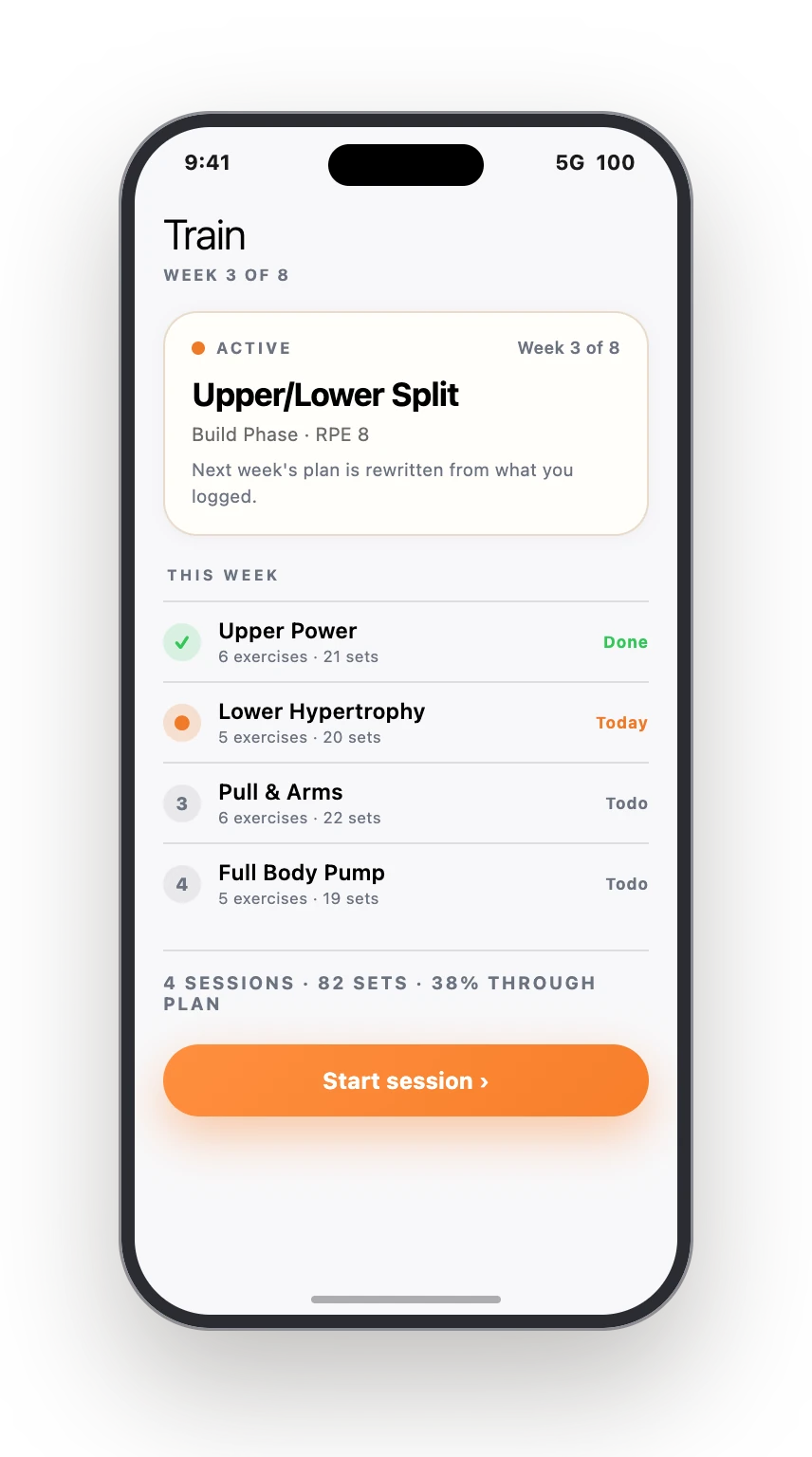
The honest limit: a template cannot see your physique or adjust week to week. It does not know your weak points, your injury history, or how fast you recover, so it stays the same until you change your answers. That is the difference between a solid starting point and a plan that adapts to you. The AI physique rating reads your body from photos and builds around what you actually need, then adapts as you log workouts.
The generator, explained.
- How does the workout plan generator work?
- It is a rule-based generator, not AI. You answer four questions, goal, experience, equipment, and days per week, and it applies proven programming rules to build your plan. The number of training days sets your split, your experience sets how many sets and exercises you do, and your goal sets the rep ranges. Your equipment then decides which exercise fills each slot.
- Is it really free with no signup?
- Yes. The generator runs entirely in your browser, so there is nothing to install, no account to create, and no email required. You can generate as many plans as you like and change your answers as often as you want.
- How does this compare to a plan built by a coach?
- A template is a solid starting point built on the same principles a coach would use, but it cannot see your body, your injury history, or how you recover week to week. A good coach adjusts your volume and exercise choice based on your progress. This tool gives you a well-structured plan to begin with, and it stays the same until you change your answers.
- When should I change the plan?
- Run the same plan for at least four to six weeks so you can progress the weights before judging it. Change it when you stop adding reps or weight for two or three sessions in a row, when your available equipment or schedule changes, or when your goal shifts. Follow the progression note on your plan to keep adding load in the meantime.
- What does the AI version add?
- The physique analysis reads your body fat and muscle development from five photos, finds your weak points, and builds a plan around what you actually need to bring up. From there it adapts as you log workouts, which a fixed template cannot do. The generator here is the free, rule-based starting point, and the AI physique rating is the personalized next step.
Get a plan built from your physique.
A template is a good start. The physique rater reads your body fat and weak points from photos and builds a plan around what you actually need.
Rate my physique