TrainingJun 30, 20269 min read
Lire en français·Auf Deutsch lesen·Leer en español·Przeczytaj po polsku
How to Start Working Out: A Beginner's Guide to Your First 12 Weeks
A simple, evidence-based plan for your first three months of training. What to do, how much, and why consistency beats intensity when you're starting your fitness journey.
Reviewed by the HyperBody team

Starting a fitness routine is equal parts exciting and overwhelming. There's an ocean of conflicting advice out there, and most of it assumes you already know what a superset is or how to program a mesocycle. You don't need any of that yet. What you need is a plan simple enough to actually follow, built on what the research says works.
This guide walks you through your first 12 weeks: how much to train, what to do each session, and what to expect from your body along the way. No fads, no gimmicks. Just the fundamentals that turn a nervous beginner into someone who trains with confidence.
How Much Should a Beginner Actually Do?
The official guidelines are clearer than the internet makes them seem. The World Health Organization recommends that adults get 150 to 300 minutes of moderate aerobic activity (or 75 to 150 minutes of vigorous activity) per week, plus muscle-strengthening activity working all the major muscle groups1. The U.S. Physical Activity Guidelines say the same thing and add a specific target: strength-train on two or more days per week2.
Here's the reassuring part: you don't have to hit those numbers on day one. The single most important message from the WHO guidance is that some activity is better than none, and more is better than some1. If you're starting from zero, three short sessions a week is a genuine win, not a compromise.
Your First 12 Weeks, in Three Phases
Think of your first three months as a progression, not a fixed routine. Each phase has a different job.
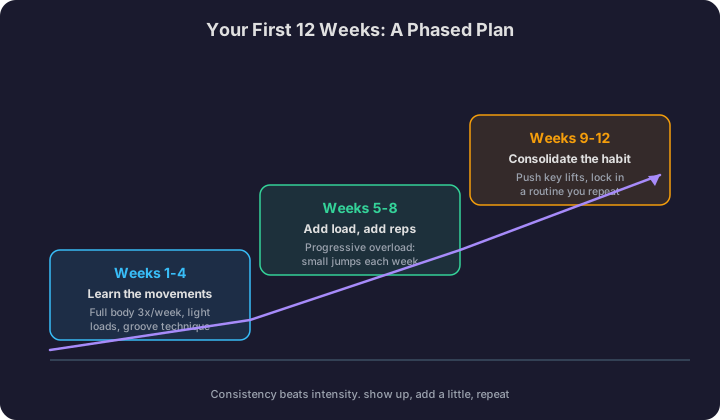
Weeks 1 to 4. Learn the movements. Your goal here isn't to lift heavy, it's to groove the patterns. Train full-body three times a week with light, manageable loads. Focus on control: full range of motion, no momentum, a weight you could do a couple more reps with. If you finish a session feeling like you could have done more, that's correct at this stage.
Weeks 5 to 8. Add load and reps. Now you start applying progressive overload, the principle that separates people who keep improving from people who plateau. The American College of Sports Medicine's position stand on resistance training recommends that novices begin with moderate loads in roughly the 8 to 15 rep range and progress systematically over time3. Small, steady jumps, an extra rep here, a little more weight there, are exactly what you want.
Weeks 9 to 12. Consolidate the habit. By now the movements feel familiar and the loads are meaningful. This phase is about locking in a routine you can repeat indefinitely and pushing your key lifts with confidence.
What to Do Each Session
You do not need a complicated split. For your first few months, one well-chosen exercise per movement pattern, done full-body two to three times a week, is plenty. In fact, when total weekly volume is equated, training a muscle across a simple 2 to 3 day full-body schedule builds just as much muscle as higher-frequency programs4. The minimum effective dose really is effective.
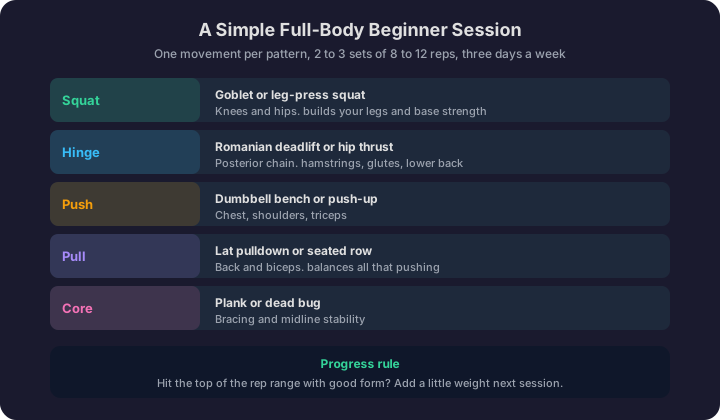
Cover five patterns each session: a squat, a hinge, a push, a pull, and some core, and you've trained your entire body. Do 2 to 3 sets of 8 to 12 reps for each. When you can hit the top of the rep range with clean form, add a little weight next time. That's progressive overload in its simplest form.
If deciding what to do each day still feels like too much, this is exactly where a structured program helps. Our smart coaching builds a beginner-appropriate plan around your body and goals, so you can skip the guesswork and just show up.
What Your Body Is Doing (and Why It Feels Weird)
Two things surprise almost every beginner. Understanding them will keep you from quitting.
"Newbie gains" are real, and they're mostly neural at first. In your first weeks, your strength shoots up fast. Classic research shows those early gains come primarily from neural adaptation, your nervous system getting better at recruiting muscle fibers, rather than from the muscles themselves getting bigger. Visible muscle growth only becomes the dominant driver of strength after roughly three to five weeks of consistent training5. So don't panic if you're getting noticeably stronger without looking different yet. The size follows.
Soreness is normal, and it fades fast. That deep ache 24 to 72 hours after an unfamiliar workout is delayed onset muscle soreness (DOMS), and it's a normal adaptation signal, not an injury. Better still, your muscle adapts quickly: thanks to the "repeated-bout effect," the same workout produces far less soreness the second time around6. The first two weeks are the sorest you'll ever be. It gets easier.
The Habit Is the Whole Game
Here's the uncomfortable truth about your first 12 weeks: the workout you do matters less than whether you keep showing up. Research on habit formation found it takes on average about 66 days, with a wide range from 18 to 254 days, for a new behavior to become automatic7. That means for the first two months, training will feel like something you have to decide to do. Push through that window and it starts to run on autopilot.
This is why we keep hammering consistency over intensity. A modest program you follow for 12 weeks will transform you. A perfect program you abandon in week three will do nothing.
The One Nutrition Rule That Matters Now
You can ignore most nutrition advice for now, but get enough protein. A large meta-analysis found that protein intake supports muscle and strength gains up to a plateau of about 1.6 grams per kilogram of body weight per day8. Beyond that, more doesn't help you build muscle faster. For most beginners, simply making sure every meal has a solid protein source gets you most of the way there.
Putting It All Together
- Train full-body 2 to 3 times a week. Squat, hinge, push, pull, core.
- Start light, then progress. Add a rep or a little weight when the current load feels manageable3.
- Expect fast early strength gains and early soreness. Both are normal and both are temporary56.
- Aim for roughly 1.6 g of protein per kg of bodyweight. Don't overthink the rest yet8.
- Play the long game. The habit takes about two months to stick. Protect your consistency above all else7.
Your first 12 weeks aren't about being impressive. They're about becoming the kind of person who trains. Do that, and everything else, the strength, the physique, the confidence, follows. When you're ready to see how your body is actually changing, a periodic physique analysis turns "I think it's working" into evidence you can track.
References
Footnotes
-
Bull FC, Al-Ansari SS, Biddle S, et al. (2020). World Health Organization 2020 guidelines on physical activity and sedentary behaviour. British Journal of Sports Medicine, 54(24), 1451-1462. https://doi.org/10.1136/bjsports-2020-102955
-
Piercy KL, Troiano RP, Ballard RM, et al. (2018). The Physical Activity Guidelines for Americans. JAMA, 320(19), 2020-2028. https://doi.org/10.1001/jama.2018.14854
-
American College of Sports Medicine (2009). Progression models in resistance training for healthy adults (Position Stand). Medicine & Science in Sports & Exercise, 41(3), 687-708. https://doi.org/10.1249/MSS.0b013e3181915670
-
Schoenfeld BJ, Grgic J, Krieger J (2019). How many times per week should a muscle be trained to maximize muscle hypertrophy? A systematic review and meta-analysis. Journal of Sports Sciences, 37(11), 1286-1295. https://doi.org/10.1080/02640414.2018.1555906
-
Moritani T, deVries HA (1979). Neural factors versus hypertrophy in the time course of muscle strength gain. American Journal of Physical Medicine, 58(3), 115-130. https://pubmed.ncbi.nlm.nih.gov/453338/
-
Hyldahl RD, Chen TC, Nosaka K (2017). Mechanisms and mediators of the skeletal muscle repeated bout effect. Exercise and Sport Sciences Reviews, 45(1), 24-33. https://doi.org/10.1249/JES.0000000000000095
-
Lally P, van Jaarsveld CHM, Potts HWW, Wardle J (2010). How are habits formed: Modelling habit formation in the real world. European Journal of Social Psychology, 40(6), 998-1009. https://doi.org/10.1002/ejsp.674
-
Morton RW, Murphy KT, McKellar SR, et al. (2018). A systematic review, meta-analysis and meta-regression of the effect of protein supplementation on resistance training-induced gains in muscle mass and strength in healthy adults. British Journal of Sports Medicine, 52(6), 376-384. https://doi.org/10.1136/bjsports-2017-097608
More field notes.

Cardio vs Weights for Fat Loss: What the Science Actually Says
Should you run to lose fat, or lift? The honest answer is that they do different jobs, and the thing that actually drives fat loss isn't either one. Here's how to combine them the right way.

Zone 2 Cardio: What It Is and Why It's Worth Your Time
Zone 2 is everywhere right now, and for once the hype is backed by real physiology. Here's what it actually means, how to find your zone, and why easy cardio might be the most underrated training you can do.

Exercise and Mental Health: How Training Changes Your Brain
The physical benefits of training get all the attention, but the mental ones may matter more. Here's the evidence for how exercise fights depression and anxiety, and literally reshapes your brain.
More on HyperBody