CoachingJul 23, 202611 min read
Lire en français·Auf Deutsch lesen·Leer en español·Przeczytaj po polsku
How to Coach Yourself: Building Your Own Training Program
You don't need to pay for a plan you could build yourself. Here's the exact framework a coach uses to write a program, broken into five decisions you can make today.
Reviewed by the HyperBody team

A good coach isn't a magician. Behind every effective training program is a set of principles you can learn and apply yourself. If you understand what a coach is actually deciding when they write your plan, you can build a program that rivals a paid one, and adjust it intelligently as you go.
This isn't about winging it. Self-coaching done right means applying the same evidence-based framework a professional uses, just without the middleman. Here are the five decisions that make up a complete program.
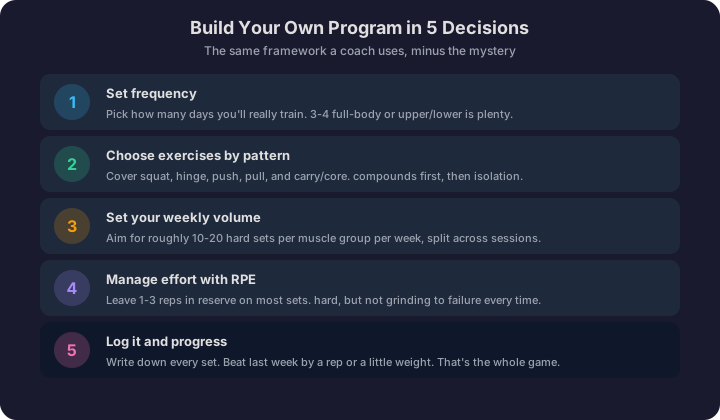
Decision 1: How Often You'll Train
Start with the honest question: how many days a week will you actually show up? Three or four is plenty for most people. The key insight from the research is flexibility. When weekly volume is equated, training a muscle roughly twice a week is at least as effective as once, and often more convenient to organize1. That gives you options:
- 3 days: full-body each session
- 4 days: upper/lower split, twice through
- 5-6 days: a push/pull/legs style rotation
Don't pick the split that looks hardcore. Pick the one you'll adhere to. Consistency is the input that makes everything else work.
Decision 2: Which Exercises to Include
Build each session around movement patterns, not muscles. Cover the five basics: squat, hinge, push, pull, and carry/core, and you've trained your whole body with no gaps. Lead with compound lifts (squats, deadlifts, presses, rows) because they train the most muscle per exercise, then add isolation work for weak points or specific goals.
You have real freedom in load selection here. Muscle growth is similar across a wide range of loads, from lighter weights for higher reps to heavy weights for lower reps, as long as your sets are taken close to failure2. Maximal strength is the exception: if getting stronger is your priority, you'll want to spend more time with heavier loads2. Pick loads that match your goal, not dogma.
Decision 3: How Much Volume to Do
Volume, your total hard sets per muscle per week, is the primary dial for muscle growth. A dose-response meta-analysis found a graded relationship: more weekly sets produce more hypertrophy, with higher volumes (broadly in the range of 10 or more sets per muscle per week) outperforming lower ones3.
A practical starting point is 10 to 20 hard sets per muscle group per week, distributed across your sessions. Beginners can start at the low end and grow into more volume over time. This is one of the most common self-coaching mistakes: people obsess over exercise selection while doing far too little total work. Count your sets.
Decision 4: How Hard to Push Each Set
You need a way to gauge and control effort without a coach yelling "one more." The tool professionals use is reps in reserve (RIR): how many reps you could still do at the end of a set. A validated RIR-based RPE scale lets you autoregulate load set to set, aiming for a target effort like 1 to 3 reps in reserve on most working sets4.
This solves two problems at once. It keeps your sets hard enough to drive growth, and it stops you from grinding to absolute failure on everything, which just digs a fatigue hole. On a good day you'll add weight; on a rough day you'll back off, all while hitting the same target effort.
Decision 5: How to Progress and Recover
A program isn't a static workout. It's a plan for getting harder over time. This is progressive overload, the non-negotiable principle behind all adaptation5. The ACSM's guidance gives you a concrete rule: when you can exceed your target reps by a rep or two for two sessions in a row, increase the load by roughly 2 to 10%5. Log every set, and beat last week by a rep or a little weight. That single habit is most of the game.
Two more pieces complete the picture:
Structure beats randomness. Having an organized, periodized plan produces modestly greater strength gains than training without structure6. You don't need elaborate periodization; you just need a plan you follow and adjust, rather than random workouts.
Plan your recovery. Fatigue accumulates. Periodic deloads, planned weeks where you deliberately reduce training stress, are a recognized way to manage that fatigue and sustain long-term progress7. Every 4 to 8 weeks, or whenever performance stalls and everything feels heavy, take a lighter week.
The Self-Coaching Loop
Put together, self-coaching is a repeatable loop:
- Train your planned sessions with appropriate effort (1 to 3 RIR)4.
- Log every set. Weight, reps, how it felt8.
- Progress by beating your logbook when you can5.
- Deload when fatigue builds up7.
- Adjust volume and exercises every several weeks based on what your log shows.
The reason logging matters so much isn't bookkeeping. Self-monitoring is one of the few behavior-change techniques with strong evidence for improving adherence and outcomes8. Your training log is both your data and your accountability.
When to Bring in Help
Self-coaching is genuinely effective, but it isn't always the right call. If you're preparing for a competition, working around an injury, or you know you need external accountability to stay consistent, structured coaching earns its cost. The honest framing is that the principles here are the same ones any coach uses. What you're deciding is whether you want to run them yourself.
If you'd rather have those decisions made and adjusted for you automatically, HyperBody's smart coaching applies this exact framework, volume, frequency, autoregulated progression, and deloads, built around your body and updated as you progress. Either way, now you know what's under the hood.
References
Footnotes
-
Schoenfeld BJ, Grgic J, Krieger J (2019). How many times per week should a muscle be trained to maximize muscle hypertrophy? A systematic review and meta-analysis. Journal of Sports Sciences, 37(11), 1286-1295. https://doi.org/10.1080/02640414.2018.1555906
-
Schoenfeld BJ, Grgic J, Ogborn D, Krieger JW (2017). Strength and hypertrophy adaptations between low- vs. high-load resistance training: a systematic review and meta-analysis. Journal of Strength and Conditioning Research, 31(12), 3508-3523. https://doi.org/10.1519/JSC.0000000000002200
-
Schoenfeld BJ, Ogborn D, Krieger JW (2017). Dose-response relationship between weekly resistance training volume and increases in muscle mass: a systematic review and meta-analysis. Journal of Sports Sciences, 35(11), 1073-1082. https://doi.org/10.1080/02640414.2016.1210197
-
Helms ER, Cronin J, Storey A, Zourdos MC (2016). Application of the repetitions in reserve-based rating of perceived exertion scale for resistance training. Strength and Conditioning Journal, 38(4), 42-49. https://doi.org/10.1519/SSC.0000000000000218
-
Ratamess NA, Alvar BA, Evetoch TK, et al. (2009). American College of Sports Medicine position stand. Progression models in resistance training for healthy adults. Medicine & Science in Sports & Exercise, 41(3), 687-708. https://doi.org/10.1249/MSS.0b013e3181915670
-
Williams TD, Tolusso DV, Fedewa MV, Esco MR (2017). Comparison of periodized and non-periodized resistance training on maximal strength: a meta-analysis. Sports Medicine, 47(10), 2083-2100. https://doi.org/10.1007/s40279-017-0734-y
-
Bell L, Darragh IAJ, Travis SK, Rogerson D, Nolan D (2025). A practical approach to deloading: recommendations and considerations for strength and physique sports. Strength and Conditioning Journal. Advance online publication. https://doi.org/10.1519/SSC.0000000000000910
-
Michie S, Abraham C, Whittington C, McAteer J, Gupta S (2009). Effective techniques in healthy eating and physical activity interventions: a meta-regression. Health Psychology, 28(6), 690-701. https://doi.org/10.1037/a0016136
More field notes.

Periodization: How to Structure Your Training Over Months
Random workouts get random results. Periodization is how coaches plan training across weeks and months to keep progress coming. Here's what it means, and how to apply it without overcomplicating things.

Double Progression: The Simplest Way to Progress Your Lifts
Progressive overload is the rule that builds muscle, but 'add weight every session' falls apart fast. Double progression is the beginner-friendly method that makes steady progress almost automatic.

How to Set Fitness Goals That Actually Stick
Most fitness goals are abandoned by February. The problem usually isn't willpower, it's how the goal was built. Here's the evidence-based way to set goals you'll actually follow through on.
More on HyperBody