CoachingSep 3, 202611 min read
Lire en français·Auf Deutsch lesen·Leer en español·Przeczytaj po polsku
Periodization: How to Structure Your Training Over Months
Random workouts get random results. Periodization is how coaches plan training across weeks and months to keep progress coming. Here's what it means, and how to apply it without overcomplicating things.
Reviewed by the HyperBody team

Most people train in the present tense: they show up, do a workout, go home, and repeat. It works for a while. Then progress stalls, and they can't figure out why. The missing ingredient is usually a plan that spans more than a single session. That's what periodization is: organizing your training across weeks and months so that it keeps driving adaptation instead of spinning in place.
It sounds like a topic reserved for elite athletes, but the core idea is simple and useful for anyone. Here's how it works.
Why Structure Beats Randomness
Let's establish the payoff first. When researchers compared periodized training programs against non-periodized ones, the periodized approach produced significantly greater gains in maximal strength1. Having an organized plan that deliberately varies over time simply works better than doing more-or-less the same thing forever, or changing things at random.
The reason is that your body adapts to a given stimulus and then stops responding to it. Progress requires that the challenge keep evolving in a structured way, and that you periodically back off to let fatigue clear. Periodization is just the framework for doing that on purpose.
The Building Blocks: Macro, Meso, Micro
Periodization organizes training into nested time blocks. Once you see the structure, it's intuitive23.
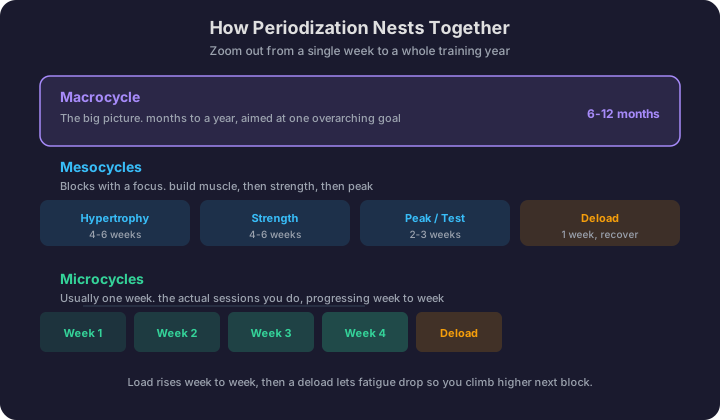
- The macrocycle is the big picture: your overarching goal across many months, up to a year. "Build noticeably more muscle this year," for example.
- Mesocycles are blocks of several weeks, each with a specific focus. You might spend 4 to 6 weeks emphasizing muscle growth, then a block emphasizing strength, then a peak or test phase. Each block builds on the last.
- Microcycles are usually a single week: the actual sessions you perform, progressing from one week to the next.
The whole thing has a theoretical backbone: periodization is grounded in the idea of applying stress and then recovering from it, deliberately alternating challenge and adaptation, so you drive progress without tipping into chronic overreaching2.
You Don't Need the "Perfect" Model
Here's where a lot of people get stuck: agonizing over which periodization model is best. Linear (gradually increasing intensity over a block)? Undulating (varying intensity and volume day to day)? The honest, evidence-based answer is that it matters far less than the internet suggests.
When total training volume is equated, linear and daily-undulating periodization produce essentially equivalent muscle growth4. There's also a well-argued case that the evidence for any single "optimal" model is weaker than tradition implies, and that flexible application suited to the individual beats dogmatic adherence to a template3. In other words: pick a sensible structure and execute it. Don't paralyze yourself choosing between models that perform about the same.
What Actually Drives It: Progressive Overload
Underneath every periodization scheme is one engine: progressive overload, the systematic increase in training demand over time. Periodization is simply how you organize that overload intelligently5.
And overload is flexible. Research shows you can drive it by adding load or by adding repetitions. Both effectively build muscle6. So progressing doesn't always mean heavier weight; doing more reps with the same weight is progression too. This gives you multiple levers to pull as you move through a training block.
Building In Recovery: The Deload
A crucial and often-skipped part of periodization is planned recovery. As you push through a mesocycle, fatigue accumulates. Left unchecked, it eventually blunts your progress. The solution is a deload: a planned week of reduced training stress, lighter loads, less volume, or fewer sessions, to let that fatigue dissipate and restore your readiness7.
Deloads are commonly programmed roughly every 4 to 8 weeks, or applied reactively when performance and motivation start to sag7. Far from being lost time, a well-placed deload is what lets you come back and climb higher in the next block.
A Simple Way to Apply It
You don't need a spreadsheet from a sports lab. Here's periodization stripped to its essentials:
- Set a months-long goal (your macrocycle). E.g. build muscle over the next six months.
- Break it into focused blocks of 4 to 6 weeks (mesocycles), perhaps alternating a higher-volume "growth" block with a heavier "strength" block.
- Progress week to week within each block using progressive overload. Add a little load or a rep where you can56.
- Deload every 4 to 8 weeks to clear fatigue, then start the next block a little stronger7.
- Consider autoregulating effort with RPE so daily loads flex to how you feel: this keeps a structured plan responsive to real life8.
The Bottom Line
- Periodized training beats unstructured training for building strength1.
- Organize it into macro, meso, and microcycles: a long-term goal, focused blocks, and weekly progression23.
- Don't obsess over the model. linear and undulating work about equally when volume matches4.
- Progressive overload is the engine, and you can drive it with load or reps56.
- Plan deloads every 4-8 weeks so fatigue never derails you7.
Periodization is really just planning ahead: deciding where you want to be in a few months and structuring your training so you actually get there. You don't have to make it complicated to make it work. If you'd rather have the blocks, progression, and deloads planned and adjusted automatically, smart coaching handles the periodization for you and adapts it as you progress.
References
Footnotes
-
Williams TD, Tolusso DV, Fedewa MV, Esco MR (2017). Comparison of periodized and non-periodized resistance training on maximal strength: a meta-analysis. Sports Medicine, 47(10), 2083-2100. https://doi.org/10.1007/s40279-017-0734-y
-
Cunanan AJ, DeWeese BH, Wagle JP, et al. (2018). The general adaptation syndrome: a foundation for the concept of periodization. Sports Medicine, 48(4), 787-797. https://doi.org/10.1007/s40279-017-0855-3
-
Kiely J (2012). Periodization paradigms in the 21st century: evidence-led or tradition-driven? International Journal of Sports Physiology and Performance, 7(3), 242-250. https://doi.org/10.1123/ijspp.7.3.242
-
Grgic J, Mikulic P, Podnar H, Pedisic Z (2017). Effects of linear and daily undulating periodized resistance training programs on measures of muscle hypertrophy: a systematic review and meta-analysis. PeerJ, 5, e3695. https://doi.org/10.7717/peerj.3695
-
American College of Sports Medicine (2009). Progression models in resistance training for healthy adults (position stand). Medicine & Science in Sports & Exercise, 41(3), 687-708. https://doi.org/10.1249/MSS.0b013e3181915670
-
Plotkin D, Coleman M, Van Every D, et al. (2022). Progressive overload without progressing load? The effects of load or repetition progression on muscular adaptations. PeerJ, 10, e14142. https://doi.org/10.7717/peerj.14142
-
Bell L, Darragh IAJ, Travis SK, Rogerson D, Nolan D (2025). A practical approach to deloading: recommendations and considerations for strength and physique sports. Strength and Conditioning Journal. Advance online publication. https://doi.org/10.1519/SSC.0000000000000910
-
Larsen S, Kristiansen E, van den Tillaar R (2021). Effects of subjective and objective autoregulation methods for intensity and volume on enhancing maximal strength during resistance-training interventions: a systematic review. PeerJ, 9, e10663. https://doi.org/10.7717/peerj.10663
More field notes.

How to Coach Yourself: Building Your Own Training Program
You don't need to pay for a plan you could build yourself. Here's the exact framework a coach uses to write a program, broken into five decisions you can make today.

Double Progression: The Simplest Way to Progress Your Lifts
Progressive overload is the rule that builds muscle, but 'add weight every session' falls apart fast. Double progression is the beginner-friendly method that makes steady progress almost automatic.

Rep Ranges Explained: Strength vs Hypertrophy vs Endurance
Should you lift heavy for 5 reps or pump out sets of 15? The 'right' rep range depends on your goal, but the truth is more flexible than the old rules suggest. Here's how to choose.
More on HyperBody