CoachingOct 12, 202610 min read
Lire en français·Auf Deutsch lesen·Leer en español·Przeczytaj po polsku
Rep Ranges Explained: Strength vs Hypertrophy vs Endurance
Should you lift heavy for 5 reps or pump out sets of 15? The 'right' rep range depends on your goal, but the truth is more flexible than the old rules suggest. Here's how to choose.
Reviewed by the HyperBody team

"Low reps for strength, medium reps for size, high reps for tone." It's one of the first rules new lifters learn, and it's mostly right, but the reality is both more nuanced and more forgiving than the old chart on the gym wall suggests. Understanding what rep ranges actually do lets you train for your specific goal without being boxed in by myths. Here's the real story.
The Strength-Endurance Continuum
Rep ranges exist on a continuum defined by load. The heavier the weight, the fewer reps you can do, and the different qualities you emphasize. The classic, evidence-based framework, codified in the ACSM's position stand, maps roughly like this1:
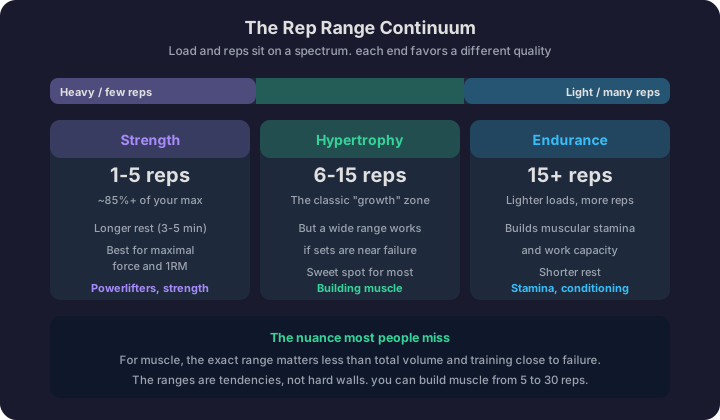
- Strength (1-5 reps, heavy): Loads around 85%+ of your one-rep max. Best for building maximal force.
- Hypertrophy (6-15 reps, moderate): The traditional "muscle-building" zone.
- Endurance (15+ reps, lighter): Builds muscular stamina and work capacity.
That framework is a useful starting point. But two big findings from modern research reshape how you should use it.
For Muscle Size, The Range Is Wide Open
Here's the finding that surprised a lot of people: for building muscle, the exact rep range matters far less than the old rules imply. A meta-analysis found that hypertrophy is similar across a wide spectrum of loads, from roughly 30% to 85% of your max, as long as sets are taken close to failure2. A controlled trial in well-trained men confirmed it: low-load training (25-35 reps) and high-load training (8-12 reps) produced comparable muscle growth3.
In other words, you can build muscle with anything from about 5 to 30 reps. The "hypertrophy range" of 6-15 is popular mostly because it's practical: heavy enough to be time-efficient, light enough to accumulate volume without brutal fatigue, but it's a preference, not a magic window.
For Strength, Heavy Still Wins
There's one clear exception where load genuinely matters: maximal strength. The same research that found similar muscle growth across rep ranges also found that strength gains favor heavier loads and lower reps23. If your goal is to lift the heaviest possible weight for one rep, as in powerlifting, you need to practice with heavy loads, because strength is partly a skill specific to heavy lifting.
So the "low reps for strength" half of the old rule holds up well. It's the "you must use medium reps for size" half that's been loosened.
For Endurance, Go Lighter and Higher
At the other end, muscular endurance, your muscles' ability to sustain repeated contractions, is best trained with higher reps and lighter loads. A classic study comparing different rep-max training zones found the high-rep group achieved the greatest gains in local muscular endurance4. If your goal is stamina for a sport or activity, higher-rep work is the specific tool.
The Two Things That Matter More Than Rep Range
Once you're chasing muscle rather than pure strength or endurance, two variables outrank your rep range:
1. Total volume. Weekly training volume, your total hard sets per muscle, is a primary driver of hypertrophy, with a graded dose-response, and it works largely independent of the specific rep range you use to accumulate it5. Ten hard sets is ten hard sets whether they're 6s or 15s.
2. Proximity to failure. Training close to failure matters for growth, and it matters especially at lighter loads6. With heavy weights, the reps are hard by nature. With light weights, you have to push near failure to fully stimulate the muscle. This is the catch with high-rep training: a set of 20 that leaves 8 reps in the tank does little, whereas a hard set of 20 grows muscle just fine.
How to Choose Your Rep Range
- Chasing maximal strength? Spend most of your time in the 1-6 rep range with heavy loads13.
- Building muscle (most people)? The 6-15 range is a practical default, but anywhere from ~5 to 30 reps works. Use what feels good and lets you accumulate volume2.
- Training for endurance/stamina? Go lighter with 15+ reps4.
- Whatever you pick, hit your volume and train close to failure, especially on lighter sets56.
- Mix it up. Many good programs use heavier work for the big compounds and higher reps for isolation, giving you strength and a joint-friendly way to rack up volume.
The rep-range rules aren't wrong, they're just softer than they were taught. Load biases the adaptation: heavy for strength, light for endurance, but for building muscle, you have enormous freedom. Pick ranges you enjoy and can progress on, make your sets hard, and get your weekly volume in. A smart coaching plan assigns rep ranges to match your goal automatically, so each lift is working toward the right adaptation.
References
Footnotes
-
American College of Sports Medicine (2009). Progression models in resistance training for healthy adults (position stand). Medicine & Science in Sports & Exercise, 41(3), 687-708. https://doi.org/10.1249/MSS.0b013e3181915670
-
Schoenfeld BJ, Grgic J, Ogborn D, Krieger JW (2017). Strength and hypertrophy adaptations between low- vs. high-load resistance training: a systematic review and meta-analysis. Journal of Strength and Conditioning Research, 31(12), 3508-3523. https://doi.org/10.1519/JSC.0000000000002200
-
Schoenfeld BJ, Peterson MD, Ogborn D, Contreras B, Sonmez GT (2015). Effects of low- vs. high-load resistance training on muscle strength and hypertrophy in well-trained men. Journal of Strength and Conditioning Research, 29(10), 2954-2963. https://doi.org/10.1519/JSC.0000000000000958
-
Campos GE, Luecke TJ, Wendeln HK, et al. (2002). Muscular adaptations in response to three different resistance-training regimens: specificity of repetition maximum training zones. European Journal of Applied Physiology, 88(1-2), 50-60. https://doi.org/10.1007/s00421-002-0681-6
-
Schoenfeld BJ, Ogborn D, Krieger JW (2017). Dose-response relationship between weekly resistance training volume and increases in muscle mass: a systematic review and meta-analysis. Journal of Sports Sciences, 35(11), 1073-1082. https://doi.org/10.1080/02640414.2016.1210197
-
Refalo MC, Helms ER, Trexler ET, Hamilton DL, Fyfe JJ (2023). Influence of resistance training proximity-to-failure on skeletal muscle hypertrophy: a systematic review with meta-analysis. Sports Medicine, 53(3), 649-665. https://doi.org/10.1007/s40279-022-01784-y
More field notes.

Double Progression: The Simplest Way to Progress Your Lifts
Progressive overload is the rule that builds muscle, but 'add weight every session' falls apart fast. Double progression is the beginner-friendly method that makes steady progress almost automatic.
Inside the HyperBody App: Your AI Physique Coach on iPhone
A guided tour of the HyperBody iPhone app: an AI physique scan with muscle-by-muscle scores, an adaptive training plan, rep-by-rep video form checks, recipes with real macros, Apple Watch support, and what is coming next on Android.

Online Fitness Coaching: Does Remote Coaching Actually Work?
Can a coach who isn't in the room really get you results? Here's what the research says about online coaching, in-person supervision, and why accountability matters more than location.
More on HyperBody