CoachingSep 28, 202610 min read
Lire en français·Auf Deutsch lesen·Leer en español·Przeczytaj po polsku
Double Progression: The Simplest Way to Progress Your Lifts
Progressive overload is the rule that builds muscle, but 'add weight every session' falls apart fast. Double progression is the beginner-friendly method that makes steady progress almost automatic.
Reviewed by the HyperBody team

Everyone in fitness agrees on one thing: progressive overload is the engine of progress. You have to systematically ask more of your muscles over time, or they have no reason to change1. The problem is how. "Just add weight every workout" sounds simple, but it collapses within weeks. Jumps of 2.5 kg are huge on a lateral raise, and no beginner adds weight to every lift every session forever.
Double progression solves this. It's a dead-simple method that tells you exactly when to push reps and when to add weight, so progression becomes almost automatic. Here's how it works and why it's so effective.
The Problem With "Just Add Weight"
Progressive overload is non-negotiable, but load isn't the only way to deliver it. This is the key insight that makes double progression work: you can drive overload by adding reps, not just weight. A study directly testing this found that progressing by adding repetitions at a fixed load produced muscle gains comparable to adding load2. Both routes work.
That matters because adding weight is a blunt instrument. The smallest jump you can make is often too big to complete for the same reps, so you stall. Adding a rep, on the other hand, is a small, achievable step you can take almost every session. Double progression uses reps as the fine adjustment and weight as the coarse one.
How Double Progression Works
The method has three parts: a rep range, a rule to add reps, and a rule to add weight.
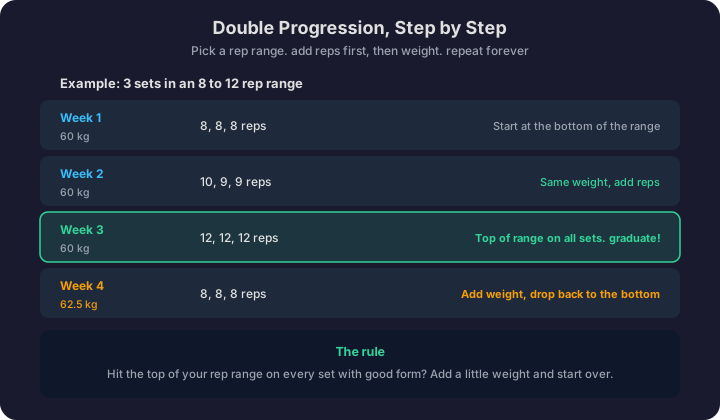
1. Pick a rep range for each exercise. Say 8 to 12 reps for a given lift. (Muscle grows well across a wide range of loads and reps as long as your sets are hard, so you have lots of freedom here3.)
2. Progress reps first. Start at a weight you can do for the bottom of the range (8 reps) across your sets. Each session, try to add reps, staying at that same weight, until you can hit the top of the range (12 reps) on all your sets with good form.
3. Then progress weight. Once you hit 12 reps on every set, add a small amount of weight next session, and you'll naturally drop back toward the bottom of the range (back to ~8 reps). Then you repeat the whole cycle at the new, heavier weight.
That's it. "Double" progression, because you're progressing along two variables in sequence. Reps, then weight, then reps again.
Why It's So Effective
Double progression works because it quietly satisfies every principle that actually drives growth.
- It guarantees progressive overload. You're always either doing more reps or more weight than before. That's overload, by definition12.
- It works within the effective rep range. Since hypertrophy happens across a broad range of reps when effort is high, staying in an 8 to 12 (or 6 to 10, or 10 to 15) window keeps you productive3.
- It accumulates volume. As you add reps week to week, your total training volume climbs, and volume has a clear dose-response with muscle growth4.
- It builds in the right effort. Progress stalls if your sets are too easy. Training reasonably close to failure matters for growth5, and double progression naturally pushes you toward hard sets as you chase the top of your range.
It also removes decision fatigue. You never have to guess whether today is an "add weight" day: the rule decides for you.
Making It Even Smarter: Add RIR
You can sharpen double progression by pairing it with effort awareness. Instead of just counting reps, gauge your reps in reserve (RIR): how many reps you had left in the tank6. A useful refinement: only add weight once you can hit the top of your rep range while still leaving a rep or so in reserve. This ensures you're progressing on genuine strength gains, not just grinding out sloppy reps. RIR also lets you autoregulate. On a bad day you might stall at the same reps, which is fine; the method still moves you forward over time6.
A Worked Example
Say you're doing dumbbell rows for 3 sets in an 8-to-12 range:
- Week 1: 60 kg for 8, 8, 8. (Starting at the bottom.)
- Week 2: 60 kg for 10, 9, 9. (Same weight, more reps.)
- Week 3: 60 kg for 12, 11, 11. (Getting there.)
- Week 4: 60 kg for 12, 12, 12. (Top of range on all sets. Graduate.)
- Week 5: 62.5 kg for 8, 8, 8. (Add weight, reset to the bottom, repeat.)
Slow? It doesn't feel like much week to week. But run that for a year across your main lifts and the numbers, and your physique, change dramatically. Small, consistent overload compounds.
The Bottom Line
- Progressive overload is mandatory, but "add weight every session" doesn't work for long1.
- You can overload by adding reps, not just weight: both build muscle2.
- Double progression: pick a rep range, add reps until you hit the top on all sets, then add weight and reset34.
- Pair it with RIR so you add weight on real strength, not sloppy reps56.
- It removes the guesswork and makes steady progress nearly automatic.
If you've been stalling because you didn't know when to push and when to add weight, double progression is your answer. Pick a range, chase the top of it, and let the method carry you forward. A smart coaching program applies this kind of structured progression to every lift automatically, so you always know your target.
References
Footnotes
-
Ratamess NA, Alvar BA, Evetoch TK, et al. (2009). American College of Sports Medicine position stand. Progression models in resistance training for healthy adults. Medicine & Science in Sports & Exercise, 41(3), 687-708. https://doi.org/10.1249/MSS.0b013e3181915670
-
Plotkin D, Coleman M, Van Every D, et al. (2022). Progressive overload without progressing load? The effects of load or repetition progression on muscular adaptations. PeerJ, 10, e14142. https://doi.org/10.7717/peerj.14142
-
Schoenfeld BJ, Grgic J, Ogborn D, Krieger JW (2017). Strength and hypertrophy adaptations between low- vs. high-load resistance training: a systematic review and meta-analysis. Journal of Strength and Conditioning Research, 31(12), 3508-3523. https://doi.org/10.1519/JSC.0000000000002200
-
Schoenfeld BJ, Ogborn D, Krieger JW (2017). Dose-response relationship between weekly resistance training volume and increases in muscle mass: a systematic review and meta-analysis. Journal of Sports Sciences, 35(11), 1073-1082. https://doi.org/10.1080/02640414.2016.1210197
-
Refalo MC, Helms ER, Trexler ET, Hamilton DL, Fyfe JJ (2023). Influence of resistance training proximity-to-failure on skeletal muscle hypertrophy: a systematic review with meta-analysis. Sports Medicine, 53(3), 649-665. https://doi.org/10.1007/s40279-022-01784-y
-
Helms ER, Cronin J, Storey A, Zourdos MC (2016). Application of the repetitions in reserve-based rating of perceived exertion scale for resistance training. Strength and Conditioning Journal, 38(4), 42-49. https://doi.org/10.1519/SSC.0000000000000218
More field notes.

How to Coach Yourself: Building Your Own Training Program
You don't need to pay for a plan you could build yourself. Here's the exact framework a coach uses to write a program, broken into five decisions you can make today.

Periodization: How to Structure Your Training Over Months
Random workouts get random results. Periodization is how coaches plan training across weeks and months to keep progress coming. Here's what it means, and how to apply it without overcomplicating things.

Online Fitness Coaching: Does Remote Coaching Actually Work?
Can a coach who isn't in the room really get you results? Here's what the research says about online coaching, in-person supervision, and why accountability matters more than location.
More on HyperBody