CoachingAug 3, 202611 min read
Lire en français·Auf Deutsch lesen·Leer en español·Przeczytaj po polsku
How to Set Fitness Goals That Actually Stick
Most fitness goals are abandoned by February. The problem usually isn't willpower, it's how the goal was built. Here's the evidence-based way to set goals you'll actually follow through on.
Reviewed by the HyperBody team

Every January, gyms fill up. By March, they've emptied again. The common explanation is a lack of willpower, but that's mostly wrong. The real issue is that most fitness goals are badly constructed from the start. They're vague, they're all about the outcome, and they have no plan for the days motivation runs dry.
The good news: goal-setting has been studied for decades, and the research points to a clear set of principles that separate goals that stick from goals that fade. Here's how to build one of the former.
Make It Specific and Challenging, Not Vague
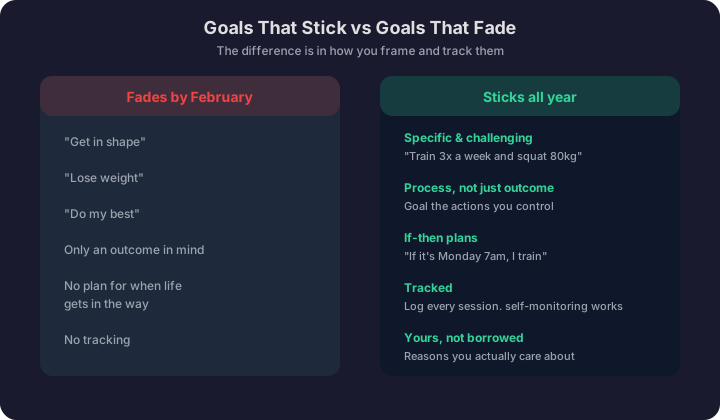
"Get in shape" is not a goal; it's a wish. Decades of goal-setting research show that specific, challenging goals produce meaningfully higher performance than vague "do your best" goals1. Your brain can't organize around "get fit," but it can organize around "train three times a week and squat 80 kg by June."
Adding goal-setting to a physical-activity plan reliably raises activity levels, with a moderate effect across ages, weights, and starting points2. The act of setting a concrete target is itself doing work.
Goal the Process, Not Just the Outcome
This is the single biggest shift most people need to make. An outcome goal ("lose 5 kg") depends on things partly outside your control and gives you nothing to do today. A process goal ("complete three training sessions this week") is entirely within your control and tells you exactly what to do.
Research on goal-setting found that process goals drove far larger performance improvements than outcome goals, and also boosted people's confidence in themselves3. Outcome goals are fine as a direction, but your day-to-day goals should be the actions you can actually execute. Control the process, and the outcome tends to follow.
Plan for the Hard Days With "If-Then"
Motivation is unreliable. What separates people who follow through is having decided in advance what they'll do when life gets in the way. This is the power of implementation intentions: simple "if-then" plans that specify exactly when, where, and how you'll act.
A meta-analysis of 94 studies found that forming if-then plans produced a medium-to-large improvement in actually achieving goals4. "If it's 7 a.m. on a weekday, then I train before work." "If I miss Monday, then I train Tuesday instead." These plans don't just help you start; they help you protect the habit from distractions and get back on track after a slip4.
Track It. Self-Monitoring Is the Engine
If you take one technique from behavior-change science, make it self-monitoring. A meta-regression found that self-monitoring, simply tracking your workouts, steps, or lifts, was the single technique explaining the most variance in whether interventions succeeded5. Pairing it with other self-regulation habits like reviewing your progress raised effectiveness further5.
Your training log isn't bookkeeping. It's the mechanism. What gets measured gets managed, and what gets tracked gets done.
Respect the Habit Timeline
People quit partly because they expect the habit to feel automatic in three weeks and give up when it doesn't. The real number is bigger and more forgiving. Research on habit formation found it takes a median of about 66 days, not the mythical 21, for a new behavior to become automatic, with a wide range depending on the person and behavior6.
Two liberating findings come with that. First, missing a single day does not reset your progress6. Second, habits form faster when you anchor them to a stable existing cue, like "after my morning coffee, I put on my gym clothes"6. Plan for a couple of months of deliberate effort, not a couple of weeks.
Make the Goal Truly Yours
Finally, the motivation underneath the goal matters for whether it lasts. A systematic review grounded in self-determination theory found that autonomous motivation, doing something because you value or enjoy it, consistently predicts sustained physical activity, whereas pressure-based or purely external motivation predicts dropping out7. A related piece: your belief in your own ability to exercise (self-efficacy) is reliably associated with actually being active8.
Practically, this means choosing goals tied to reasons you actually care about, feeling strong, having energy for your kids, managing stress, rather than borrowed goals you think you should want. The goal that survives is the one that's genuinely yours.
Your Goal-Setting Checklist
- Specific and challenging, not "get in shape"1.
- Process goals you control ("3 sessions this week"), with outcomes as direction3.
- If-then plans for the obstacles you can predict4.
- Track everything. self-monitoring is the highest-leverage habit5.
- Expect ~2 months for it to feel automatic, and don't quit over one missed day6.
- Anchor it to reasons you actually care about7.
Willpower isn't the variable that decides whether you succeed. Structure is. Build the goal well, and following through gets dramatically easier. This is exactly what a good coaching system does for you: smart coaching turns a vague ambition into specific, trackable sessions with built-in progression, so the structure that makes goals stick is there by default.
References
Footnotes
-
Locke EA, Latham GP (2002). Building a practically useful theory of goal setting and task motivation: a 35-year odyssey. American Psychologist, 57(9), 705-717. https://doi.org/10.1037/0003-066X.57.9.705
-
McEwan D, Harden SM, Zumbo BD, et al. (2016). The effectiveness of multi-component goal setting interventions for changing physical activity behaviour: a systematic review and meta-analysis. Health Psychology Review, 10(1), 67-88. https://doi.org/10.1080/17437199.2015.1104258
-
Williamson O, Swann C, Bennett KJM, et al. (2022). The performance and psychological effects of goal setting in sport: a systematic review and meta-analysis. International Review of Sport and Exercise Psychology, 17(2), 1-29. https://doi.org/10.1080/1750984X.2022.2116723
-
Gollwitzer PM, Sheeran P (2006). Implementation intentions and goal achievement: a meta-analysis of effects and processes. Advances in Experimental Social Psychology, 38, 69-119. https://doi.org/10.1016/S0065-2601(06)38002-1
-
Michie S, Abraham C, Whittington C, McAteer J, Gupta S (2009). Effective techniques in healthy eating and physical activity interventions: a meta-regression. Health Psychology, 28(6), 690-701. https://doi.org/10.1037/a0016136
-
Lally P, van Jaarsveld CHM, Potts HWW, Wardle J (2010). How are habits formed: modelling habit formation in the real world. European Journal of Social Psychology, 40(6), 998-1009. https://doi.org/10.1002/ejsp.674
-
Teixeira PJ, Carraça EV, Markland D, Silva MN, Ryan RM (2012). Exercise, physical activity, and self-determination theory: a systematic review. International Journal of Behavioral Nutrition and Physical Activity, 9, 78. https://doi.org/10.1186/1479-5868-9-78
-
Xie L, Ma W, Du K, et al. (2025). Association between exercise self-efficacy and physical activity in elderly individuals: a systematic review and meta-analysis. Frontiers in Psychology, 16, 1525277. https://doi.org/10.3389/fpsyg.2025.1525277
More field notes.

RPE and RIR: How to Gauge Training Effort Like a Coach
Percentages of your one-rep max look precise, but they ignore how you feel today. Here's how coaches use RPE and reps-in-reserve to autoregulate effort, and how to use them yourself.

Periodization: How to Structure Your Training Over Months
Random workouts get random results. Periodization is how coaches plan training across weeks and months to keep progress coming. Here's what it means, and how to apply it without overcomplicating things.

Double Progression: The Simplest Way to Progress Your Lifts
Progressive overload is the rule that builds muscle, but 'add weight every session' falls apart fast. Double progression is the beginner-friendly method that makes steady progress almost automatic.
More on HyperBody