CoachingAug 24, 202610 min read
Lire en français·Auf Deutsch lesen·Leer en español·Przeczytaj po polsku
RPE and RIR: How to Gauge Training Effort Like a Coach
Percentages of your one-rep max look precise, but they ignore how you feel today. Here's how coaches use RPE and reps-in-reserve to autoregulate effort, and how to use them yourself.
Reviewed by the HyperBody team

Some days the weight flies up. Some days the same load feels welded to the floor. A training plan built on rigid percentages of your one-rep max ignores that reality, prescribing the exact same weight whether you slept eight hours or three. Coaches solve this with a smarter tool: rating effort by feel, using RPE and reps-in-reserve. Once you understand it, you'll never look at a set the same way.
What RPE and RIR Actually Mean
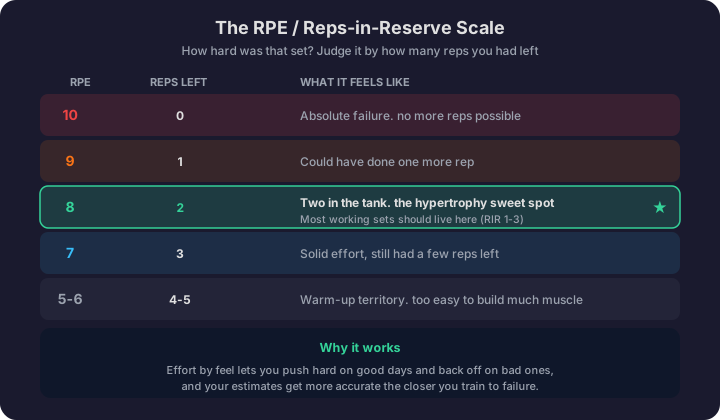
RIR stands for reps in reserve. How many more reps you could have done at the end of a set before hitting failure. RPE (rating of perceived exertion), in its modern resistance-training form, is simply the flip side: a 0 to 10 scale anchored to RIR1.
The mapping is intuitive:
- RPE 10 = 0 reps in reserve: true failure, nothing left.
- RPE 9 = 1 rep in reserve.
- RPE 8 = 2 reps in reserve.
- RPE 7 = 3 reps in reserve.
So "3 sets at RPE 8" means three sets where you stop with about two good reps still in the tank. Simple, and far more responsive to your body than a fixed number.
Why Effort by Feel Beats Rigid Percentages
The genius of this system is autoregulation: because the target is anchored to reps in reserve rather than a fixed percentage, the actual weight automatically adjusts to your daily capacity1. On a strong day, RPE 8 might mean more weight than usual; on a rough day, less. Either way, you're applying the right effort.
And this isn't just intuitive, it's validated. Research shows RPE and RIR ratings are a genuine marker of intensity: they rise predictably as you get closer to your one-rep max and as your bar speed slows within a set2. Systematic reviews confirm the practical payoff. Autoregulating intensity using RPE/RIR produces strength gains at least as good as fixed percentage-based programming3, and a meta-analysis of trained lifters found autoregulated loading matched percentage-based loading for both strength and hypertrophy4.
In short: you give up the illusion of precision that percentages offer, and gain a method that actually accounts for how you show up each day.
You Don't Need to Train to Failure
RPE and RIR also settle one of the most persistent gym debates: do you have to train to failure to grow? The evidence says no.
A meta-analysis found that training closer to failure gave only a small-to-trivial advantage for muscle growth (an effect size of about 0.19). You capture most of the growth stimulus within roughly 0 to 5 reps in reserve5. Another review found no significant difference between training to failure and stopping short for either strength or hypertrophy6. Grinding every set to absolute failure isn't necessary, and it piles on fatigue that can cost you on later sets and sessions.
This is why most coaches park the bulk of your working sets around RPE 7 to 9 (1 to 3 reps in reserve): hard enough to drive growth, controlled enough to recover from and repeat.
The Honest Limitation: Estimates Aren't Perfect
To use RPE well, know its weakness. Your RIR estimate is not perfectly accurate. Research shows lifters tend to underestimate how many reps they actually have left, especially when they're far from failure, with an error margin of a couple of reps7. In practice, that means an "RPE 8" for a beginner might really be an RPE 6.
The reassuring part is that this is a skill that improves. Accuracy gets better with training experience27, and it's naturally sharpest when you're close to failure (it's much easier to feel "1 rep left" than "5 reps left"). Two practical implications:
- Occasionally take a set to true failure (safely, on machines or with a spotter) to calibrate what your RPE 10 actually feels like.
- Expect your gauge to sharpen over months. treat early RPE numbers as approximate and adjust as you learn your body.
How to Start Using RPE Today
- Rate your last set. After each working set, ask: how many more good reps could I have done? That number is your RIR.
- Aim for RPE 7-9 on most working sets. roughly 1 to 3 reps in reserve56.
- Save RPE 10 for rare tests, not everyday training. Failure isn't required and adds fatigue6.
- Let the weight float. use the same RPE target across days and let the load rise and fall with your readiness1.
- Be patient with your accuracy. it's a learnable skill that sharpens with experience7.
RPE and RIR turn training from rigid math into a responsive conversation with your body. It's how good coaches keep effort productive day to day, and it's a skill you can start building on your very next set. Programs like smart coaching use exactly this effort-based approach, prescribing targets that adapt to how you're actually performing rather than a number frozen months ago.
References
Footnotes
-
Helms ER, Cronin J, Storey A, Zourdos MC (2016). Application of the repetitions in reserve-based rating of perceived exertion scale for resistance training. Strength and Conditioning Journal, 38(4), 42-49. https://doi.org/10.1519/SSC.0000000000000218
-
Zourdos MC, Klemp A, Dolan C, et al. (2016). Novel resistance training-specific rating of perceived exertion scale measuring repetitions in reserve. Journal of Strength and Conditioning Research, 30(1), 267-275. https://doi.org/10.1519/JSC.0000000000001049
-
Larsen S, Kristiansen E, van den Tillaar R (2021). Effects of subjective and objective autoregulation methods for intensity and volume on enhancing maximal strength during resistance-training interventions: a systematic review. PeerJ, 9, e10663. https://doi.org/10.7717/peerj.10663
-
Hickmott LM, Chilibeck PD, Shaw KA, Butcher SJ (2022). The effect of load and volume autoregulation on muscular strength and hypertrophy: a systematic review and meta-analysis. Sports Medicine - Open, 8(1), 9. https://doi.org/10.1186/s40798-021-00404-9
-
Refalo MC, Helms ER, Trexler ET, Hamilton DL, Fyfe JJ (2023). Influence of resistance training proximity-to-failure on skeletal muscle hypertrophy: a systematic review with meta-analysis. Sports Medicine, 53(3), 649-665. https://doi.org/10.1007/s40279-022-01784-y
-
Grgic J, Schoenfeld BJ, Orazem J, Sabol F (2022). Effects of resistance training performed to repetition failure or non-failure on muscular strength and hypertrophy: a systematic review and meta-analysis. Journal of Sport and Health Science, 11(2), 202-211. https://doi.org/10.1016/j.jshs.2021.01.007
-
Steele J, Endres A, Fisher J, Gentil P, Giessing J (2017). Ability to predict repetitions to momentary failure is not perfectly accurate, though improves with resistance training experience. PeerJ, 5, e4105. https://doi.org/10.7717/peerj.4105
More field notes.

Double Progression: The Simplest Way to Progress Your Lifts
Progressive overload is the rule that builds muscle, but 'add weight every session' falls apart fast. Double progression is the beginner-friendly method that makes steady progress almost automatic.

Online Fitness Coaching: Does Remote Coaching Actually Work?
Can a coach who isn't in the room really get you results? Here's what the research says about online coaching, in-person supervision, and why accountability matters more than location.

Periodization: How to Structure Your Training Over Months
Random workouts get random results. Periodization is how coaches plan training across weeks and months to keep progress coming. Here's what it means, and how to apply it without overcomplicating things.
More on HyperBody