Home workout tracker
No gym?Your living room is enough.
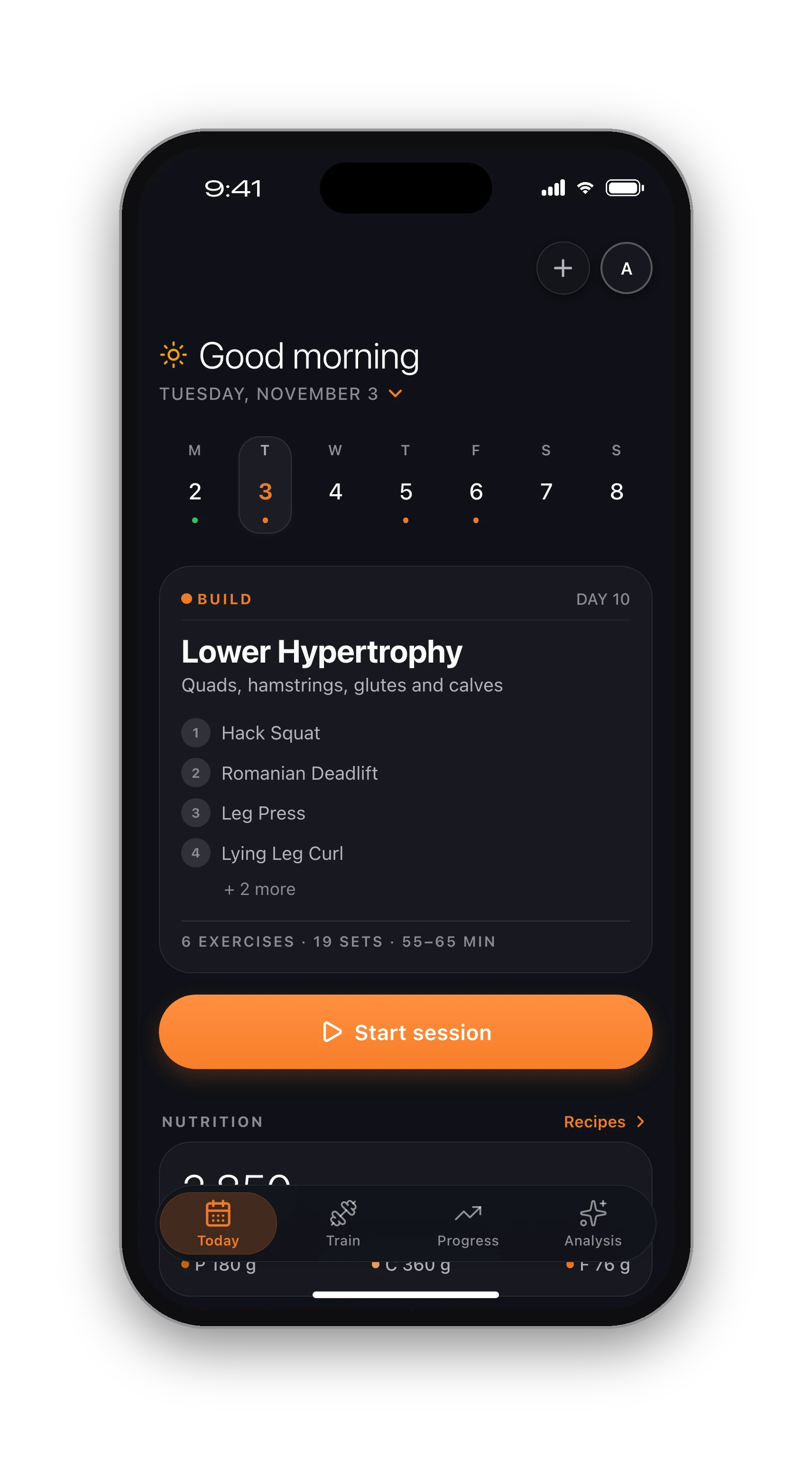
Two free programs built for home, one with just your bodyweight and one with a pair of dumbbells and a bench, and a tracker that logs reps, timed holds and added weight so you can see yourself progress without heavier machines.
Free · iPhone and Android
2
Programs made for home
3 or 4
Days a week
Holds
Timed sets logged
Free
Programs and logging
Two programs made for home.
Pick by what you have, not by what a gym has.
- Bodyweight at Home, 3 days: three full-body sessions, Monday, Wednesday and Friday. Squats, push-ups and their harder variations, pike push-ups for the shoulders, planks and wall sits. One movement, the inverted row, needs a pull-up bar or a sturdy table edge, because the back has no good equipment-free exercise.
- Dumbbell Only, 4 days: upper and lower body twice a week, Monday, Tuesday, Thursday and Friday, with nothing but a pair of dumbbells and a bench. Bench press, rows, shoulder press, goblet squat, Romanian deadlift and split squats. It works just as well in a hotel gym.
Logging bodyweight, done properly.
Gym apps often treat bodyweight work as an afterthought. In HyperBody a push-up logs reps with no weight, a plank or wall sit logs seconds, and a weighted push-up or a backpack squat logs the added weight on top of your body. Each keeps its own records: most reps for bodyweight moves, longest hold for timed ones, heaviest set for dumbbell work.
Tick a timed set and the rest timer starts like after any other set, so your circuit keeps moving without you watching the clock.
Progress without heavier weights.
At home you cannot just add a plate, so you overload in other ways: more reps in the same range, longer holds, slower lowering, or a harder variation of the same movement. The bodyweight program already climbs that ladder: push-up, then decline push-up with your feet on a chair, diamond push-up for triceps, and pike push-up for shoulders.
The last-time line under each exercise shows your reps from last session, so beating it is a matter of one more rep. With dumbbells, once you hit the top of the rep range on every set, move to the next pair. See double progression for the method.
When you are ready for a gym.
Home training builds real muscle, but past a point bodyweight alone gets hard to progress for the legs and back. If you join a gym, Push Pull Legs 3-day or Full Body 3-day are the natural next step, and your history and records come with you. You can also mix: a home program on busy days and a gym session at the weekend, all in one calendar.
From couch to logged.
01
Pick your program
Bodyweight at Home if you have no equipment, Dumbbell Only if you have a pair and a bench.
02
Train in your living room
Each exercise shows how it is done. Log reps, holds or weight and let the rest timer run.
03
Beat last time
Your reps and holds from the last session sit under each exercise. One more is progress.
Know what's free before you sign up.
Free, with no time limit
Log every workout, build your own routines, follow the 8 ready programs, and keep your full history, records and charts. No card needed.
What Pro adds
An AI training plan that adapts to what you lift, full physique reports from photos, form checks inside the app and AI recipes. Trial included.
Straight answers.
Yes, especially as a beginner, as long as sets are taken close to failure and you keep making them harder. Push-ups, squats and rows can build chest, arms and legs. It gets harder over time for the legs and back, which is when dumbbells or a gym help.
For the bodyweight program, only a pull-up bar or a sturdy table edge for inverted rows, and a chair for decline push-ups. For the dumbbell program, a pair of dumbbells and a bench. Adjustable dumbbells save space and money as you get stronger.
Add reps until you reach about 15 to 20 on every set, then move to a harder variation: decline push-ups with feet raised, diamond push-ups, or a slower lowering of three seconds. A backpack with books adds weight, and the app logs it as added weight.
Yes. Every session lives on the same calendar, whatever program or routine it comes from. Build a home routine and a gym routine and put each on the days that suit you; records and history are kept per exercise, wherever you did it.
The workouts are simple; remembering the numbers is not. Knowing you did 14 push-ups and a 45-second plank last Monday is what turns the same routine into progress, and that is what a tracker does for you.
Keep going.
iPhone, Apple Watch and Android.
HyperBody runs on iPhone with an Apple Watch app, and on Android. Your workouts, programs and records follow your account, and the web app shows the same data.


Train at home, see the progress.
Free on iPhone and Android. Two home programs, ready to start.
Start a home program free