TrainingSep 24, 202610 min read
Lire en français·Auf Deutsch lesen·Leer en español·Przeczytaj po polsku
Tempo and Time Under Tension: Does Lifting Speed Matter?
Should you lift slow to maximize 'time under tension,' or explode through your reps? The research on lifting tempo is clearer than the gym debates suggest, and mostly, it tells you to relax.
Reviewed by the HyperBody team

You've probably heard both pieces of advice. "Slow down your reps to maximize time under tension and really feel the muscle work." And, "explode up with power on every rep." They can't both be optimal, so which is right? The research on lifting tempo is refreshingly clear, and the headline is reassuring: within a broad, sensible range, how fast you lift matters far less than you've been led to believe.
Here's what the science actually says about tempo, time under tension, and lifting speed.
A Wide Range of Speeds Builds Muscle Equally
The single most useful finding comes from a meta-analysis on repetition duration. It concluded that muscle growth is similar across a wide range of rep speeds. Roughly 0.5 to 8 seconds per rep1. That's an enormous window. From a controlled, deliberate cadence to a fairly brisk one, hypertrophy comes out about the same.
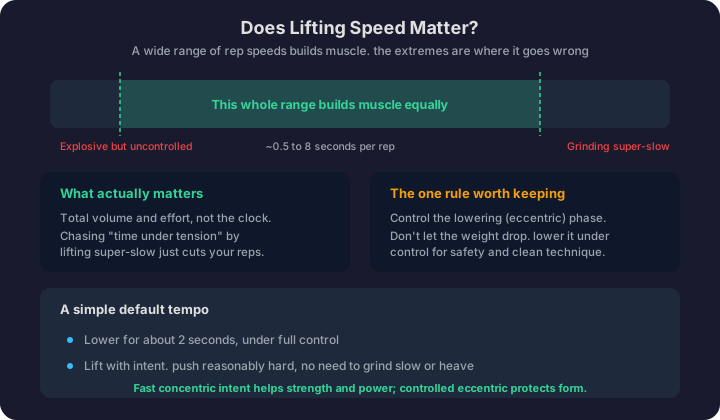
What this means practically: there's no magic tempo you have to nail. If you're lifting with control and reasonable intent, you're already in the effective zone. You can stop overthinking the exact count.
Super-Slow Reps Are Not the Answer
The one clear exception is the extreme slow end. The same meta-analysis found that deliberately very slow reps, taking more than about 10 seconds each, are actually inferior for muscle growth, not superior1. This directly contradicts the "grind it out super slow for maximum tension" advice you'll still hear.
Why do super-slow reps backfire? Because to lift that slowly, you have to use a much lighter weight, and you fatigue before accumulating meaningful work. Which brings us to the real driver of growth.
Time Under Tension Is the Wrong Target
"Time under tension" gets treated as a goal in itself, as if artificially lengthening each set is what builds muscle. It isn't. The actual driver is total training volume and effort. Research shows a clear dose-response between weekly training volume and muscle growth. More hard sets means more muscle, up to a point2.
Here's the trap: when you deliberately slow your reps to inflate time under tension, you're forced to drop the load and you accumulate fewer quality reps. You feel like you're doing something special, but you may be reducing the volume and load that actually grow muscle12. Chasing time under tension for its own sake is optimizing the wrong number.
The Nuance Worth Keeping: Control the Eccentric
So is tempo completely irrelevant? Not quite. There's one principle worth applying, and it's about the lowering (eccentric) phase.
Reviews of movement tempo conclude that neither purely slow nor purely fast lifting is clearly best, but a sensible pairing is a controlled eccentric with a more forceful concentric3. The eccentric phase matters: research shows that eccentric training contributes meaningfully to strength and muscle gains4. And controlling the lowering (rather than letting the weight drop) is what lets you apply that stimulus safely and with clean technique.
There's a bonus safety angle too. Unaccustomed eccentric loading causes muscle damage and soreness, but your body adapts with a protective "repeated-bout effect," so progressing your eccentric load gradually keeps soreness and injury risk in check5. Dropping weights fast and uncontrolled forfeits both the growth stimulus and the safety.
What About Lifting Fast?
On the other end, deliberately fast, explosive intent on the way up has its own benefit, not so much for muscle size, but for strength and power. A network meta-analysis found that training with fast, explosive concentric intent (velocity-based approaches) produced advantages for explosive and maximal strength and for jump and sprint performance6. So if power is your goal, driving the concentric with force is worthwhile.
Your Simple Tempo Guide
Put it all together and the practical advice is almost boringly simple:
- Don't obsess over tempo. any controlled cadence from about 0.5 to 8 seconds per rep builds muscle similarly1.
- Don't lift super-slow. reps over ~10 seconds are worse for growth, not better1.
- Control the lowering phase. roughly a 2-second eccentric, under control, is a great default for stimulus, technique, and safety35.
- Drive the concentric with intent. push reasonably hard on the way up, useful for strength and power6.
- Prioritize volume and effort over the clock. hitting enough hard sets matters far more than any tempo trick2.
The bottom line is liberating: stop counting seconds and start lifting with control and intent. Control the weight down, push it up with purpose, and focus your attention on doing enough hard, quality sets over time. That's what builds muscle, not a stopwatch. A smart coaching plan keeps your focus on the variables that actually move the needle.
References
Footnotes
-
Schoenfeld BJ, Ogborn DI, Krieger JW (2015). Effect of repetition duration during resistance training on muscle hypertrophy: a systematic review and meta-analysis. Sports Medicine, 45(4), 577-585. https://doi.org/10.1007/s40279-015-0304-0
-
Schoenfeld BJ, Ogborn D, Krieger JW (2017). Dose-response relationship between weekly resistance training volume and increases in muscle mass: a systematic review and meta-analysis. Journal of Sports Sciences, 35(11), 1073-1082. https://doi.org/10.1080/02640414.2016.1210197
-
Wilk M, Zajac A, Tufano JJ (2021). The influence of movement tempo during resistance training on muscular strength and hypertrophy responses: a review. Sports Medicine, 51(8), 1629-1650. https://doi.org/10.1007/s40279-021-01465-2
-
Roig M, O'Brien K, Kirk G, et al. (2009). The effects of eccentric versus concentric resistance training on muscle strength and mass in healthy adults: a systematic review with meta-analysis. British Journal of Sports Medicine, 43(8), 556-568. https://doi.org/10.1136/bjsm.2008.051417
-
Hody S, Croisier JL, Bury T, Rogister B, Leprince P (2019). Eccentric muscle contractions: risks and benefits. Frontiers in Physiology, 10, 536. https://doi.org/10.3389/fphys.2019.00536
-
Held S, Speer K, Rappelt L, Wicker P, Donath L (2022). The effectiveness of traditional vs. velocity-based strength training on explosive and maximal strength performance: a network meta-analysis. Frontiers in Physiology, 13, 926972. https://doi.org/10.3389/fphys.2022.926972
More field notes.

Compound vs Isolation Exercises: Which Should You Prioritize?
Should you build your workouts around big lifts like squats and rows, or chase the pump with curls and extensions? The research gives a clear, nuanced answer: use both, in the right order.

How Long Should You Rest Between Sets?
Rushing between sets to 'keep the intensity up' might be quietly costing you muscle and strength. Here's what the research says about rest, and how long you should actually wait.

Free Weights vs Machines: Which Is Better for Muscle?
The barbell purists say machines are a waste of time. The machine crowd says free weights are just risky. The research settles it: for building muscle, they're about equal. What differs is everything else.
More on HyperBody