TrainingSep 10, 202610 min read
Lire en français·Auf Deutsch lesen·Leer en español·Przeczytaj po polsku
Compound vs Isolation Exercises: Which Should You Prioritize?
Should you build your workouts around big lifts like squats and rows, or chase the pump with curls and extensions? The research gives a clear, nuanced answer: use both, in the right order.
Reviewed by the HyperBody team

Every gym has two tribes. One believes compound lifts, squats, deadlifts, presses, rows, are all you need. The other lives for isolation: curls, extensions, raises, and the pump. As usual, the truth isn't a tribe but a toolkit. Both build muscle, they just do slightly different jobs, and the research is refreshingly clear on how to use each.
The Difference, and Why Both Work
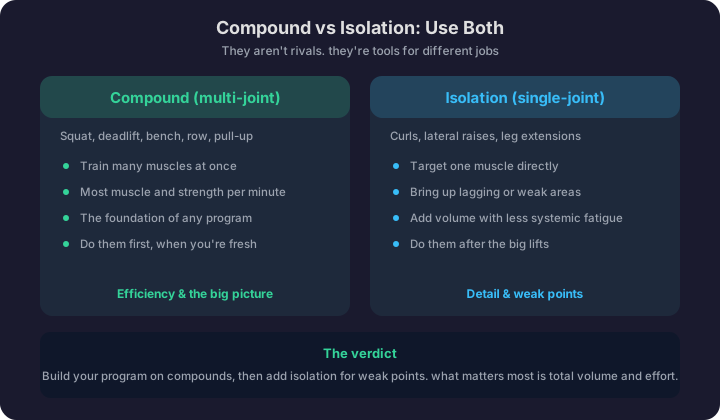
A compound (multi-joint) exercise moves load across two or more joints and trains many muscles at once: a squat, a bench press, a row. An isolation (single-joint) exercise targets essentially one muscle: a biceps curl, a leg extension.
Crucially, both build muscle through the same underlying mechanisms: mechanical tension, metabolic stress, and muscle damage1. There's no magic pathway available to one and not the other. Which means the real question isn't "which builds muscle?" (both do) but "how should I prioritize them?"
Compounds Are More Efficient
The strongest case for compounds is efficiency. Because they train more muscle per exercise, you get more adaptation per unit of time and effort. When researchers matched total load volume and compared multi-joint versus single-joint programs, the multi-joint program produced greater gains in both strength and cardiorespiratory fitness2. More result, same work.
This is why nearly every well-designed program is built on a foundation of compound lifts, performed first in the session when you're freshest. They give you the most bang for your training buck.
Does Isolation Actually Add Anything?
Here's where it gets interesting, because the evidence is genuinely nuanced.
In untrained people, adding isolation work on top of compounds doesn't seem to add much. One study found that adding elbow flexion and extension exercises to a program of bench press and lat pulldown produced no extra gains in arm size or strength versus the compounds alone3. When you're new, the compounds are already driving near-maximal adaptation.
In trained lifters, adding isolation gives a small, non-decisive edge. Both groups grew similarly, with only minor advantages from the extra single-joint work4. So for general development, compounds do most of the heavy lifting.
But and this is the key nuance. When you want to grow a specific muscle, isolation can outperform a compound. In one study, an isolated biceps curl produced roughly 11% elbow-flexor growth versus about 5% from a multi-joint row over eight weeks5. If a muscle is lagging, targeting it directly works better than hoping a big compound covers it.
The Science of Targeting Weak Points
Why can isolation target a muscle better? Because muscle growth is regional. Research shows different parts of the same muscle grow to different degrees, and that regional growth tracks where the muscle was actually worked during training6. Exercise selection, including targeted isolation, lets you bias growth toward a lagging region that your main compounds might under-stimulate.
One important caveat while we're here: don't be fooled by "muscle activation" claims. You'll see exercises marketed as superior because they show higher EMG "activation." But research has shown that acute EMG amplitude is not a validated predictor of long-term hypertrophy7. An exercise lighting up on an activation chart doesn't prove it builds more muscle. Judge exercises by results and sensible mechanics, not activation hype.
The Thing That Matters More Than Either
Step back and there's a bigger lever than the compound-vs-isolation question: total volume and effort. Muscle growth follows a dose-response with weekly training volume. More hard sets generally means more growth8. Whether those sets come from compounds or isolation matters far less than whether you're doing enough of them with enough effort.
So the exercise-category debate is real but secondary. It's about efficiency and targeting, not about whether you'll grow at all.
How to Prioritize: A Simple Framework
- Build the program on compounds. They're the most efficient way to train the most muscle and build overall strength. Do them first2.
- Add isolation for weak points. If a muscle lags (arms, side delts, hamstrings, calves), target it directly, that's where isolation earns its place56.
- Beginners: keep it mostly compound. you'll get almost everything from the big lifts early on3.
- Advanced lifters: use isolation to fine-tune. small, specific advantages add up when you're chasing detail4.
- Above all, hit your volume. enough hard sets per muscle per week matters more than the exact exercise mix8.
The compound-versus-isolation debate has a boring, correct answer: it's not either/or. Anchor your training in compounds for efficiency and strength, then layer in isolation to sculpt the details and bring up what's behind, and make sure, either way, that you're doing enough total work. A smart coaching program balances compounds and targeted isolation around your specific weak points automatically.
References
Footnotes
-
Schoenfeld BJ (2010). The mechanisms of muscle hypertrophy and their application to resistance training. Journal of Strength and Conditioning Research, 24(10), 2857-2872. https://doi.org/10.1519/JSC.0b013e3181e840f3
-
Paoli A, Gentil P, Moro T, Marcolin G, Bianco A (2017). Resistance training with single vs. multi-joint exercises at equal total load volume: effects on body composition, cardiorespiratory fitness, and muscle strength. Frontiers in Physiology, 8, 1105. https://doi.org/10.3389/fphys.2017.01105
-
Gentil P, Soares SRS, Pereira MC, et al. (2013). Effect of adding single-joint exercises to a multi-joint exercise resistance-training program on strength and hypertrophy in untrained subjects. Applied Physiology, Nutrition, and Metabolism, 38(3), 341-344. https://doi.org/10.1139/apnm-2012-0176
-
de França HS, Branco PAN, Guedes Junior DP, Gentil P, Steele J, Teixeira CVLS (2015). The effects of adding single-joint exercises to a multi-joint exercise resistance training program on upper body muscle strength and size in trained men. Applied Physiology, Nutrition, and Metabolism, 40(8), 822-826. https://doi.org/10.1139/apnm-2015-0109
-
Mannarino P, Matta T, Lima J, Simão R, Freitas de Salles B (2021). Single-joint exercise results in higher hypertrophy of elbow flexors than multijoint exercise. Journal of Strength and Conditioning Research, 35(10), 2677-2681. https://doi.org/10.1519/JSC.0000000000003234
-
Wakahara T, Miyamoto N, Sugisaki N, et al. (2012). Association between regional differences in muscle activation in one session of resistance exercise and in muscle hypertrophy after resistance training. European Journal of Applied Physiology, 112(4), 1569-1576. https://doi.org/10.1007/s00421-011-2121-y
-
Vigotsky AD, Halperin I, Trajano GS, Vieira TM (2022). Longing for a longitudinal proxy: acutely measured surface EMG amplitude is not a validated predictor of muscle hypertrophy. Sports Medicine, 52(2), 193-199. https://doi.org/10.1007/s40279-021-01619-2
-
Schoenfeld BJ, Ogborn D, Krieger JW (2017). Dose-response relationship between weekly resistance training volume and increases in muscle mass: a systematic review and meta-analysis. Journal of Sports Sciences, 35(11), 1073-1082. https://doi.org/10.1080/02640414.2016.1210197
More field notes.

The Mind-Muscle Connection: Science or Bro Science?
Bodybuilders swear by it, skeptics dismiss it. Here's what the research actually says about the mind-muscle connection and how to use it effectively.

How to Start Working Out: A Beginner's Guide to Your First 12 Weeks
A simple, evidence-based plan for your first three months of training. What to do, how much, and why consistency beats intensity when you're starting your fitness journey.

Cardio vs Weights for Fat Loss: What the Science Actually Says
Should you run to lose fat, or lift? The honest answer is that they do different jobs, and the thing that actually drives fat loss isn't either one. Here's how to combine them the right way.
More on HyperBody