TrainingSep 21, 202610 min read
Lire en français·Auf Deutsch lesen·Leer en español·Przeczytaj po polsku
Free Weights vs Machines: Which Is Better for Muscle?
The barbell purists say machines are a waste of time. The machine crowd says free weights are just risky. The research settles it: for building muscle, they're about equal. What differs is everything else.
Reviewed by the HyperBody team

It's one of the oldest arguments in the gym. On one side, the free-weight loyalists who believe barbells and dumbbells are the only "real" training. On the other, people who prefer the guided path of machines. Each camp is sure the other is wasting effort. The research has a clear, slightly anticlimactic answer: for building muscle, free weights and machines are roughly equal. The interesting differences are in everything around that.
For Muscle Growth, It's a Tie
Let's settle the main question first. When training is matched for effort and volume, free weights and machines produce statistically similar muscle growth. A systematic review and meta-analysis of 13 studies found no significant difference in hypertrophy or overall maximal strength between the two1. A direct 8-week randomized trial backed this up: biceps and quadriceps thickness and strength increased equally whether people trained with free weights or machines2.
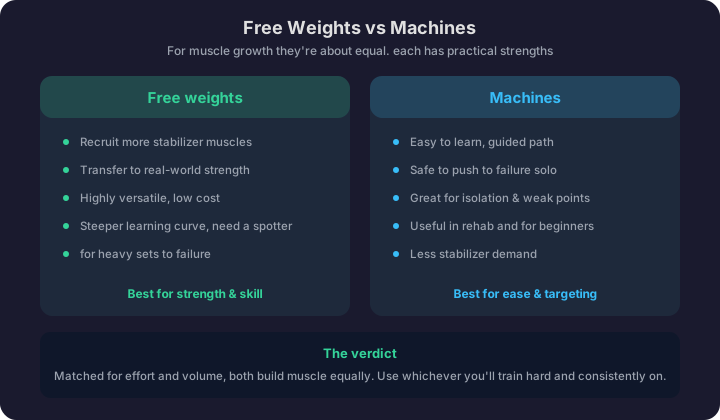
The reason is the one that keeps coming up in training science: the stimulus matters more than the tool. Muscle growth scales with your weekly training volume and effort3. A hard set is a hard set. Your muscles don't know whether the resistance came from a barbell or a cable stack; they respond to tension and effort. So if someone tells you machines "don't build real muscle," the evidence simply doesn't support it.
Where Free Weights Have an Edge
That said, free weights do have genuine advantages. They're just not about raw muscle growth.
More stabilizer recruitment. Because free weights aren't on a fixed track, you have to control them in all directions. A study comparing free-weight and Smith machine squats found the free-weight version produced about 43% higher overall lower-body muscle activation, with notably more work from stabilizing muscles4.
Better transfer to real-world strength. Strength adaptations are specific to how you train. The meta-analysis found free-weight training transferred better to free-weight and functional tasks, while machine training transferred better to machine tests1. If your goal is strength you can use in sport or daily life, free weights have the specificity edge.
One important caveat, though: don't overrate that higher "activation" number. Research has shown that acute EMG activation is not a validated predictor of long-term muscle growth5. So the free-weight activation advantage is real for stabilizer recruitment and skill, but it does not automatically mean more muscle: it just means more coordination demand.
Where Machines Shine
Machines have their own real strengths, and dismissing them is a mistake.
They're easier to learn and use. The guided path lets you focus on pushing hard without mastering a complex movement pattern first. This makes them an excellent on-ramp for beginners. In fact, a trial in novice lifters found machines and free weights produced equal strength gains over 10 weeks, with strength transferring in both directions. Machines are a perfectly legitimate place to start6.
They let you train hard, safely, on your own. This one is practical rather than from a controlled trial, but it's widely accepted: on a machine you can push a set close to failure without a spotter and without the risk of being pinned under a barbell. That makes machines especially useful for training isolation movements to failure, for solo lifters, and in rehab settings where controlled, guided movement is safer.
They're great for targeting. Machines make it easy to isolate a specific muscle and add volume with less systemic fatigue, handy for bringing up weak points after your main compound work.
So Which Should You Use?
Since neither is superior for muscle growth, the honest recommendation is to choose based on you: your goals, your experience, and, above all, what you'll actually train hard and consistently on16.
- Want general muscle and strength? Either works. Most good programs use both.
- Training for sport or functional strength? Lean toward free weights for their specific transfer1.
- New to lifting, or coming back from injury? Machines are a safe, effective starting point6.
- Training alone and want to push isolation to failure? Machines let you do that safely.
- Chasing a lagging muscle? Machines make targeted, low-fatigue volume easy.
The best setup for most people isn't a tribe. It's a toolbox. Anchor your training in whichever tools let you apply progressive overload with real effort, and don't let gym dogma talk you out of a tool that works for you. What matters is that you're training hard, adding volume over time, and showing up. A smart coaching plan can be built around whatever equipment you actually have access to.
References
Footnotes
-
Haugen ME, Vårvik FT, Larsen S, Haugen AS, van den Tillaar R, Bjørnsen T (2023). Effect of free-weight vs. machine-based strength training on maximal strength, hypertrophy and jump performance: a systematic review and meta-analysis. BMC Sports Science, Medicine and Rehabilitation, 15(1), 103. https://doi.org/10.1186/s13102-023-00713-4
-
Schwanbeck SR, Cornish SM, Barss T, Chilibeck PD (2020). Effects of training with free weights versus machines on muscle mass, strength, free testosterone, and free cortisol levels. Journal of Strength and Conditioning Research, 34(7), 1851-1859. https://doi.org/10.1519/JSC.0000000000003349
-
Schoenfeld BJ, Ogborn D, Krieger JW (2017). Dose-response relationship between weekly resistance training volume and increases in muscle mass: a systematic review and meta-analysis. Journal of Sports Sciences, 35(11), 1073-1082. https://doi.org/10.1080/02640414.2016.1210197
-
Schwanbeck S, Chilibeck PD, Binsted G (2009). A comparison of free weight squat to Smith machine squat using electromyography. Journal of Strength and Conditioning Research, 23(9), 2588-2591. https://doi.org/10.1519/JSC.0b013e3181b1b181
-
Vigotsky AD, Halperin I, Trajano GS, Vieira TM (2022). Longing for a longitudinal proxy: acutely measured surface EMG amplitude is not a validated predictor of muscle hypertrophy. Sports Medicine, 52(2), 193-199. https://doi.org/10.1007/s40279-021-01619-2
-
Aerenhouts D, D'Hondt E (2020). Using machines or free weights for resistance training in novice males? A randomized parallel trial. International Journal of Environmental Research and Public Health, 17(21), 7848. https://doi.org/10.3390/ijerph17217848
More field notes.

Compound vs Isolation Exercises: Which Should You Prioritize?
Should you build your workouts around big lifts like squats and rows, or chase the pump with curls and extensions? The research gives a clear, nuanced answer: use both, in the right order.

How Long Should You Rest Between Sets?
Rushing between sets to 'keep the intensity up' might be quietly costing you muscle and strength. Here's what the research says about rest, and how long you should actually wait.

How to Start Working Out: A Beginner's Guide to Your First 12 Weeks
A simple, evidence-based plan for your first three months of training. What to do, how much, and why consistency beats intensity when you're starting your fitness journey.
More on HyperBody