TrainingOct 5, 202610 min read
Lire en français·Auf Deutsch lesen·Leer en español·Przeczytaj po polsku
Does Cardio Kill Your Gains? The Interference Effect Explained
Lifters have long feared that cardio 'eats' muscle. There's real science behind that fear: it's called the interference effect, but the modern evidence is far more reassuring than the myth suggests.
Reviewed by the HyperBody team

It's one of the most persistent anxieties in the gym: that doing cardio will sabotage your hard-won muscle. Skip leg day for a run and you can feel your gains evaporating, right? This fear isn't pure myth: there's a real phenomenon called the interference effect. But the modern research paints a far more nuanced, and reassuring, picture than "cardio kills gains." Here's what actually happens when you combine cardio and lifting.
The Interference Effect Is Real, But Specific
The interference effect describes how doing aerobic and resistance training concurrently can blunt the gains you'd get from lifting alone. The foundational meta-analysis on this, from 2012, found that concurrent training could attenuate strength, power, and hypertrophy compared to resistance training by itself1. So the concern has a legitimate basis.
But which gains get hit, and how hard, is the whole story, and here the news is good.
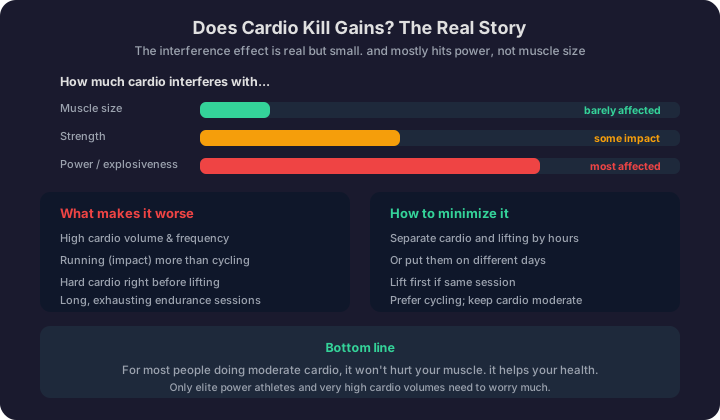
Muscle Size Is Barely Affected
Here's the finding that should calm most lifters down. An updated, larger meta-analysis of 43 studies concluded that concurrent training does not significantly compromise muscle hypertrophy or maximal strength2. The thing most people are worried about, losing muscle size, is, in the modern pooled data, essentially not a problem.
Some researchers go further, arguing that the evidence for a hypertrophy interference effect in real, chronic human training is weak or even absent, and that with sensible programming, muscle growth is preserved3. So if your goal is building muscle, moderate cardio is very unlikely to cost you.
Power Is Where Cardio Actually Interferes
If size and strength are largely safe, where does the interference show up? Explosive power. The same updated meta-analysis found that while hypertrophy and max strength were unaffected, explosive/power strength was meaningfully attenuated by concurrent training2. This is why the interference effect matters most to athletes who depend on speed and explosiveness: sprinters, jumpers, Olympic lifters, and much less to someone training for muscle and general strength.
What Makes Interference Worse
The size of any interference depends on how you do your cardio. The research points to a few clear factors:
- Same-session pairing. Doing cardio and lifting back-to-back in one session is the biggest practical driver of interference. It's when the attenuation of explosive strength was clearest2. Separating the two removes much of the effect.
- Modality: running vs cycling. Running interferes more than cycling. The original meta-analysis found significant decrements with running but not cycling, and fiber-level data show running is far worse than cycling for the growth of slow-twitch fibers14. The impact and muscle damage of running seem to be the culprit.
- Volume and frequency. More cardio, done more often and for longer, produces larger decrements1. A little is fine; a lot competes.
Why It Happens: Competing Signals
There's a real biological basis for all this. Endurance and resistance exercise activate partly opposing molecular programs in your muscle. Endurance training switches on an energy-sensing pathway (AMPK) that supports mitochondrial adaptations but can suppress the anabolic pathway (mTOR) that resistance training uses to build muscle56. In effect, the two types of training send somewhat conflicting instructions to the cell.
But, crucially, these are distinct programs governed by specificity, not a blanket rule that cardio destroys muscle7. Manage the variables, and you can keep the conflict minimal.
How to Get the Best of Both
You don't have to choose between a strong heart and a strong physique. To minimize interference while keeping your cardio:
- Separate cardio and lifting by several hours, or put them on different days62.
- Lift first if you must combine them in one session, so your resistance training gets your freshest effort.
- Prefer cycling over running when muscle is the priority, lower impact, less interference14.
- Keep cardio volume moderate. you're complementing your lifting, not training for a marathon13.
- Prioritize by goal. if power is your sport, be more careful; if you just want muscle and health, relax.
The Bottom Line
- The interference effect is real but specific. it mainly blunts power, not muscle size or max strength12.
- For muscle building, moderate cardio is very unlikely to hurt you, and modern evidence shows hypertrophy is preserved23.
- Running interferes more than cycling, and same-session pairing is the biggest culprit14.
- Minimize interference by separating sessions, lifting first, and keeping cardio moderate26.
- Cardio's health benefits are worth it. for most people, the trade-off is a non-issue.
So no, cardio doesn't "kill your gains": not for the average lifter doing a reasonable amount. Cardiovascular fitness is one of the most important things you can build for a long, healthy life, and you can absolutely have it alongside a strong, muscular physique. Program both intelligently, and a smart coaching plan can help you balance the two so each keeps improving.
References
Footnotes
-
Wilson JM, Marín PJ, Rhea MR, Wilson SMC, Loenneke JP, Anderson JC (2012). Concurrent training: a meta-analysis examining interference of aerobic and resistance exercises. Journal of Strength and Conditioning Research, 26(8), 2293-2307. https://doi.org/10.1519/JSC.0b013e31823a3e2d
-
Schumann M, Feuerbacher JF, Sünkeler M, et al. (2022). Compatibility of concurrent aerobic and strength training for skeletal muscle size and function: an updated systematic review and meta-analysis. Sports Medicine, 52(3), 601-612. https://doi.org/10.1007/s40279-021-01587-7
-
Murach KA, Bagley JR (2016). Skeletal muscle hypertrophy with concurrent exercise training: contrary evidence for an interference effect. Sports Medicine, 46(8), 1029-1039. https://doi.org/10.1007/s40279-016-0496-y
-
Lundberg TR, Feuerbacher JF, Sünkeler M, Schumann M (2022). The effects of concurrent aerobic and strength training on muscle fiber hypertrophy: a systematic review and meta-analysis. Sports Medicine, 52(10), 2391-2403. https://doi.org/10.1007/s40279-022-01688-x
-
Hawley JA (2009). Molecular responses to strength and endurance training: are they incompatible? Applied Physiology, Nutrition, and Metabolism, 34(3), 355-361. https://doi.org/10.1139/H09-023
-
Baar K (2014). Using molecular biology to maximize concurrent training. Sports Medicine, 44(Suppl 2), S117-S125. https://doi.org/10.1007/s40279-014-0252-0
-
Coffey VG, Hawley JA (2017). Concurrent exercise training: do opposites distract? The Journal of Physiology, 595(9), 2883-2896. https://doi.org/10.1113/JP272270
More field notes.

Cardio vs Weights for Fat Loss: What the Science Actually Says
Should you run to lose fat, or lift? The honest answer is that they do different jobs, and the thing that actually drives fat loss isn't either one. Here's how to combine them the right way.

Zone 2 Cardio: What It Is and Why It's Worth Your Time
Zone 2 is everywhere right now, and for once the hype is backed by real physiology. Here's what it actually means, how to find your zone, and why easy cardio might be the most underrated training you can do.

Compound vs Isolation Exercises: Which Should You Prioritize?
Should you build your workouts around big lifts like squats and rows, or chase the pump with curls and extensions? The research gives a clear, nuanced answer: use both, in the right order.
More on HyperBody