TrainingJul 16, 202610 min read
Lire en français·Auf Deutsch lesen·Leer en español·Przeczytaj po polsku
Zone 2 Cardio: What It Is and Why It's Worth Your Time
Zone 2 is everywhere right now, and for once the hype is backed by real physiology. Here's what it actually means, how to find your zone, and why easy cardio might be the most underrated training you can do.
Reviewed by the HyperBody team

Scroll any fitness feed and you'll hit someone preaching "Zone 2." It's the rare trend where the science underneath is genuinely solid, not a podcast invention, but decades of exercise physiology. The catch is that most explanations either oversimplify it or drown it in jargon.
Here's the honest version: Zone 2 is easy, conversational cardio, and doing more of it builds an aerobic engine that improves your health, your endurance, and your recovery. Let's unpack why.
What "Zone 2" Actually Means
Exercise intensity isn't a smooth gradient. Physiologists divide it into distinct domains separated by metabolic thresholds. Below your first threshold sits the moderate domain, where blood lactate stays close to resting levels and your oxygen uptake reaches a comfortable steady state within a couple of minutes1. That moderate domain is what "Zone 2" refers to.
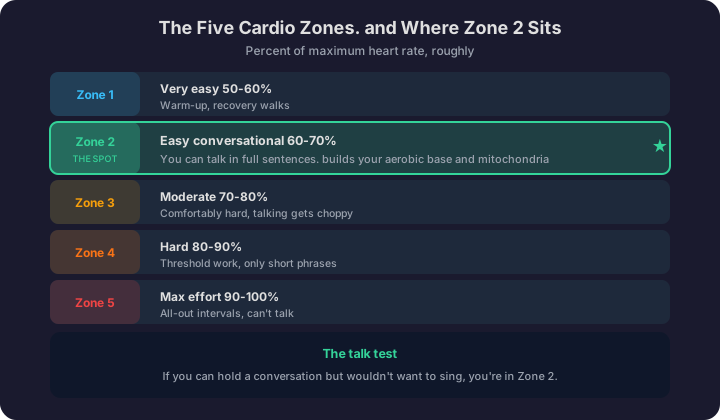
In the popular five-zone model, Zone 2 is the second-easiest band, sitting just below the first ventilatory or lactate threshold2. It's the pace you could hold for a long time: working, but not straining.
How to Find Your Zone 2 (No Lab Required)
You don't need a lactate meter. The simplest, well-validated tool is the talk test. The ability to speak tracks your ventilatory threshold closely: if you can still hold a conversation in full sentences but wouldn't want to belt out a song, you're right around the moderate-intensity boundary. Zone 23.
As a rough heart-rate guide, Zone 2 tends to fall around 60 to 70% of your maximum heart rate. But the talk test is more reliable than any formula, because estimated max-HR equations are notoriously imprecise. If you're gasping or can only manage a few words, you've drifted into Zone 3 or above. Slow down. That "slow down" instinct being wrong is the single most common Zone 2 mistake: most people train too hard to get the Zone 2 benefit.
Why Easy Cardio Is So Effective
Here's the part that makes Zone 2 worth prioritizing.
It builds mitochondria. Mitochondria are the aerobic power plants in your cells, and endurance training is a potent stimulus for them. Classic work showed that endurance training roughly doubles the mitochondrial respiratory-enzyme activity in trained muscle4. More mitochondria means more capacity to produce energy aerobically. Better endurance, better recovery between hard efforts, and better metabolic health.
It's where you burn the most fat. Fat oxidation rises from low to moderate intensity, then falls off as you push harder, a concept called Fatmax. Maximal fat burning occurs at roughly 47 to 64% of VO2max depending on training status, squarely in the Zone 2 range5. This doesn't mean Zone 2 is magic for fat loss (a calorie deficit still governs that), but it does make Zone 2 an efficient, sustainable way to use fat as fuel.
The endurance world is built on it. This isn't just a beginner tactic. When researchers studied how elite endurance athletes actually train, they found roughly 80% of sessions are done at low intensity, below the first lactate threshold, with only about 20% hard2. The best endurance athletes on earth spend most of their time in easy zones, building an enormous aerobic base, and reserve high intensity for a smaller, targeted dose2.
The Health Payoff
Zone 2's benefits go well beyond performance. The engine you build with easy cardio, your cardiorespiratory fitness, is one of the strongest predictors of how long you'll live. In a study of over 122,000 adults, higher cardiorespiratory fitness was associated with lower all-cause mortality, with no observed upper limit to the benefit. Fitter was better, all the way up6.
And Zone 2 is simply a comfortable, repeatable way to accumulate the activity health authorities recommend: 150 to 300 minutes per week of moderate aerobic activity7. Because it's easy, it's sustainable, and because it's sustainable, you'll actually do it.
How to Add It to Your Week
- Start with 2 to 3 sessions of 30 to 45 minutes. Walking on an incline, easy cycling, rowing, or a light jog, anything you can sustain at a conversational pace.
- Use the talk test constantly. If you can't speak in full sentences, slow down3. Ego is the enemy of Zone 2.
- Keep it genuinely easy. It should feel almost too easy at first. That's the point; the adaptations come from volume at low stress, not from grinding.
- Pair it with your lifting. Zone 2 recovers well alongside strength training and won't sabotage your gains the way frequent high-intensity cardio can.
The Bottom Line
Zone 2 is one of the few fitness trends that earns the attention. It's easy, conversational cardio that builds mitochondria, improves your aerobic base, burns fat efficiently, and drives the cardiorespiratory fitness most tied to a long, healthy life456. The hardest part is going slow enough to reap it.
If your training so far has been all weights and no cardio, adding a couple of easy Zone 2 sessions a week is one of the highest-return changes you can make, and smart coaching can help you balance it against your lifting so both keep improving.
References
Footnotes
-
Burnley M, Jones AM (2018). Power-duration relationship: physiology, fatigue, and the limits of human performance. European Journal of Sport Science, 18(1), 1-12. https://doi.org/10.1080/17461391.2016.1249524
-
Seiler S (2010). What is best practice for training intensity and duration distribution in endurance athletes? International Journal of Sports Physiology and Performance, 5(3), 276-291. https://doi.org/10.1123/ijspp.5.3.276
-
Reed JL, Pipe AL (2014). The talk test: a useful tool for prescribing and monitoring exercise intensity. Current Opinion in Cardiology, 29(5), 475-480. https://doi.org/10.1097/HCO.0000000000000097
-
Holloszy JO (1967). Biochemical adaptations in muscle: effects of exercise on mitochondrial oxygen uptake and respiratory enzyme activity in skeletal muscle. Journal of Biological Chemistry, 242(9), 2278-2282. https://pubmed.ncbi.nlm.nih.gov/4290225/
-
Achten J, Jeukendrup AE (2004). Optimizing fat oxidation through exercise and diet. Nutrition, 20(7-8), 716-727. https://doi.org/10.1016/j.nut.2004.04.005
-
Mandsager K, Harb S, Cremer P, Phelan D, Nissen SE, Jaber W (2018). Association of cardiorespiratory fitness with long-term mortality among adults undergoing exercise treadmill testing. JAMA Network Open, 1(6), e183605. https://doi.org/10.1001/jamanetworkopen.2018.3605
-
Bull FC, Al-Ansari SS, Biddle S, et al. (2020). World Health Organization 2020 guidelines on physical activity and sedentary behaviour. British Journal of Sports Medicine, 54(24), 1451-1462. https://doi.org/10.1136/bjsports-2020-102955
More field notes.

Cardio vs Weights for Fat Loss: What the Science Actually Says
Should you run to lose fat, or lift? The honest answer is that they do different jobs, and the thing that actually drives fat loss isn't either one. Here's how to combine them the right way.

Does Cardio Kill Your Gains? The Interference Effect Explained
Lifters have long feared that cardio 'eats' muscle. There's real science behind that fear: it's called the interference effect, but the modern evidence is far more reassuring than the myth suggests.

Exercise and Mental Health: How Training Changes Your Brain
The physical benefits of training get all the attention, but the mental ones may matter more. Here's the evidence for how exercise fights depression and anxiety, and literally reshapes your brain.
More on HyperBody