Body CompositionJul 9, 20269 min read
Lire en français·Auf Deutsch lesen·Leer en español·Przeczytaj po polsku
Waist-to-Height Ratio: A Simple Health Metric That Beats BMI
BMI can't tell muscle from fat, and it ignores where you carry weight. There's a simpler number you can check with a tape measure that predicts health risk better. Keep your waist under half your height.
Reviewed by the HyperBody team

Key takeaways
- What is a healthy waist-to-height ratio?
- Keep your waist under half your height, a ratio below 0.5. UK NICE guidance bands it clearly: roughly 0.4 to 0.49 is healthy, 0.5 to 0.59 signals increased cardiometabolic risk, and 0.6 or above is high risk. People at or above 0.50 show significantly higher odds of high blood pressure, blood sugar, and triglycerides.
- Why is waist-to-height ratio better than BMI?
- BMI cannot distinguish fat from muscle and ignores where you store fat, so it mislabels lean, muscular people as overweight. A meta-analysis of more than 300,000 adults found waist-to-height ratio a better screening tool than both waist circumference and BMI for cardiometabolic risk factors, in men and women alike.
- How do I measure my waist-to-height ratio?
- Measure your bare waist midway between the bottom of your ribs and the top of your hip bones, roughly at the navel. Relax, exhale normally, and keep the tape snug but not tight. Divide waist by height in the same units. Under 0.5 is the target; repeat monthly under the same conditions.
- What waist size should I have for my height?
- Keep your waist under half your height. At 160 cm that means under 80 cm (31.5 inches), at 170 cm under 85 cm (33.5 inches), at 180 cm under 90 cm (35.4 inches), and at 190 cm under 95 cm (37.4 inches). If you measure over your threshold, trend the waist down and re-check monthly.
If you lift, you already know BMI is broken. The formula that's supposed to flag "overweight" routinely flags lean, muscular people as unhealthy while waving through others who carry dangerous amounts of belly fat. There's a better number, and it's almost embarrassingly simple: your waist should measure less than half your height.
That's the waist-to-height ratio (WHtR), and a growing body of evidence, now backed by official UK health guidance, says it screens health risk better than BMI. Here's why, and how to use it.
Why BMI Falls Short
BMI is just your weight divided by your height squared. It's cheap and easy, which is why it caught on. But it's only an indirect estimate of body fat, and it has real, well-documented flaws: it can't distinguish fat from muscle, and its accuracy for actual adiposity is poor1.
For anyone who trains, this isn't academic. Add 15 kg of muscle and BMI cheerfully labels you "obese." Meanwhile, two people with the identical BMI can carry completely different amounts and distributions of fat. And because body composition drifts with age. Fat up, muscle down. BMI can stay flat while your actual health risk climbs1.
BMI's other blind spot is location. It treats a kilogram of fat on your hips the same as a kilogram wrapped around your organs. But those aren't the same at all.
Where You Store Fat Matters More Than How Much
Fat around the midsection, visceral fat packed around your abdominal organs, is the metabolically dangerous kind. This is why a waist-based measure carries information BMI simply doesn't have.
The evidence here is heavy. In the EPIC study of over 359,000 Europeans, measures of abdominal fat like waist circumference were independently associated with risk of death, on top of BMI2. A pooled analysis of 650,000 adults went further: a larger waist predicted higher mortality at every BMI level from 20 to 50, including people sitting comfortably in the "normal" BMI range3. Where you carry weight is doing work that BMI can't see.
Enter the Waist-to-Height Ratio
WHtR fixes both problems at once. You divide your waist circumference by your height (same units: centimeters over centimeters, inches over inches), and you get a single number that reflects central fat relative to your frame.
The keystone evidence is a meta-analysis of more than 300,000 adults across multiple ethnic groups, which found that WHtR is a better screening tool than both waist circumference and BMI for cardiometabolic risk factors, in both men and women4. It's not a marginal edge dressed up as a breakthrough, but it consistently out-predicts the metric most doctors still lead with.
The Rule: Keep Your Waist Under Half Your Height
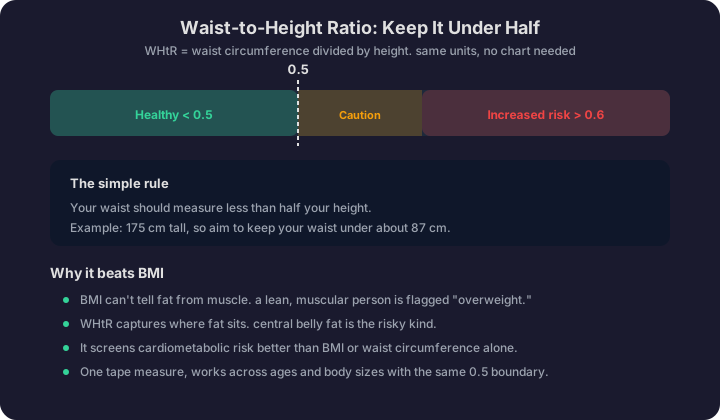
The beauty of WHtR is the boundary. A ratio of 0.5, keeping your waist under half your height, is where risk starts to climb. The original work establishing this found that people at or above a WHtR of 0.50 had significantly higher odds of high blood pressure, high blood sugar, and high triglycerides5.
This is now official guidance, not fringe advice. The UK's National Institute for Health and Care Excellence (NICE) recommends that adults use waist-to-height ratio alongside BMI, with a simple message: keep your waist to less than half your height6. NICE bands it clearly: roughly 0.4 to 0.49 is healthy, 0.5 to 0.59 is increased risk, and 0.6 or above is high risk, and specifically notes it's useful for people with high muscle mass, where BMI misleads6.
A worked example: if you're 175 cm tall, aim to keep your waist under about 87 cm. If you're 5'10" (70 inches), keep it under 35 inches. No sex-specific tables, no age adjustments, no chart, one measurement, one comparison.
Waist-to-height ratio categories
Here are the bands in one table, aligned with the NICE guidance above:
| Waist-to-height ratio | Category | What it means |
|---|---|---|
| Below 0.4 | Very lean | Common in lean, well-trained people with small waists. Usually fine, but very low values paired with underfueling deserve attention. |
| 0.4–0.49 | Healthy | Central fat sits in the range associated with the lowest cardiometabolic risk. Maintain what you are doing. |
| 0.5–0.59 | Increased risk | The odds of high blood pressure, high blood sugar, and high triglycerides start climbing. Time to trend your waist down. |
| 0.6 and above | High risk | Strongly associated with cardiometabolic disease. Make fat loss the priority and involve your doctor. |
Am I at a healthy ratio?
Find your height and check whether your waist sits under the 0.5 threshold:
| Your height | Keep your waist under |
|---|---|
| 160 cm (5'3") | 80 cm (31.5 inches) |
| 170 cm (5'7") | 85 cm (33.5 inches) |
| 180 cm (5'11") | 90 cm (35.4 inches) |
| 190 cm (6'3") | 95 cm (37.4 inches) |
If your waist measures under the number for your height, your ratio is below 0.5 and you are in the healthy band. If it is over, you have a concrete, measurable target: bring the waist down below that threshold, a few millimeters per month, and re-measure under the same conditions.
How to Measure It Right
- Find the spot. Measure your bare waist midway between the bottom of your ribs and the top of your hip bones (roughly at the navel). Not where your jeans sit.
- Relax and exhale. Don't suck in, don't push out. Breathe out normally and measure.
- Snug, not tight. The tape should sit flush against skin without compressing it.
- Divide by height. Waist ÷ height, in the same units. Under 0.5 is the target.
Do it once a month under the same conditions and you've got a trend that means far more than the number on a scale.
WHtR Isn't the Whole Picture Either
To be clear, WHtR is a screening tool, not a full body-composition analysis. It tells you about central-fat health risk, but it says nothing about your muscle distribution, your proportions, or how your physique is actually developing. A lean, well-trained person and an untrained person can share the same WHtR and look nothing alike.
That's the difference between a health metric and a physique metric. WHtR answers "is my belly fat in a healthy range?" A full physique analysis answers "how is my body actually composed and developing?" You want both: WHtR as a fast monthly health check, and a proper analysis for the training and physique picture.
The Takeaway
- BMI can't tell fat from muscle and ignores fat location. For anyone who trains, that makes it nearly useless as a personal health gauge1.
- Belly fat is the risky fat, and it predicts mortality risk even when BMI looks fine23.
- Waist-to-height ratio beats BMI for screening cardiometabolic risk4, and the rule is dead simple: keep your waist under half your height56.
- Use it as a monthly health check, and pair it with a real physique analysis for the full story.
Next time a BMI chart tries to tell you a body you've built in the gym is "overweight," reach for a tape measure instead. The math that matters fits in one sentence.
References
Footnotes
-
Rothman KJ (2008). BMI-related errors in the measurement of obesity. International Journal of Obesity, 32(Suppl 3), S56-S59. https://doi.org/10.1038/ijo.2008.87
-
Pischon T, Boeing H, Hoffmann K, et al. (2008). General and abdominal adiposity and risk of death in Europe. New England Journal of Medicine, 359(20), 2105-2120. https://doi.org/10.1056/NEJMoa0801891
-
Cerhan JR, Moore SC, Jacobs EJ, et al. (2014). A pooled analysis of waist circumference and mortality in 650,000 adults. Mayo Clinic Proceedings, 89(3), 335-345. https://doi.org/10.1016/j.mayocp.2013.11.011
-
Ashwell M, Gunn P, Gibson S (2012). Waist-to-height ratio is a better screening tool than waist circumference and BMI for adult cardiometabolic risk factors: systematic review and meta-analysis. Obesity Reviews, 13(3), 275-286. https://doi.org/10.1111/j.1467-789X.2011.00952.x
-
Hsieh SD, Yoshinaga H, Muto T (2003). Waist-to-height ratio, a simple and practical index for assessing central fat distribution and metabolic risk in Japanese men and women. International Journal of Obesity and Related Metabolic Disorders, 27(5), 610-616. https://doi.org/10.1038/sj.ijo.0802259
-
National Institute for Health and Care Excellence (2025). Overweight and obesity management (NICE guideline NG246): identifying and assessing overweight, obesity and central adiposity. https://www.nice.org.uk/guidance/ng246
More field notes.

What Is a Physique Rating? Body Types, Scores, and How AI Does It
What a physique rating is, from the 9 body types on a body composition scale to AI photo ratings: what the scores measure, how they compare with DEXA and smart scales, and how to turn a rating into training priorities.

Body Fat Percentage From a Photo: How It Works and How Accurate It Is
AI can estimate your body fat percentage from photos. Here is what the estimate is based on, how it compares to DEXA, calipers, and smart scales, and how to take photos that make the number trustworthy.

Body Fat Percentage Chart: Healthy Ranges by Age and Sex
What is a healthy body fat percentage? See the ranges for men and women, how they shift with age, how to measure yours, and how to lower it without losing muscle.
More on HyperBody