TrainingJul 6, 202610 min read
Lire en français·Auf Deutsch lesen·Leer en español·Przeczytaj po polsku
Cardio vs Weights for Fat Loss: What the Science Actually Says
Should you run to lose fat, or lift? The honest answer is that they do different jobs, and the thing that actually drives fat loss isn't either one. Here's how to combine them the right way.
Reviewed by the HyperBody team

Walk into any gym in January and you'll see the same split: one crowd grinding away on treadmills to "burn fat," another in the weight room to "tone up." Both are half right, and the way most people combine them is backwards. The research on cardio versus weights for fat loss is actually pretty clear once you separate what each one does.
Spoiler: the biggest driver of fat loss isn't cardio or weights at all. But the two together, in the right proportion, shape the body you end up with.
What Cardio Actually Does
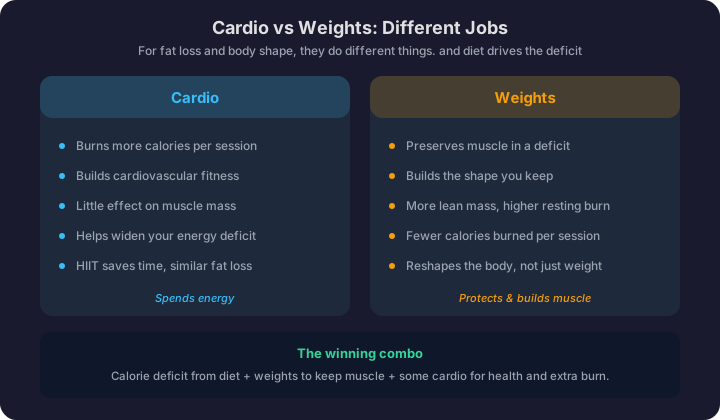
Cardio's main contribution to fat loss is simple: it burns calories, and more of them per session than lifting does. In the STRRIDE trial, a well-controlled study that ran aerobic training, resistance training, and a combination head-to-head for eight months, the aerobic and combined groups lost more total body mass and fat mass than the resistance-only group. Largely because aerobic work burns more energy per session1.
So if your only goal is to widen your calorie deficit, cardio is efficient at that. But notice the ceiling: cardio burns calories while you do it and adds little muscle. It spends energy; it doesn't reshape you.
What Weights Actually Do
Resistance training plays a completely different role, and it's the one people underrate for fat loss.
In that same STRRIDE trial, resistance training alone didn't significantly reduce fat mass, but it increased lean body mass, which aerobic training didn't1. That distinction is everything when you're dieting. When you lose weight through a calorie deficit, some of that loss can come from muscle. Resistance training is what tells your body to keep the muscle and burn fat instead.
The evidence is direct: adding resistance training to a calorie-restricted diet produces the greatest fat loss while preserving lean mass2. And resistance training is itself an effective fat-loss and body-composition intervention in overweight and obese adults, not just a muscle-building tool3. The reason weights matter for fat loss isn't the calories you burn lifting. It's the muscle you keep, which is what makes you look lean rather than simply smaller.
The Thing That Actually Drives Fat Loss
Here's the part both treadmill and barbell crowds tend to miss: the deficit itself comes mostly from your diet.
Body weight is fundamentally governed by energy balance, and the intake side is the dominant lever. Your body actively defends against weight loss by adjusting hunger and expenditure4. Worse for the "exercise it off" crowd, exercise contributes less to your total daily energy expenditure than a calorie tracker suggests. Research on constrained energy expenditure shows that as you do more activity, your body compensates elsewhere, so total burn plateaus rather than climbing in a straight line5.
This is why you can't out-train a bad diet, and why the "afterburn" effect is oversold. EPOC, the extra calories burned after intense exercise, is real but small in absolute terms; relying on it for weight loss isn't supported by the evidence6.
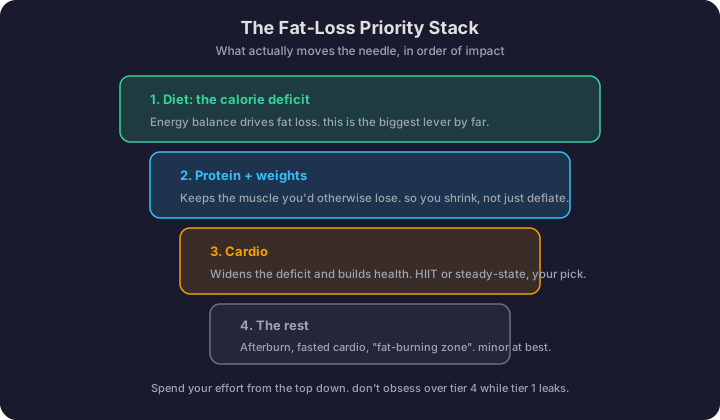
Put simply: diet creates the deficit, and exercise shapes what you lose within it.
How to Combine Them the Right Way
Once you understand the roles, the optimal setup writes itself. It's not cardio or weights, it's a stack of priorities.
1. Set the deficit with your diet. This is the biggest lever by far4. Keep it modest. A deficit of around 500 kcal per day or less protects lean mass, whereas aggressive deficits blunt it7.
2. Lift to keep your muscle. Resistance training plus adequate protein is what preserves the lean mass a diet would otherwise cost you2. Aim for a high protein intake while cutting; more protein is linearly associated with better preservation of lean mass during a deficit, up to roughly 1.9 g per kg of bodyweight8.
3. Add cardio to widen the deficit and build health. Here's the freeing part: it doesn't much matter whether you do HIIT or steady-state. A meta-analysis found the two produce statistically similar body-composition results, with HIIT's main advantage being time efficiency. About 40% less training time for comparable outcomes9. Pick whichever you'll actually keep doing.
4. Don't sweat the small stuff. Fasted cardio, the "fat-burning zone," afterburn hacks. These are tier-four concerns. Nail diet, protein, and lifting first6.
The Verdict
Cardio versus weights is the wrong question. For fat loss:
- Diet drives the deficit. you lose fat because you're eating at a deficit, not because of any specific workout45.
- Weights protect your muscle, so you end up lean and defined rather than just lighter12.
- Cardio adds energy expenditure and health, and the type barely matters. Do what you enjoy9.
- The best body-composition results come from combining all three: a diet-driven deficit, resistance training with enough protein, and some cardio128.
If your goal is a leaner, more athletic physique rather than just a smaller number on the scale, weights aren't optional. They're how you keep what makes you look good while the fat comes off. A periodic physique analysis shows you whether your cut is actually costing you muscle or preserving it, and smart coaching builds the training side of that equation around your body.
References
Footnotes
-
Willis LH, Slentz CA, Bateman LA, et al. (2012). Effects of aerobic and/or resistance training on body mass and fat mass in overweight or obese adults. Journal of Applied Physiology, 113(12), 1831-1837. https://doi.org/10.1152/japplphysiol.01370.2011
-
Miller T, Mull S, Aragon AA, Krieger J, Schoenfeld BJ (2018). Resistance training combined with diet decreases body fat while preserving lean mass independent of resting metabolic rate: a randomized trial. International Journal of Sport Nutrition and Exercise Metabolism, 28(1), 46-54. https://doi.org/10.1123/ijsnem.2017-0221
-
Lopez P, Taaffe DR, Galvão DA, et al. (2022). Resistance training effectiveness on body composition and body weight outcomes in individuals with overweight and obesity across the lifespan: a systematic review and meta-analysis. Obesity Reviews, 23(5), e13428. https://doi.org/10.1111/obr.13428
-
Hall KD, Guo J (2017). Obesity energetics: body weight regulation and the effects of diet composition. Gastroenterology, 152(7), 1718-1727.e3. https://doi.org/10.1053/j.gastro.2017.01.052
-
Pontzer H, Durazo-Arvizu R, Dugas LR, et al. (2016). Constrained total energy expenditure and metabolic adaptation to physical activity in adult humans. Current Biology, 26(3), 410-417. https://doi.org/10.1016/j.cub.2015.12.046
-
LaForgia J, Withers RT, Gore CJ (2006). Effects of exercise intensity and duration on the excess post-exercise oxygen consumption. Journal of Sports Sciences, 24(12), 1247-1264. https://doi.org/10.1080/02640410600552064
-
Murphy C, Koehler K (2022). Energy deficiency impairs resistance training gains in lean mass but not strength: a meta-analysis and meta-regression. Scandinavian Journal of Medicine & Science in Sports, 32(1), 125-137. https://doi.org/10.1111/sms.14075
-
Refalo MC, Trexler ET, Helms ER (2025). Effect of dietary protein on fat-free mass in energy restricted, resistance-trained individuals: an updated systematic review with meta-regression. Strength & Conditioning Journal. https://doi.org/10.1519/SSC.0000000000000888
-
Wewege M, van den Berg R, Ward RE, Keech A (2017). The effects of high-intensity interval training vs. moderate-intensity continuous training on body composition in overweight and obese adults: a systematic review and meta-analysis. Obesity Reviews, 18(6), 635-646. https://doi.org/10.1111/obr.12532
More field notes.

Zone 2 Cardio: What It Is and Why It's Worth Your Time
Zone 2 is everywhere right now, and for once the hype is backed by real physiology. Here's what it actually means, how to find your zone, and why easy cardio might be the most underrated training you can do.

Does Cardio Kill Your Gains? The Interference Effect Explained
Lifters have long feared that cardio 'eats' muscle. There's real science behind that fear: it's called the interference effect, but the modern evidence is far more reassuring than the myth suggests.

Exercise and Mental Health: How Training Changes Your Brain
The physical benefits of training get all the attention, but the mental ones may matter more. Here's the evidence for how exercise fights depression and anxiety, and literally reshapes your brain.
More on HyperBody