CoachingJul 13, 202611 min read
Lire en français·Auf Deutsch lesen·Leer en español·Przeczytaj po polsku
AI Fitness Coach vs Personal Trainer: Which Is Right for You?
One costs a few dollars a month and never sleeps. The other stands beside you and adjusts your form in real time. Here's an honest, evidence-based look at what each does well and when to use which.
Reviewed by the HyperBody team

Key takeaways
- How much does an AI fitness coach cost compared to a personal trainer?
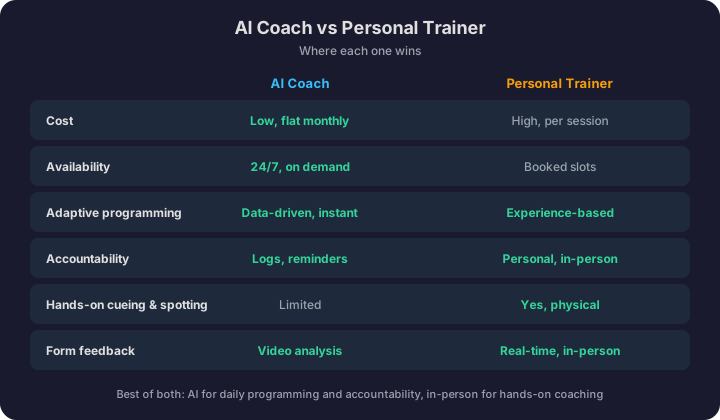
- A personal trainer typically runs $40 to $100 or more per session, while an AI coach costs a few dollars a month and is available anytime, at 6 a.m. or midnight. For most beginners and intermediates, that accessibility is often the difference between training consistently and not training at all.
- What does a personal trainer do better than an AI coach?
- A trainer wins on hands-on advantages an algorithm cannot replicate: physically correcting your bar path mid-rep, spotting heavy or max sets, real-time physiological monitoring, and individualized screening for injuries or medical conditions. In one trial, directly supervised lifters increased loads faster and gained significantly more strength than unsupervised lifters.
- Is AI-based workout programming actually effective?
- Yes. AI coaches prescribe effort using autoregulation (RPE and reps-in-reserve) rather than rigid percentages, and systematic reviews confirm autoregulated load prescription produces strength gains comparable to, and sometimes better than, traditional percentage-based loading. The accountability engine, self-monitoring plus goal-setting, is also strongly evidence-backed and highly automatable.
- Should I choose an AI coach or a personal trainer?
- It is not either/or. Choose an AI coach for structured, adaptive programming on a budget and your own schedule, especially as a beginner to intermediate. Choose a trainer for hands-on technique, spotting, or injury recovery. The strongest model is hybrid: AI handles daily programming and accountability while a trainer does periodic form audits.
"Can an app really replace a personal trainer?" It's the right question, and the honest answer is: for some things yes, for others no. AI fitness coaching has gotten genuinely good at the parts that make training work: structure, progression, and accountability. But a human trainer still owns a few things an algorithm can't touch.
Instead of hype in either direction, let's look at what the research actually shows each one does, so you can pick the right tool for where you are.
What a Personal Trainer Does Well
The core value of a trainer isn't the exercises they know. It's what their presence does to your effort. When researchers had two groups run the identical program, the directly supervised group increased their loads faster and gained significantly more strength than the unsupervised group1. A coach in the room pushes your intensity in a way that's hard to replicate alone.
That effect shows up in adherence too. In a 2025 randomized trial comparing in-person training, app-based coaching, and self-guided training, in-person supervision produced the highest attendance and was the only group to gain significant muscle mass over the study2. Human contact, hands-on cueing, spotting on heavy sets, and the simple fact that someone is expecting you. These are real advantages, especially if you're working around an injury or medical condition where individualized screening matters3.
What an AI Coach Does Well
Here's where the picture flips. The engine of good coaching, structured programming, progressive overload, and accountability, turns out to be highly automatable.
The programming logic is valid. AI coaches prescribe effort using autoregulation (RPE and reps-in-reserve) rather than rigid percentages. Systematic reviews confirm that autoregulated load prescription produces strength gains comparable to, and sometimes better than, traditional percentage-based loading45. The algorithmic approach an app uses isn't a gimmick; it's a validated method.
The accountability mechanism is real. The single most evidence-backed ingredient in behavior change is self-monitoring, logging your workouts and food, combined with other self-regulation techniques6. That's exactly what a good app automates: effortless logging, streaks, reminders, and progress you can see. Add structured goal-setting, which produces a moderate positive effect on physical-activity behavior3, and the app is delivering the same behavioral levers a coach uses, at scale.
It's cheap and always available. A personal trainer typically runs $40 to $100+ per session; an AI coach is a few dollars a month, available at 6 a.m. or midnight, on your schedule. For most beginners and intermediates, that accessibility is the difference between training consistently and not training at all.
The Honest Limitations of AI Coaching
Good AI coaching content should tell you where AI falls short, so here it is.
When researchers critically evaluated a leading AI model's exercise prescriptions, they found real problems: the programs were often overly conservative, lacked systematic long-term progression, and gave generic recommendations that ignored individual joint issues, medications, and specific conditions7. And no AI can do real-time physiological monitoring, physically correct your bar path mid-rep, spot you on a max, or screen an injury by feel7.
There's also a human element the data captures. A 2025 systematic review of human, AI, and hybrid coaching found that while both human and AI coaching improve outcomes, human coaching showed stronger engagement and a better "working alliance," whereas AI was valued for 24/7, non-judgmental access but sometimes criticized as repetitive or impersonal8. And a sober note on apps specifically: a meta-analysis found smartphone-app interventions produce only modest, mostly short-term gains in physical activity9. An app is a tool, not a magic wand. What separates a great AI coach from a forgettable one is how well it drives the accountability loop over months, not weeks.
So Which Should You Choose?
It's not really either/or. Match the tool to your situation.
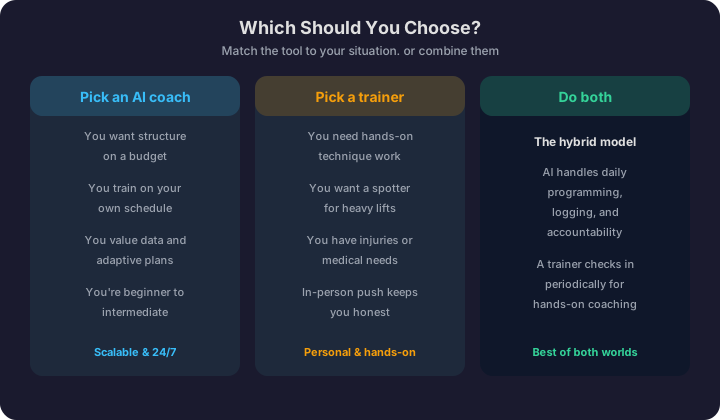
Choose an AI coach if you want structured, adaptive programming on a budget, you train on your own schedule, and you're a beginner to intermediate lifter who mainly needs a good plan and consistent accountability. That describes most people.
Choose a personal trainer if you need hands-on technique work, you want a spotter for heavy lifts, you're returning from injury or have medical considerations, or you simply know you need a human physically expecting you to show up.
Do both if you can. The strongest model is hybrid: let an AI coach handle daily programming, logging, and accountability, and see a trainer periodically for hands-on coaching and form audits. You get the AI's consistency and the human's expertise, and the research supports this combined approach8.
The Bottom Line
The old debate assumed you had to pick a side. You don't. AI coaching has genuinely mastered the parts of coaching that drive results for most people, programming, progression, and accountability, at a fraction of the cost. A trainer still wins on hands-on cueing, spotting, and individualized screening. The biggest mistake isn't choosing "wrong": it's choosing neither and training without structure at all, which the data shows is where people stall2.
This is the thinking behind HyperBody's smart coaching: validated, autoregulated programming built around your body, with form check video analysis to cover the technique feedback an app historically couldn't, all anchored to a periodic physique analysis so the plan adapts to the body it's actually coaching.
References
Footnotes
-
Mazzetti SA, Kraemer WJ, Volek JS, et al. (2000). The influence of direct supervision of resistance training on strength performance. Medicine & Science in Sports & Exercise, 32(6), 1175-1184. https://doi.org/10.1097/00005768-200006000-00023
-
Gavanda S, Held S, Schrey S, et al. (2025). Optimizing resistance training outcomes: comparing in-person supervision, online coaching, and self-guided approaches. A randomized controlled trial. Journal of Strength and Conditioning Research, 39(11), 1129-1137. https://doi.org/10.1519/JSC.0000000000005216
-
McEwan D, Harden SM, Zumbo BD, et al. (2016). The effectiveness of multi-component goal setting interventions for changing physical activity behaviour: a systematic review and meta-analysis. Health Psychology Review, 10(1), 67-88. https://doi.org/10.1080/17437199.2015.1104258
-
Hickmott LM, Chilibeck PD, Shaw KA, Butcher SJ (2022). The effect of load and volume autoregulation on muscular strength and hypertrophy: a systematic review and meta-analysis. Sports Medicine - Open, 8, 9. https://doi.org/10.1186/s40798-021-00404-9
-
Larsen S, Kristiansen E, van den Tillaar R (2021). Effects of subjective and objective autoregulation methods for intensity and volume on enhancing maximal strength during resistance-training interventions: a systematic review. PeerJ, 9, e10663. https://doi.org/10.7717/peerj.10663
-
Michie S, Abraham C, Whittington C, McAteer J, Gupta S (2009). Effective techniques in healthy eating and physical activity interventions: a meta-regression. Health Psychology, 28(6), 690-701. https://doi.org/10.1037/a0016136
-
Dergaa I, Ben Saad H, El Omri A, et al. (2024). Using artificial intelligence for exercise prescription in personalised health promotion: a critical evaluation of OpenAI's GPT-4 model. Biology of Sport, 41(2), 221-241. https://doi.org/10.5114/biolsport.2024.133661
-
Loughnane C, Laiti J, O'Donovan R, Dunne PJ (2025). Systematic review exploring human, AI, and hybrid health coaching in digital health interventions: trends, engagement, and lifestyle outcomes. Frontiers in Digital Health, 7, 1536416. https://doi.org/10.3389/fdgth.2025.1536416
-
Romeo A, Edney S, Plotnikoff R, et al. (2019). Can smartphone apps increase physical activity? Systematic review and meta-analysis. Journal of Medical Internet Research, 21(3), e12053. https://doi.org/10.2196/12053
More field notes.

Online Fitness Coaching: Does Remote Coaching Actually Work?
Can a coach who isn't in the room really get you results? Here's what the research says about online coaching, in-person supervision, and why accountability matters more than location.

How to Coach Yourself: Building Your Own Training Program
You don't need to pay for a plan you could build yourself. Here's the exact framework a coach uses to write a program, broken into five decisions you can make today.

How to Set Fitness Goals That Actually Stick
Most fitness goals are abandoned by February. The problem usually isn't willpower, it's how the goal was built. Here's the evidence-based way to set goals you'll actually follow through on.
More on HyperBody