TrainingNov 2, 20269 min read
Lire en français·Auf Deutsch lesen·Leer en español·Przeczytaj po polsku
Fasted Cardio: Does It Burn More Fat?
Doing cardio on an empty stomach is supposed to torch more fat. It's a compelling idea with a kernel of truth, and a conclusion that falls apart once you look at what actually matters for fat loss.
Reviewed by the HyperBody team

The logic sounds airtight: train before you've eaten, and with no food to burn, your body will tap into stored fat instead. That's the pitch behind fasted cardio, a staple of morning routines and cutting phases everywhere. And there's even a grain of real physiology behind it. But when you follow the science all the way through to what actually changes your body over time, the case for fasted cardio being better for fat loss collapses. Here's the honest breakdown.
The Kernel of Truth: More Fat Burned During the Session
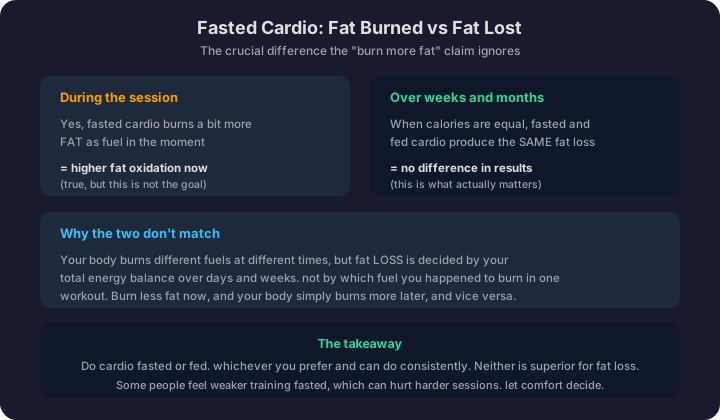
Let's give the idea its due, because part of it is real. When you exercise fasted, your body does burn more fat as fuel during that session. A meta-analysis confirmed it: fasted aerobic exercise increased fat oxidation during the workout by a few grams compared to doing it fed1.
So the premise isn't a myth. Fasted, you do burn a bit more fat in the moment. The problem is what people conclude from it.
The Fatal Flaw: Fat Burned Now ≠ Fat Lost Over Time
Here's the crucial distinction the "burn more fat" pitch glosses over. Burning more fat during a workout is not the same as losing more fat over days and weeks. And the researchers who found that extra in-session fat burning said so explicitly: they warned that the acute fat-oxidation difference should not be extrapolated to long-term body-fat reduction1.
Why? Because your body burns different fuels at different times, and it balances out. Burn a little less fat during your fasted-off session and your body simply burns more fat later, and vice versa. What determines whether you actually lose fat over time is your total energy balance: calories in versus calories out, integrated over days and weeks2, not which fuel you happened to oxidize during one 30-minute session.
What the Head-to-Head Studies Show
This isn't just theory. It's been tested directly. A controlled trial had two groups do the same steady-state cardio on the same calorie-controlled diet, one fasted, one fed, for four weeks. The result: equivalent fat loss and body-composition change. Both groups lost fat, and there was no significant difference between them3. The fat loss came from the calorie deficit, not the fasted state.
A dedicated meta-analysis of fasted versus fed exercise reached the same verdict: only trivial-to-small effects, and it's simply unclear that fasted training produces greater weight loss or better body composition4. When the studies are done properly with calories controlled, the "fasted advantage" evaporates.
The Performance Angle
Beyond fat loss, there's a practical consideration: how you feel and perform. The evidence here is nuanced. Combining fasting-style approaches with exercise doesn't significantly impair most performance measures like VO2 max and most strength metrics5, so fasted training is a viable option for people who tolerate it well.
However, carbohydrate is the dominant fuel at higher intensities, and training with low carbohydrate availability, the physiological basis of fasted training, can compromise high-intensity or long endurance efforts in some people6. In plain terms: easy fasted cardio is usually fine, but a hard fasted session might feel worse and underperform. It varies by person.
So Should You Do Fasted Cardio?
The answer is refreshingly simple: do whatever you'll actually do consistently. Since fasted and fed cardio produce the same fat loss when calories match34, the "best" option is the one that fits your life and preferences.
- Like training on an empty stomach? It's completely fine, and may be convenient in the morning5.
- Feel weak or lightheaded fasted? Eat something first. You won't lose any fat-loss benefit, and you'll likely train harder.
- Doing a hard or long session? Consider having some carbs beforehand, since fasted high-intensity work can suffer6.
- Above all, be consistent. Health and body-composition benefits come from accumulated activity over time: the strongest lever is simply doing it regularly7.
The Bottom Line
- Fasted cardio does burn slightly more fat during the session: that part is true1.
- But in-session fat burning doesn't equal more fat lost over time, and the researchers themselves say not to extrapolate1.
- Fat loss is governed by total energy balance, not workout-fuel choice2.
- Head-to-head, fasted and fed cardio produce the same fat loss when calories are equated34.
- Do whichever you prefer and can sustain. consistency beats timing tricks7.
Fasted cardio isn't wrong, it's just not magic. Don't force yourself to train hungry and miserable chasing a benefit that disappears in the long run. Put your energy into the things that actually drive fat loss, a sustainable calorie deficit, enough protein, and consistent training, all of which a smart coaching plan is designed to support.
References
Footnotes
-
Vieira AF, Costa RR, Macedo RCO, Coconcelli L, Kruel LFM (2016). Effects of aerobic exercise performed in fasted v. Fed state on fat and carbohydrate metabolism in adults: a systematic review and meta-analysis. British Journal of Nutrition, 116(7), 1153-1164. https://doi.org/10.1017/S0007114516003160
-
Hall KD, Guo J (2017). Obesity energetics: body weight regulation and the effects of diet composition. Gastroenterology, 152(7), 1718-1727.e3. https://doi.org/10.1053/j.gastro.2017.01.052
-
Schoenfeld BJ, Aragon AA, Wilborn CD, Krieger JW, Sonmez GT (2014). Body composition changes associated with fasted versus non-fasted aerobic exercise. Journal of the International Society of Sports Nutrition, 11(1), 54. https://doi.org/10.1186/s12970-014-0054-7
-
Hackett DA, Hagstrom AD (2017). Effect of overnight fasted exercise on weight loss and body composition: a systematic review and meta-analysis. Journal of Functional Morphology and Kinesiology, 2(4), 43. https://doi.org/10.3390/jfmk2040043
-
Kazeminasab F, Sharafifard F, Bahrami Kerchi A, et al. (2025). Effects of intermittent fasting and calorie restriction on exercise performance: a systematic review and meta-analysis. Nutrients, 17(12), 1992. https://doi.org/10.3390/nu17121992
-
Gejl KD, Nybo L (2021). Performance effects of periodized carbohydrate restriction in endurance-trained athletes: a systematic review and meta-analysis. Journal of the International Society of Sports Nutrition, 18, 37. https://doi.org/10.1186/s12970-021-00435-3
-
2018 Physical Activity Guidelines Advisory Committee (2018). 2018 Physical Activity Guidelines Advisory Committee Scientific Report. U.S. Department of Health and Human Services. https://odphp.health.gov/our-work/nutrition-physical-activity/physical-activity-guidelines/current-guidelines/scientific-report
More field notes.

Cardio vs Weights for Fat Loss: What the Science Actually Says
Should you run to lose fat, or lift? The honest answer is that they do different jobs, and the thing that actually drives fat loss isn't either one. Here's how to combine them the right way.

Zone 2 Cardio: What It Is and Why It's Worth Your Time
Zone 2 is everywhere right now, and for once the hype is backed by real physiology. Here's what it actually means, how to find your zone, and why easy cardio might be the most underrated training you can do.

Does Cardio Kill Your Gains? The Interference Effect Explained
Lifters have long feared that cardio 'eats' muscle. There's real science behind that fear: it's called the interference effect, but the modern evidence is far more reassuring than the myth suggests.
More on HyperBody