TrainingSep 14, 202610 min read
Lire en français·Auf Deutsch lesen·Leer en español·Przeczytaj po polsku
How Long Should You Rest Between Sets?
Rushing between sets to 'keep the intensity up' might be quietly costing you muscle and strength. Here's what the research says about rest, and how long you should actually wait.
Reviewed by the HyperBody team

It's one of the most common training mistakes, and it comes from good intentions. People keep their rest periods short (30 to 60 seconds) because it feels harder and they assume harder means better. For years, that was even the standard advice for building muscle. The research has since flipped that script. For most of your training, resting longer than you think is the smarter move.
Here's what the science actually says about rest between sets, and how to set your rest by your goal.
The Study That Changed the Advice
For a long time, short rest was recommended for hypertrophy on the theory that the extra "burn" and metabolic stress would drive growth. Then a well-controlled study tested it directly. Trained men followed the same program with either 1-minute or 3-minute rest between sets for eight weeks. The result surprised a lot of people: the 3-minute rest group gained more strength and more muscle1. Longer rest didn't just preserve strength; it grew more muscle in the thigh too1.
Why? Because rest protects the thing that actually drives growth: your ability to perform quality reps.
Rest Preserves Your Volume
The mechanism is simple. When you cut rest short, you can't do as many reps on your next set, because you haven't recovered. Research measuring this found that total training volume, reps completed across your sets, rises with longer rest: 5-minute rest beat 2-minute, which beat 1-minute, for total reps on squats and bench2.
Since weekly training volume is one of the primary drivers of muscle growth, anything that quietly slashes your per-session volume is working against you. Short rest feels productive, but it can cost you the very reps that build muscle. Longer rest lets each set be a genuine, high-quality effort.
The Nuance: How Long Is Long Enough?
Now for the honest, up-to-date picture, because "rest longer" has limits. The most recent Bayesian meta-analysis found only a small hypertrophy benefit to longer rest, with no meaningful added growth once rest exceeds about 90 seconds3. Systematic reviews land in a similar place: both short and longer rest can build muscle, but longer rest tends to be advantageous specifically for trained lifters4.
Reconciling this: the disaster is very short rest (under a minute) on hard sets, which tanks your volume. Once you're resting long enough to perform your next set well, roughly 90 seconds to a few minutes, you've captured most of the hypertrophy benefit. So you don't need to obsessively time five-minute rests for growth, but you shouldn't be rushing back in under a minute either.
Set Your Rest by Your Goal
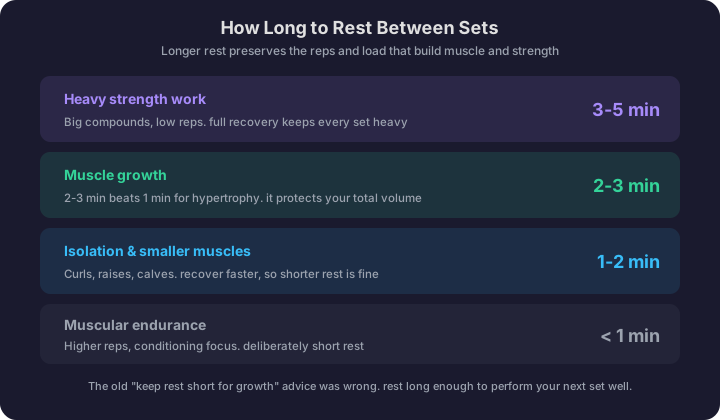
The right rest depends on what you're training for. The ACSM's guidance and the broader review literature converge on a goal-based approach567:
- Heavy strength work (big compounds, low reps): 2 to 5 minutes. Maximal-strength development benefits from longer rest. Reviews find rest over ~2 minutes tends to be optimal for strength in trained lifters5. Full recovery keeps every heavy set heavy.
- Muscle growth (hypertrophy): about 2 to 3 minutes on compounds, ~90 seconds on smaller lifts. Enough to protect your reps, with little extra benefit past ~90 seconds to 2 minutes13.
- Isolation and smaller muscles: 1 to 2 minutes. They recover faster, so shorter rest is fine.
- Muscular endurance / conditioning: under a minute. Here, short rest is the point.
A useful shortcut: rest long enough that the previous set isn't sabotaging your next one. If your reps are falling off a cliff set to set, you're resting too little for your goal.
What About Metabolic Stress?
Short rest does increase metabolic stress: the metabolite buildup and "pump" that's one proposed contributor to growth8. That's the kernel of truth behind the old short-rest advice. But the research shows this doesn't outweigh the cost of lost volume for most people18. Metabolic stress is real, but it's a minor lever compared to doing enough quality reps. You don't need to manufacture a burn by cutting rest; you get plenty of stimulus from hard, well-rested sets.
The Bottom Line
- Don't rush. very short rest (under a minute) on hard sets costs you reps, and therefore muscle and strength12.
- For strength, rest 2-5 minutes. heavy work needs recovery56.
- For muscle, ~2-3 minutes on big lifts is a safe default, with most of the benefit captured by ~90 seconds+13.
- Shorten rest for isolation and endurance work, where it costs less or is the goal67.
- Simplest rule: rest long enough to perform your next set well.
The gym clock isn't something to race. Give yourself permission to rest. Your strength, your volume, and your muscle will all thank you for it. A smart coaching plan sets appropriate rest targets for each exercise so you're never guessing.
References
Footnotes
-
Schoenfeld BJ, Pope ZK, Benik FM, et al. (2016). Longer interset rest periods enhance muscle strength and hypertrophy in resistance-trained men. Journal of Strength and Conditioning Research, 30(7), 1805-1812. https://doi.org/10.1519/JSC.0000000000001272
-
Willardson JM, Burkett LN (2005). A comparison of 3 different rest intervals on the exercise volume completed during a workout. Journal of Strength and Conditioning Research, 19(1), 23-26. https://doi.org/10.1519/R-13853.1
-
Singer A, Wolf M, Generoso L, et al. (2024). Give it a rest: a systematic review with Bayesian meta-analysis on the effect of inter-set rest interval duration on muscle hypertrophy. Frontiers in Sports and Active Living, 6, 1429789. https://doi.org/10.3389/fspor.2024.1429789
-
Grgic J, Lazinica B, Mikulic P, Krieger JW, Schoenfeld BJ (2017). The effects of short versus long inter-set rest intervals in resistance training on measures of muscle hypertrophy: a systematic review. European Journal of Sport Science, 17(8), 983-993. https://doi.org/10.1080/17461391.2017.1340524
-
Grgic J, Schoenfeld BJ, Skrepnik M, Davies TB, Mikulic P (2018). Effects of rest interval duration in resistance training on measures of muscular strength: a systematic review. Sports Medicine, 48(1), 137-151. https://doi.org/10.1007/s40279-017-0788-x
-
American College of Sports Medicine (2009). Progression models in resistance training for healthy adults (position stand). Medicine & Science in Sports & Exercise, 41(3), 687-708. https://doi.org/10.1249/MSS.0b013e3181915670
-
de Salles BF, Simão R, Miranda F, da Silva Novaes J, Lemos A, Willardson JM (2009). Rest interval between sets in strength training. Sports Medicine, 39(9), 765-777. https://doi.org/10.2165/11315230-000000000-00000
-
Schoenfeld BJ (2013). Potential mechanisms for a role of metabolic stress in hypertrophic adaptations to resistance training. Sports Medicine, 43(3), 179-194. https://doi.org/10.1007/s40279-013-0017-1
More field notes.

Compound vs Isolation Exercises: Which Should You Prioritize?
Should you build your workouts around big lifts like squats and rows, or chase the pump with curls and extensions? The research gives a clear, nuanced answer: use both, in the right order.

Workout Splits Explained: How to Structure Your Training Week
Full body, upper/lower, push-pull-legs, the bro split. Everyone argues about which is best. The research says you're asking the wrong question. Here's how to actually choose.

Understanding Body Composition Analysis: Beyond the Scale
Discover why body composition matters more than body weight, and how smart photo-based analysis can give you the insights you need to train effectively.
More on HyperBody