TrainingOct 26, 202610 min read
Lire en français·Auf Deutsch lesen·Leer en español·Przeczytaj po polsku
Full Range of Motion vs Partial Reps: Which Builds More Muscle?
Should you lower the weight all the way, or is a partial rep enough? The research on range of motion has evolved fast, and the answer now hinges on one thing: the stretch. Here's what to do.
Reviewed by the HyperBody team

Walk into any gym and you'll see it: people cutting their reps short, bouncing half-way down on the squat, or doing quarter-rep bicep curls with an ego-boosting weight. Meanwhile, the coaching mantra has always been "full range of motion." So who's right? The science on range of motion (ROM) has advanced quickly in the last few years, and the modern answer is more interesting than a flat "always go full range." It comes down to where in the movement you load the muscle, specifically, the stretch.
Full Range Is the Safe Default
Start with the well-established baseline: for most purposes, full range of motion is at least as good as, and often better than, partial reps. A meta-analysis found that full ROM produced significantly greater gains in both strength and lower-body muscle growth compared to partial ROM1. A systematic review reached a similar conclusion, especially for the lower body2.
Full range also has two bonus benefits partials don't. It builds strength across the entire range of the movement (strength gains are somewhat specific to the joint angles you train)1, and it improves flexibility. Resistance training through a full range increases joint mobility about as much as stretching does3. So as a default, moving the weight all the way is the right call.
The Plot Twist: The Stretch Matters Most
Here's where the recent research gets fascinating. It turns out that the reason full ROM works so well may be less about "full" and more about the fact that full range takes the muscle into a deep stretch. And when researchers isolate that stretched position, something surprising happens.
Studies on "lengthened partials," partial reps performed in the stretched portion of the movement, found that training at long muscle lengths produced muscle growth comparable to, or even exceeding, full ROM, and clearly better than partials done in the shortened (easy) range4. A controlled trial in trained lifters confirmed that lengthened partials and full ROM produced statistically similar gains in muscle thickness and strength endurance5.
The emerging principle, from a systematic review of the topic, is that the muscle length you train at matters more than "full versus partial" per se. training at longer muscle lengths tends to optimize growth of muscles like the quads, biceps, and triceps6. The deep, stretched position is where a huge amount of the growth stimulus lives.
Why the Stretch Is So Powerful
There's a mechanistic reason. Muscle growth is regional: different parts of a muscle can grow to different degrees, and that regional growth tracks where the muscle was most loaded during the exercise7. Loading a muscle when it's stretched long places high tension on it in that position, biasing growth there. This is why emphasizing the stretched portion of a lift, the bottom of a squat, the deep stretch of a curl or a fly, is such an effective stimulus67.
Not all partials are equal, though. This all applies to partials in the stretched range. Partials in the shortened, easy range (like top-half quarter reps with ego weight) are generally the weakest choice for growth4. So "partial reps" being good or bad depends entirely on which partial.
What This Means for Your Training
Putting the evidence together gives clear, practical guidance:
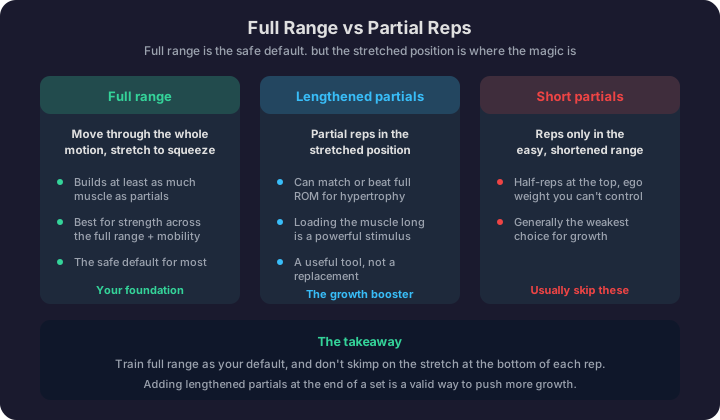
- Train full range as your default. It builds strength across the whole movement, improves flexibility, and takes the muscle through the growth-rich stretch automatically123.
- Never skimp on the stretch. The bottom of the movement, where the muscle is long, is the most valuable part of the rep. Control it and reach it fully. Don't cut depth to lift more.
- Use lengthened partials as a tool. When you hit failure on a full-range set, continuing with a few extra partial reps in the stretched position is a legitimate way to squeeze out more growth stimulus45.
- Skip shortened partials. Half-reps at the top with a weight you can't control are the least productive option4.
The old advice to "always use full range" wasn't wrong: it was just incomplete. What full range does so well is guarantee you hit the stretched position, which is where much of the magic happens. So go full range, respect the stretch, and consider lengthened partials as a bonus tool: that's the modern, evidence-based approach.
If you want your exercises and rep execution structured to make the most of these principles, a smart coaching program builds them in, and a periodic physique analysis helps you see which muscles are responding.
References
Footnotes
-
Pallarés JG, Hernández-Belmonte A, Martínez-Cava A, Vetrovsky T, Steffl M, Courel-Ibáñez J (2021). Effects of range of motion on resistance training adaptations: a systematic review and meta-analysis. Scandinavian Journal of Medicine & Science in Sports, 31(10), 1866-1881. https://doi.org/10.1111/sms.14006
-
Schoenfeld BJ, Grgic J (2020). Effects of range of motion on muscle development during resistance training interventions: a systematic review. SAGE Open Medicine, 8, 2050312120901559. https://doi.org/10.1177/2050312120901559
-
Alizadeh S, Daneshjoo A, Zahiri A, et al. (2023). Resistance training induces improvements in range of motion: a systematic review and meta-analysis. Sports Medicine, 53(3), 707-722. https://doi.org/10.1007/s40279-022-01804-x
-
Pedrosa GF, Lima FV, Schoenfeld BJ, et al. (2022). Partial range of motion training elicits favorable improvements in muscular adaptations when carried out at long muscle lengths. European Journal of Sport Science, 22(8), 1250-1260. https://doi.org/10.1080/17461391.2021.1927199
-
Wolf M, Androulakis-Korakakis P, Piñero A, et al. (2025). Lengthened partial repetitions elicit similar muscular adaptations as full range of motion repetitions during resistance training in trained individuals. PeerJ, 13, e18904. https://doi.org/10.7717/peerj.18904
-
Kassiano W, Costa B, Nunes JP, Ribeiro AS, Schoenfeld BJ, Cyrino ES (2023). Which ROMs lead to Rome? A systematic review of the effects of range of motion on muscle hypertrophy. Journal of Strength and Conditioning Research, 37(5), 1135-1144. https://doi.org/10.1519/JSC.0000000000004415
-
Wakahara T, Miyamoto N, Sugisaki N, et al. (2012). Association between regional differences in muscle activation in one session of resistance exercise and in muscle hypertrophy after resistance training. European Journal of Applied Physiology, 112(4), 1569-1576. https://doi.org/10.1007/s00421-011-2121-y
More field notes.

Tempo and Time Under Tension: Does Lifting Speed Matter?
Should you lift slow to maximize 'time under tension,' or explode through your reps? The research on lifting tempo is clearer than the gym debates suggest, and mostly, it tells you to relax.

Compound vs Isolation Exercises: Which Should You Prioritize?
Should you build your workouts around big lifts like squats and rows, or chase the pump with curls and extensions? The research gives a clear, nuanced answer: use both, in the right order.

How Long Should You Rest Between Sets?
Rushing between sets to 'keep the intensity up' might be quietly costing you muscle and strength. Here's what the research says about rest, and how long you should actually wait.
More on HyperBody