TrainingSep 27, 20268 min read
Lire en français·Auf Deutsch lesen·Leer en español·Przeczytaj po polsku
Left-Right Muscle Imbalances: How to Spot Them and Fix Them
One arm slightly bigger, one side always finishing the set first: left-right asymmetries are nearly universal, and most of them need no fixing at all. Here is how to tell a normal difference from a real imbalance, and the toolkit that closes the gap when it matters.
Reviewed by the HyperBody team

At some point every lifter notices it: one bicep peaks a little higher, one pec line sits a little fuller, one leg finishes the set while the other grinds. The discovery is usually followed by a week of obsessive mirror-checking and a search that ends at an article like this one.
So let us start with the most useful fact on the topic: left-right asymmetry is the normal human condition, not a defect. Nobody is symmetrical. The question is never whether you have differences between sides, you do, but whether yours are big enough to matter and growing instead of shrinking. This article covers how asymmetries happen, how to tell a normal one from a problem, how to measure yours honestly, and the toolkit that closes a real gap.
One scope note before we start: this piece is about left-right differences, one arm versus the other, one leg versus the other. Front-to-back imbalances, the rounded-shoulder, weak-upper-back pattern that comes from desk life and pressing-heavy programs, are a different topic with a different fix, and we cover them separately in posture and muscle imbalances.
Why One Side Gets Ahead
Asymmetries are not random. They accumulate from a handful of predictable sources, usually over years.
Handedness is the biggest one. Your dominant arm has done more work every day of your life: carrying, opening, throwing, gripping. By the time you touch a barbell, your dominant side already has a head start in both muscle and coordination, and coordination matters more than people think. The dominant side recruits more efficiently, so even in a perfectly symmetrical exercise it quietly takes a slightly larger share of the load.
Sport history compounds it. A decade of tennis, golf, football with one striking foot, or a throwing sport builds one side deliberately. Those adaptations do not vanish when you switch to lifting; they come with you as a baseline tilt.
Technique leaks favor the stronger side. Under a heavy bilateral lift, your body solves the problem with the resources it has, and the strong side is the resource it reaches for. The bar drifts a centimeter toward the strong arm on a press, the hips shift toward the strong leg out of the bottom of a squat. Each rep is a tiny extra vote for the side that is already winning, which is how small asymmetries grow if nothing interrupts them.
Injury compensation is the most aggressive source. A sprained ankle, a tweaked shoulder, even a few weeks of favoring one side teaches a movement pattern that often outlives the injury by months or years. Many of the larger asymmetries in the gym are the fossil record of an injury the lifter has forgotten about.
Normal Difference or Real Imbalance?
Here is the part that saves you from fixing problems you do not have.
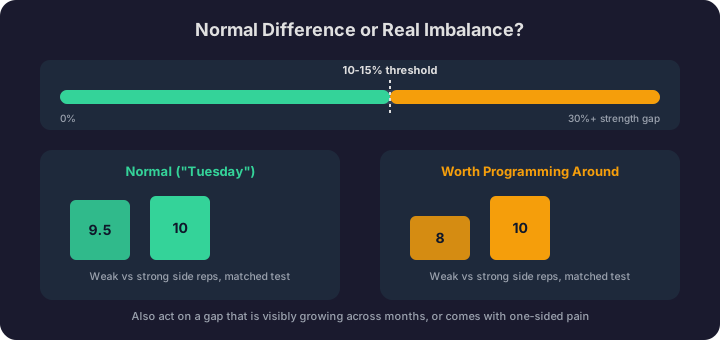
Small visual differences are universal and mostly cosmetic. A slightly higher bicep peak, a pec that inserts differently, an oblique that shows more on one side: much of this is insertion points and bone structure, which training does not change. If you only notice the difference because you went looking for it under gym lighting, it is almost certainly in the normal range, and nobody else has ever seen it.
A practical coaching heuristic for when to act, and we frame it as a heuristic rather than a law: pay attention when the strength gap between sides exceeds roughly 10 to 15 percent on a matched unilateral test, or when an asymmetry is visibly growing across months rather than holding steady. A weaker side that does eight reps to the strong side's ten is worth programming around. A weaker side that does nine and a half to the strong side's ten is Tuesday.
The other trigger for action is symptoms: an asymmetry that comes with one-sided pain, a visible hip or bar shift under load, or a side that fatigues dramatically earlier. Those point to a movement problem, not just a size difference, and they are worth addressing regardless of how small the visual gap is.
Measure It Before You Fix It
The mirror is a terrible instrument. It shows you one angle, in one light, filtered through whatever you are anxious about that day, and gym mirrors and bathroom mirrors disagree with each other. Before reorganizing your training around an imbalance, measure it two ways.
First, standardized photos. Same spot, same time of day, same neutral lighting, front and back, arms relaxed and then flexed. Photos taken under identical conditions a month apart will tell you more than a hundred mirror checks, because they remove the variables your eyes cannot. This is exactly what HyperBody's physique analysis is built on: five standardized photos, scored muscle group by muscle group, so left-right differences show up as comparable numbers over time instead of impressions. Whichever tool you use, the principle is the same: identical conditions, repeated monthly, trend over snapshot.
Second, simple unilateral strength tests. Pick one upper body and one lower body movement you can do strictly one side at a time: a single-arm dumbbell row and a single-leg split squat work well. Same weight, both sides, taken close to failure with honest form, and count the reps. The rep gap between sides is your number. Re-test every four to six weeks under the same conditions. This matters because visual asymmetry and strength asymmetry do not always agree, and the strength gap is the one that responds fastest to training.
The Fix Toolkit
If your gap clears the threshold, the fix is not exotic. It is a handful of programming rules applied patiently.
Make unilateral work a staple, not a garnish. Exercises where each side works alone make it impossible for the strong side to silently donate force. The Bulgarian split squat is the standard for legs; the dumbbell row covers the upper back and lats one side at a time. Single-arm presses and single-leg Romanian deadlifts round out the pattern. You do not need to replace your bilateral lifts; you need two or three unilateral movements in the week that refuse to let the imbalance hide.
Start every unilateral set with the weaker side, and let it set the terms. The weak side works first, while you are freshest, and however many quality reps it produces, the strong side gets the same number and not one more. The strong side will feel underworked. That is the point: you are holding it steady while the weak side closes the distance.
Equalize volume, not intensity. The temptation is to pile extra sets onto the weak side. A more sustainable approach is matching: same sets, same reps, same load on both sides, dictated by the weaker one. If the gap is large, add at most one extra set for the weak side. The weak side grows because it is finally receiving a full, honest stimulus, not because you buried it in remedial volume it cannot recover from.
Log each side separately. If your training log records "split squats 3x10" as one line, the imbalance is invisible in the place you make decisions. Write the weak side's reps and load as their own entry, every session, and the log becomes the early-warning system: you will see the gap closing, stalling, or quietly widening weeks before the mirror or the tape measure registers anything. It also keeps you honest on the matching rule, because the strong side's number is sitting right there next to the weak side's, and any session where they drift apart is a session where the old pattern crept back in.
Audit your bilateral technique, because this is where the imbalance feeds. A bar that tilts on the press, a hip that shifts sideways out of the squat hole, a deadlift that turns slightly in your hands: these are the leaks that built the gap, and they are nearly impossible to feel from inside the rep. Film your main lifts from the front, where left-right deviations actually show. HyperBody's video form check flags exactly this class of fault, bar tilt and side-to-side shift included, rep by rep, which makes it useful here even if your form feels perfectly even. Feeling even is not evidence.
What Not to Do
Two mistakes make imbalance projects fail.
The first is training only the weak side. It feels logical: pause the strong arm entirely until the weak one catches up. In practice you detrain the strong side, lose progress on every bilateral lift, shrink the total training stimulus, and create a new problem in the other direction. The strong side maintains; it does not sit out.
The second is chasing perfect symmetry. There is no finish line where both arms measure identical and both sides rep identically forever, because bone, insertions, and a lifetime of handedness guarantee residual differences. Perfect symmetry is not the goal; a strength gap inside roughly ten percent and a visual difference nobody but you can find is the goal. Past that point, further obsession costs more than it returns.
How Long This Takes
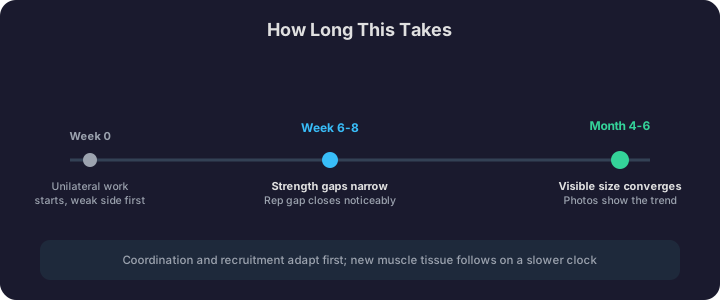
Set expectations now, because this is a slow fix. Strength gaps respond first: with consistent unilateral work, rep gaps often narrow noticeably inside six to eight weeks, because much of the early change is the weak side learning to recruit properly. Visible size differences move on muscle-growth timelines, which means months. A noticeable arm or leg asymmetry typically takes four to six months of consistent work to visibly converge, sometimes longer, and progress shows up in your monthly photos and rep tests long before the mirror admits it.
That is the real argument for measuring: motivation survives on visible trend lines. A monthly photo comparison and a rep-gap log will show the gap closing while your eyes are still insisting nothing has changed.
The Bottom Line
Everyone is asymmetrical, and most asymmetries deserve a shrug. Measure before you act: standardized monthly photos plus a simple rep test on one upper and one lower body movement. Act when the strength gap clears roughly 10 to 15 percent, when the difference is growing, or when it travels with pain or a visible shift under load. Then fix it with patience instead of panic: unilateral staples, weak side first and setting the rep count, matched volume across sides, and a camera on your bilateral lifts so the leak that built the gap stops feeding it. Hold the strong side steady, bring the weak side up, and judge the project monthly. Symmetry is a direction, not a destination.
More field notes.

Weak Point Training: How to Bring Up Lagging Muscle Groups
Every physique has a lagging muscle group, and most lifters attack theirs with more enthusiasm than strategy. Here is how to diagnose a true weak point objectively, and the programming playbook that actually brings it up.

How to Start Working Out: A Beginner's Guide to Your First 12 Weeks
A simple, evidence-based plan for your first three months of training. What to do, how much, and why consistency beats intensity when you're starting your fitness journey.

Cardio vs Weights for Fat Loss: What the Science Actually Says
Should you run to lose fat, or lift? The honest answer is that they do different jobs, and the thing that actually drives fat loss isn't either one. Here's how to combine them the right way.
More on HyperBody