Squat form check
Am I squattingdeep enough?
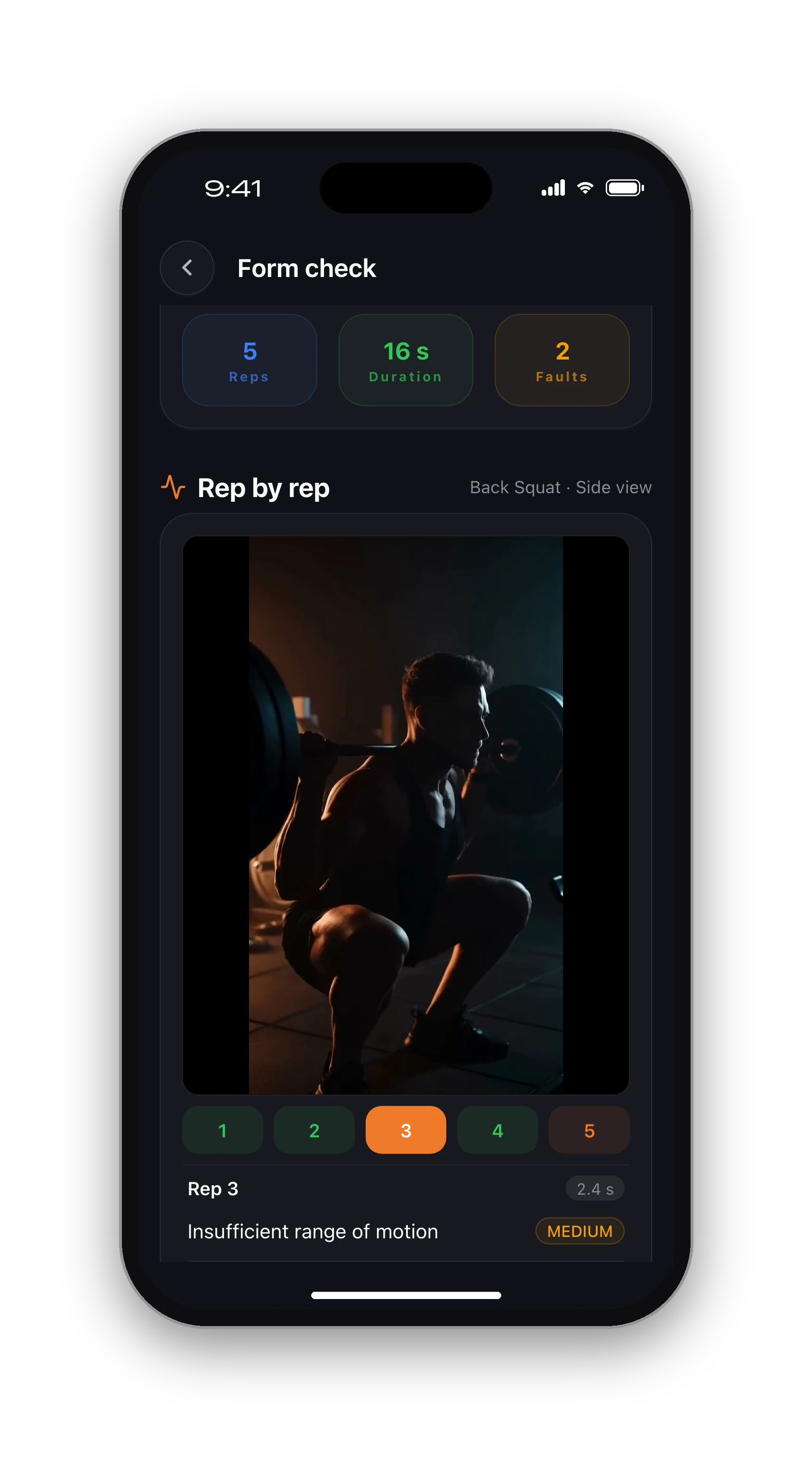
Parallel means your hip crease drops level with the top of your knee. Film one set from the side and the free check tells you, rep by rep, whether you got there.
6-second clip · no account · free once a day
6 s
Clip is enough
Free
No account needed
Every
Rep checked
Side
View works best
Parallel, and just short of it.
Look at yourself from the side at the bottom of the rep. At parallel, the crease where your hip folds is level with the top of your knee. Below parallel, the hip crease sits lower than the knee. A shallow squat stops with the thighs still pointing slightly up, often a few centimetres higher than it feels.
That last part is why people ask. From inside the rep, a squat a hand's width above parallel feels deep, especially under a heavy bar. The fault also creeps in late in a set: the first reps hit depth and the last two get cut short as you tire. The only reliable way to know is to film it.
Depth is part of the lift.
A deeper squat works your glutes and inner thighs through a longer range, and a full rep is a fairer test of strength. Cut the depth and you can put more weight on the bar while doing less work, so the numbers in your log stop meaning what you think they mean.
Consistency matters as much as depth itself. If one week you squat to parallel and the next week a bit higher, you cannot tell whether you got stronger. Pick a depth you can hit on every rep, keep it, and add weight from there. For the long answer, read how deep should you squat.
A cue, a drill, a setup change.
Try them in this order. Most people only need the first two.
- The cue: "sit between your heels" and let your knees travel forward over your toes. Fighting forward knee travel is the most common reason a squat stops short
- The drill: paused goblet squats. Hold the bottom for three seconds with the weight at your chest; it teaches you where depth is and lets your hips and ankles settle there
- The load or setup: drop the bar weight by about 10 to 20 percent for a few weeks and own the depth, then build back. Small plates under your heels or a slightly wider stance with toes turned out can help if your ankles are stiff
What the check actually measures.
The check tracks your hips and knees in every frame of the video. For each rep it finds the bottom position, the moment your hips are lowest, and compares the height of your hips with the height of your knees. Hips at or below the knees pass; a rep that stops above that line is marked as not deep enough.
It also measures how far your hips travel from the top of the rep to the bottom. A rep where the hips barely move, a quarter squat or a bounce, is flagged as a short range of motion, even if the knees are hard to see. You get the rep numbers where it happened, not a vague score.
A side view gives the clearest answer; a front view still works. More on how an AI form check works and how to film your lifts.
Six seconds of video.
Film one set from the side, whole body in frame, phone steady at about hip height. Upload it to the free AI form check, no account needed, and you get your rep count, up to two faults and one cue to fix first. The clip is deleted when the check is done.
Want every rep scored and your progress tracked over time? That is the form check inside the app, part of Pro. See the squat form check for every fault we look for, the back squat guide, and the 6-day push pull legs program, which squats to depth twice a week.
From one set to a clear answer.
01
Film from the side
Whole body in frame, phone at hip height, one set of up to 6 seconds.
02
Upload the clip
Choose back squat on the free form check. No account needed.
03
Read your reps
See which reps reached depth, the top fault and the one cue to fix first.
Know what's free before you sign up.
Free, with no time limit
Log every workout, build your own routines, follow the 8 ready programs, and keep your full history, records and charts. No card needed.
What Pro adds
An AI training plan that adapts to what you lift, full physique reports from photos, form checks inside the app and AI recipes. Trial included.
Straight answers.
Keep going.
Squat form check
Every squat fault the check looks for.
OpenBack squat
Setup, execution and the muscles it trains.
OpenHow deep should you squat?
Depth, mobility and safety, in detail.
Open6-day push pull legs
A program that squats to depth twice a week.
OpenFree AI form check
Upload a 6-second clip, no account.
OpeniPhone, Apple Watch and Android.
HyperBody runs on iPhone with an Apple Watch app, and on Android. Your workouts, programs and records follow your account, and the web app shows the same data.


Stop guessing your depth. Film one set.
Free from a 6-second clip, no account needed.
Check my squat free