TrainingSep 13, 20269 min read
Lire en français·Auf Deutsch lesen·Leer en español·Przeczytaj po polsku
How Deep Should You Squat? Depth, Mobility, and Safety
Squat depth starts more arguments than almost any other topic in the gym, and most of the arguing ignores both the evidence and your individual anatomy. Here is what the research actually says about depth, knees, and muscle growth, and how to find the depth that fits your body.
Reviewed by the HyperBody team

Ask three lifters how deep you should squat and you will get four answers. One insists anything above parallel does not count. Another swears deep squats wreck your knees. A third tells you depth does not matter as long as the bar moves. The argument has been running for decades, and most of it ignores the two things that actually settle it: what the research says, and what your individual anatomy allows.
The honest answer is that for most people, most of the time, squatting deeper is better for muscle growth and is not dangerous for healthy knees. But "deeper" does not mean one universal depth, and the right depth for you is determined by your ankles, your hips, and your femurs, not by what someone else's squat looks like. This article walks through both halves: the evidence, and the individual.
What Depth Actually Means
Before arguing about depth, it helps to define it, because the labels get thrown around loosely.
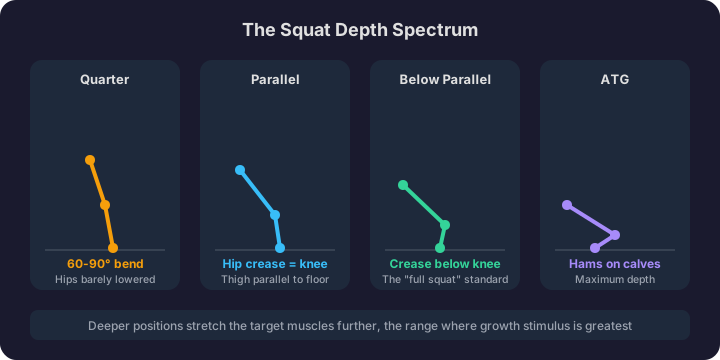
A quarter squat stops well above parallel, with the knees bent somewhere around 60 to 90 degrees and the hips barely lowered. It is what most people do when the bar is too heavy.
A parallel squat brings the crease of your hip level with the top of your knee. Viewed from the side, your thigh is roughly parallel to the floor. This is the standard most powerlifting federations judge against, give or take an inch.
Below parallel means the hip crease drops beneath the top of the knee. This is what most coaches mean when they say "full squat" or "deep squat."
ATG, ass to grass, is the deepest version: descending until your hamstrings rest on your calves and you simply cannot go lower. Olympic weightlifters live here.
The differences between these are not cosmetic. Each depth changes how far your muscles stretch under load, how much weight you can handle, and what adaptations you get. Which brings us to the evidence.
What the Evidence Says About Depth and Muscle Growth
The clearest controlled comparison comes from a Danish study that trained two groups for twelve weeks: one squatting through a shallow range, about 60 degrees of knee bend, the other squatting deep, around 120 degrees. The deep squat group gained significantly more muscle in the thigh, and the growth advantage showed up along the whole front of the leg, while the shallow group's gains were concentrated and smaller1. The deep group also improved their shallow squat strength, but the shallow group did not improve their deep squat nearly as much. Training deep transferred up; training shallow did not transfer down.
A later Japanese study compared full squats against half squats over ten weeks and found a similar pattern: full squats produced more growth in the adductors and glutes, the muscles that do their hardest work in the bottom of the squat2. Quad growth was comparable between groups in that study, which is a useful nuance: the deepest range seems to matter most for the muscles that get stretched hardest down there, the inner thighs and glutes.
The pattern fits the broader hypertrophy literature: training a muscle at long lengths, in its stretched position, tends to produce more growth than training it short. The bottom of a deep squat is exactly that stretched position for the quads, adductors, and glutes. Cut the depth and you cut the stretch, and with it a meaningful share of the stimulus.
None of this means quarter squats build nothing. It means that rep for rep, set for set, deeper squats give you more muscle for the same time investment. If you can squat deep, the evidence says you should.
The Knee Safety Myth
The reason many people do not squat deep is fear, usually planted by a coach, a physio, or a relative who heard somewhere that deep squats grind your knees into dust. The claim has been investigated thoroughly, and it does not hold up.
A comprehensive review looked specifically at the loads on the knee joint and spine at different squat depths and concluded that, for healthy lifters with sensible loading, deep squats do not pose an increased injury risk to the knee compared with shallower squats3. Two findings from that review are worth knowing. First, compressive forces in the knee do not keep climbing the deeper you go: in the deepest position, the contact between hamstrings and calves and the way the joint surfaces share load actually help distribute forces. Second, and counterintuitively, shallow squats may be the riskier habit over time, because stopping at quarter depth lets you load far more weight, and that heavier load is carried by the knee and spine through the range where shear stress is highest.
There is a real caveat: this applies to healthy knees, progressive loading, and controlled technique. If you have an existing knee injury, a history of surgery, or pain in the deep position, that is a conversation with a professional, not a blog article. But "deep squats are bad for your knees" as a blanket rule belongs in the bin.
Why Your Depth Is Not My Depth
Here is where the internet arguments go wrong: maximum useful depth varies enormously between bodies, and three structures decide most of it.
Ankle dorsiflexion is how far your knee can travel forward over your toes with your heel flat. Squatting deep requires a lot of it. If your ankles are stiff, your knees stop moving forward early in the descent, your torso pitches forward to compensate, and your heels start floating. Many "bad squatters" are just lifters with stiff ankles.
Hip anatomy is the one nobody can train around. The depth and orientation of your hip sockets and the shape of your femoral necks are skeletal facts. Some hips allow a deep, upright squat with a narrow stance. Others physically run out of room: the femur contacts the pelvis and the only way lower is for the pelvis to tuck. No amount of stretching changes bone shape.
Femur length relative to torso changes the picture too. Long femurs with a short torso push the hips far back and the chest far down to keep the bar balanced over midfoot. That lifter's deep squat will always look more folded over than a short-femured lifter's, and that is geometry, not a flaw.
Then there is the butt wink, which deserves a plain-language explanation because it generates so much anxiety. Near the bottom of a squat, when your hips run out of flexion range, your pelvis tucks under and your lower back rounds slightly. That is the wink. A small, consistent tuck right at the bottom, under moderate load, is common and not a proven injury mechanism. A large, sudden rounding under heavy load is different: it shifts stress to the spine at the worst moment and usually means you have squatted below the depth your hips currently allow. The practical rule: your useful depth ends where your spine stops staying neutral, and that point is yours, not a standard.
How to Find Your Depth
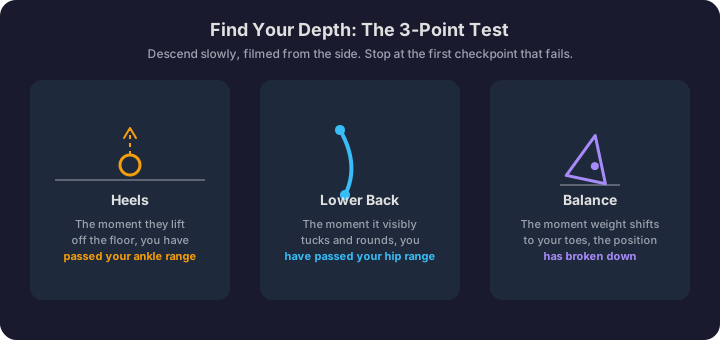
Forget the labels for a session and run a simple test. Take an empty bar or a light goblet hold. Descend slowly, three or four seconds down, heels glued to the floor, and have someone film you from the side, or prop your phone at hip height.
Watch for three things. Your heels: the moment they lift, you have passed your ankle range. Your lower back: the moment it visibly tucks and rounds, you have passed your hip range. Your balance: the moment the weight shifts to your toes or you tip forward, the position has broken down.
Your working depth is just above the point where the first of those three fails. For many lifters that is comfortably below parallel. For some it is right at parallel for now. Either way, you now have a depth chosen by your body rather than by a stranger's opinion, and a clear picture of which limitation to attack in order to earn more range.
Earning More Depth
If your test showed you running out of range before you would like, the fixes depend on which link failed first.
For stiff ankles, the highest-value habit is loaded ankle work: a half-kneeling position, driving the front knee over the toes with the heel down, a few minutes per side before squatting, plus calf stretching with a bent knee. Progress is slow but real. Measure it monthly by how far your knee passes your toes against a wall.
Experiment with stance before assuming you have a mobility problem. Widening your feet and turning your toes out 15 to 30 degrees gives many hips the clearance they need, and an inch of stance change can buy more depth than a month of stretching. There is no prize for squatting narrow if your hips prefer wide.
Elevate your heels. Lifting shoes or a small plate under each heel reduce the ankle range the squat demands and let you sit deeper and more upright immediately. This is not cheating; it is changing the exercise to fit your levers. The same logic is why many long-femured lifters get more quad work from a front squat, where the bar position forces an upright torso and the depth comes more naturally.
And keep squatting deep with lighter loads. Range of motion adapts to what you practice. The deep positions you visit regularly with control become positions you own.
When Partial Range Has a Place
Saying deeper is generally better is not the same as saying partials are useless. Quarter and half squats have legitimate jobs: overloading the top range for sport-specific reasons, working around an injury that tolerates only partial range, or adding top-end volume late in a session when full-depth quality is gone. Some advanced lifters add lengthened partials in the bottom range, the opposite of the classic quarter squat, precisely because the stretched position is so productive.
The problem is not partial squats. The problem is partial squats by accident, loaded as if they were full squats, counted as if they were full squats. Choose your range on purpose.
Film It, Because Depth Lies
Here is the uncomfortable truth about depth: almost everyone squats higher than they think. The bottom of a squat feels deeper than it looks, and a rep that feels below parallel is often an inch or two above. You cannot judge your own depth from inside the lift, and the front-view mirror is the worst possible angle for it.
A side-on video at hip height settles the question in one set. Our guide on how to film your lifts covers angles and setup. If you want the footage assessed rather than just recorded, HyperBody's video form check analyzes your back squat rep by rep and flags depth, heel lift, and forward lean, so you can see whether the depth you think you hit is the depth you actually hit.
The Bottom Line
Squat as deep as your body allows with a neutral spine and flat heels, because the evidence says depth grows more muscle12 and does not threaten healthy knees3. Find your personal limit with a slow, filmed descent. If you want more range, fix the ankle or stance issue that is actually limiting you instead of forcing depth your hips do not have. And measure depth with a camera, not with feel, because feel flatters everyone.
References
Footnotes
-
Bloomquist K et al. (2013). Effect of range of motion in heavy load squatting on muscle and tendon adaptations. European Journal of Applied Physiology, 113(8), 2133-2142. https://doi.org/10.1007/s00421-013-2642-1
-
Kubo K, Ikebukuro T & Yata H (2019). Effects of squat training with different depths on lower limb muscle volumes. European Journal of Applied Physiology, 119(9), 1933-1942. https://doi.org/10.1007/s00421-019-04181-y
-
Hartmann H, Wirth K & Klusemann M (2013). Analysis of the load on the knee joint and vertebral column with changes in squatting depth and weight load. Sports Medicine, 43(10), 993-1008. https://doi.org/10.1007/s40279-013-0073-6
More field notes.

The 7 Most Common Bench Press Mistakes (And How to Fix Them)
The bench press looks like the simplest lift in the gym, which is exactly why it collects more technique errors than any other. Here are the seven mistakes that cost you the most strength and shoulder health, and the specific cue that fixes each one.

How to Warm Up Properly: A Science-Based Approach
Most people either skip the warm-up entirely or waste 20 minutes on a treadmill. Here's what an effective warm-up actually looks like and why it matters.

How to Start Working Out: A Beginner's Guide to Your First 12 Weeks
A simple, evidence-based plan for your first three months of training. What to do, how much, and why consistency beats intensity when you're starting your fitness journey.
More on HyperBody