Deadlift form check
Is your back roundingon the deadlift?
It is hard to feel and easy to film. Record one set from the side and the free check shows which reps lost your back position on the way up.
6-second clip · no account · free once a day

6 s
Clip is enough
Free
No account needed
Every
Frame of the pull tracked
Side
View needed
The back gives before the bar moves.
At the start of a good deadlift your back is set in one firm line from hips to head, and it keeps that shape all the way to lockout. Rounding is when that line bends as you pull: the lower back flexes, the chest drops toward the bar and the hips rise faster than the shoulders.
It usually shows in one of two places. Right off the floor, when the bar is heaviest relative to your position, or late in a set, when your grip and upper back tire. From inside the lift you rarely feel it, which is why so many people only see it on video.
Where the load goes instead.
When your back stays set, your hips and legs do the lifting and your spine passes the force along. When it rounds under a heavy bar, the lift can shift load onto your lower back and the bar drifts away from you, which makes the same weight harder to move.
Some upper back rounding is not the same as lower back rounding, and plenty of strong lifters pull with a slightly rounded upper back on purpose. What matters is that your position does not change during the rep. If you feel pain, stop and talk to a physio before you load it again. The deadlift form guide covers the full hinge.
A cue, a drill, a load change.
Start with the cue and the load change; they solve most cases within a few sessions.
- The cue: "pull the slack out" before the bar leaves the floor. Grip the bar, pull up on it until it clicks against the plates, chest up, then push the floor away with your legs
- The drill: Romanian deadlifts with a weight you can control, or paused deadlifts that stop an inch off the floor for two seconds. Both teach you to hold your back position under load
- The load: drop the weight 10 to 20 percent and rebuild with a neutral back on every rep. Set up with the bar over the middle of your foot, and if you cannot reach it without rounding, pull from blocks for a while
What the check actually measures.
The check tracks the line from your shoulders to your hips in every frame of the pull, from the bottom of the rep to lockout. On a clean deadlift that line gets steadily more upright as you stand. If it tips forward by more than 20 degrees from where it started after the bar leaves the floor, the rep is flagged as back rounding.
To be honest about what a phone sees: the camera tracks shoulders and hips, not each vertebra, so it reads what rounding does to your position (chest dropping, hips shooting up) rather than the curve of your spine directly. The same check also watches how far the bar drifts away from you and whether you reach full lockout. A side view is required.
More on how an AI form check works and how to film your lifts.
Film one set, get the answer.
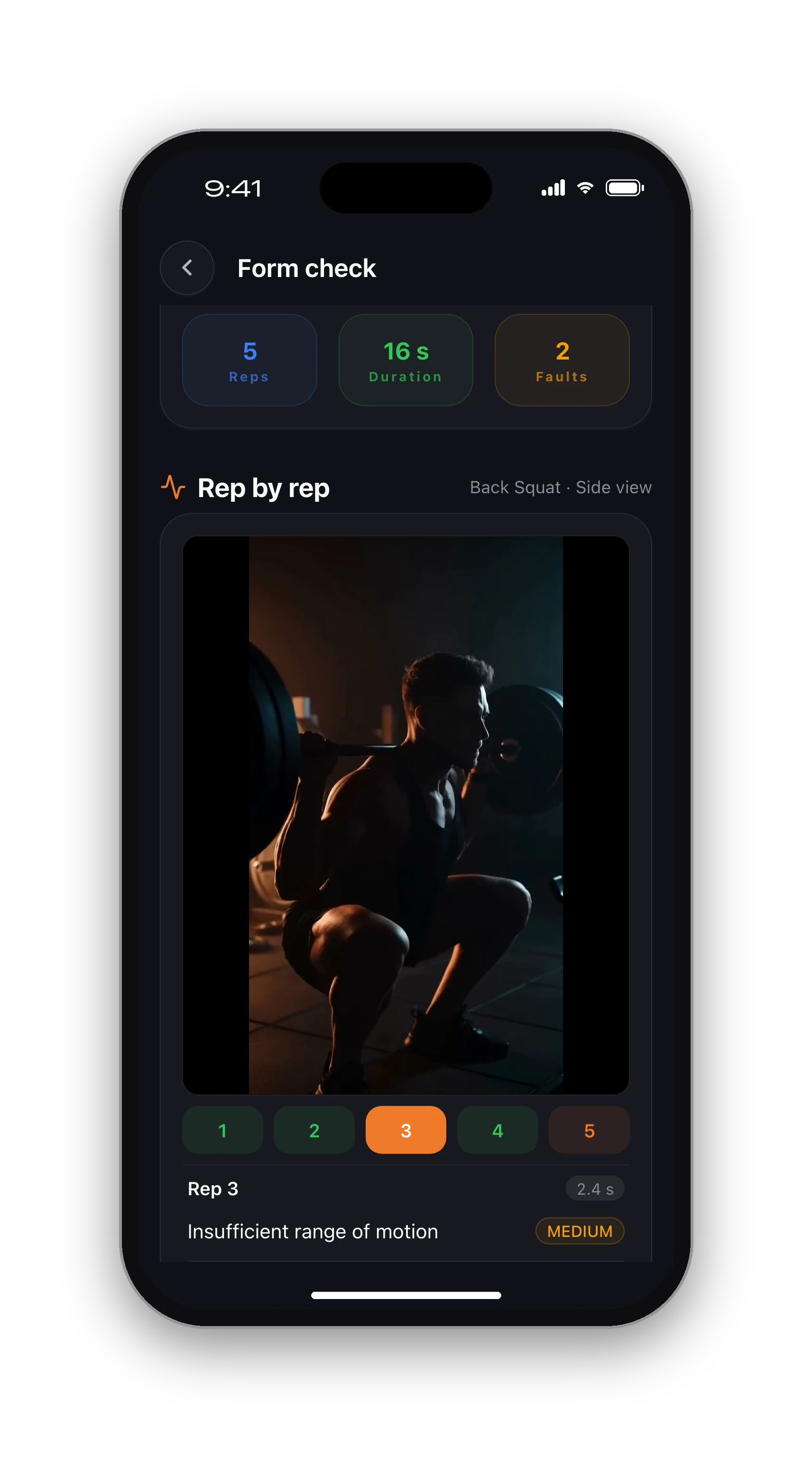
Stand the phone side on, at about hip height, with your whole body and the bar in frame. Upload up to 6 seconds to the free AI form check, no account needed. You get your rep count, up to two faults and one cue to fix first, and the clip is deleted when the check finishes.
In the app, with Pro, the form check scores every rep and tracks your progress over time. See the deadlift form check for every fault we look for, the conventional deadlift guide, and the powerbuilding upper lower program, where the deadlift is the heaviest lift of the week.
From one set to a clear answer.
01
Film from the side
Whole body and the bar in frame, phone at hip height, up to 6 seconds.
02
Upload the clip
Choose deadlift on the free form check. No account needed.
03
Read your reps
See which reps lost your back position, the top fault and the cue to fix first.
Know what's free before you sign up.
Free, with no time limit
Log every workout, build your own routines, follow the 8 ready programs, and keep your full history, records and charts. No card needed.
What Pro adds
An AI training plan that adapts to what you lift, full physique reports from photos, form checks inside the app and AI recipes. Trial included.
Straight answers.
Keep going.
Deadlift form check
Every deadlift fault the check looks for.
OpenConventional deadlift
Setup, execution and the muscles it trains.
OpenDeadlift form guide
Hinge mechanics, bracing and common faults.
OpenPowerbuilding upper lower
Heavy deadlifts once a week, with the rest built around them.
OpenFree AI form check
Upload a 6-second clip, no account.
OpeniPhone, Apple Watch and Android.
HyperBody runs on iPhone with an Apple Watch app, and on Android. Your workouts, programs and records follow your account, and the web app shows the same data.


See your back position. Film one set.
Free from a 6-second clip, no account needed.
Check my deadlift free