CoachingNov 19, 20269 min read
Lire en français·Auf Deutsch lesen·Leer en español·Przeczytaj po polsku
Why a Training Log Is Your Most Underrated Tool
The simplest habit in fitness is also one of the most powerful, and most people skip it. Here's the science on why writing down your workouts quietly separates the people who progress from those who spin their wheels.
Reviewed by the HyperBody team

Walk through any gym and you'll see two kinds of people. Some drift from machine to machine, doing "whatever feels right," with no idea what they lifted last week. Others log every set. Over a year, the difference between them is enormous, and it isn't genetics or a secret program. It's the logbook. Tracking your training is the least glamorous habit in fitness and one of the most powerful. Here's the evidence for why.
The Science of Self-Monitoring
The value of a training log isn't gym-bro folklore. It's one of the best-established findings in behavior-change science. When researchers analyzed 122 diet and physical-activity interventions covering some 44,000 people, self-monitoring came out as the single most effective behavior-change technique1. Interventions that paired self-monitoring with related self-regulation techniques nearly doubled their effectiveness compared to those without1.
This holds across domains. A systematic review of weight-loss studies found a consistent, significant association between self-monitoring and better results2. The simple act of recording what you do reliably improves outcomes.
And here's the most striking part: it's causal, not just correlational. A meta-analysis of 138 experiments (nearly 20,000 people) found that prompting people to monitor their progress toward a goal significantly increased both their monitoring and their actual goal attainment3. Tracking doesn't just reflect progress: it drives it. Your logbook is an active tool, not a passive diary.
Why It Matters Specifically for Lifting
Beyond general behavior change, a training log is mechanically essential for the thing that builds muscle and strength: progressive overload. Progress requires systematically doing more over time. More weight, more reps, more quality4. But you literally cannot beat a number you didn't record.
Think about it. If you don't know that you benched 60 kg for 8 reps last Tuesday, how do you know to aim for 9 reps or 62.5 kg today? Without a log, every session is a guess, and "progressive" overload becomes random overload. The ACSM's progression guidelines, moving through defined rep ranges and loads over time, presuppose that you know your current numbers4. The logbook is what makes deliberate progression possible.
What a Log Does For You
A good training log quietly delivers four things:
1. It enables progression. You walk in knowing exactly what to beat. This turns vague effort into a concrete, winnable target every session4.
2. It creates accountability. Because monitoring itself boosts follow-through3, the habit of logging keeps you consistent and honest. It's an adherence tool disguised as a record1.
3. It lets you troubleshoot. When progress stalls, your log is the evidence. You can see whether your volume dropped, whether you've been stuck at the same weight for weeks, or whether poor sleep is tanking your sessions. You can't fix what you didn't measure.
4. It captures effort, not just numbers. Logging how hard a set felt, your reps in reserve (RIR), lets you autoregulate: pushing on good days, backing off on bad ones5. And this data is trustworthy, because the RIR-based effort scale is validated to track true proximity to failure6.
Goal-Setting Plus Tracking Is the Winning Combo
Tracking is even more powerful when paired with goals. A meta-analysis found that multi-component interventions combining goal-setting, self-monitoring, and feedback produced a medium positive effect on physical-activity behavior7. Your log is the "monitoring" and "feedback" half of that equation: it turns a goal from a wish into something you steer toward with real data.
What to Actually Log
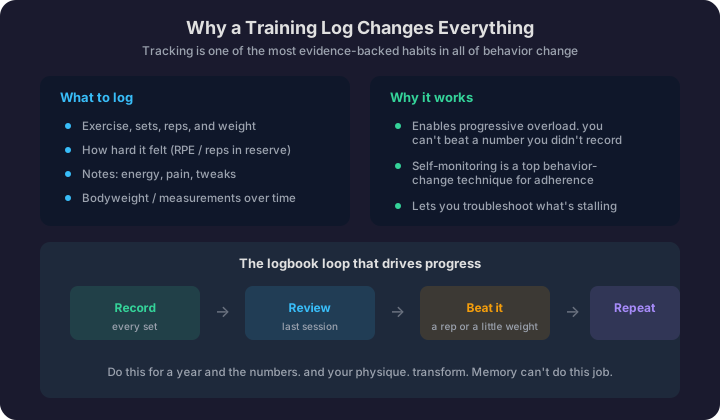
You don't need anything fancy. A notes app, a spreadsheet, or a paper notebook all work. For each session, record:
- The exercise, sets, reps, and weight. the core data that enables progression.
- How hard it felt (RPE or reps in reserve). so you can gauge effort and autoregulate5.
- Brief notes. energy levels, pain or niggles, form cues, anything that helps you interpret trends later.
- Periodically, your bodyweight and measurements. to connect the training to the physique results.
Then, and this is the part people skip, review it before each session. Look at last week's numbers and set today's target. Record, review, beat it, repeat. That's the entire loop that drives long-term progress.
The Bottom Line
- Self-monitoring is the most effective behavior-change technique for diet and exercise12.
- It's causal. tracking your progress actually increases your results, not just reflects them3.
- It's essential for progressive overload. you can't beat numbers you didn't record4.
- It provides accountability and lets you troubleshoot when you stall1.
- Log sets, reps, weight, and effort (RIR), then review and beat it each session56.
The training log is the highest return-on-effort habit in all of fitness. It costs you thirty seconds a set and pays you back in years of steady progress. If you take one thing from this article, make it this: start writing your workouts down. HyperBody's smart coaching builds this in: it tracks every set, shows you your targets, and turns your training history into your next session's plan.
References
Footnotes
-
Michie S, Abraham C, Whittington C, McAteer J, Gupta S (2009). Effective techniques in healthy eating and physical activity interventions: a meta-regression. Health Psychology, 28(6), 690-701. https://doi.org/10.1037/a0016136
-
Burke LE, Wang J, Sevick MA (2011). Self-monitoring in weight loss: a systematic review of the literature. Journal of the American Dietetic Association, 111(1), 92-102. https://doi.org/10.1016/j.jada.2010.10.008
-
Harkin B, Webb TL, Chang BPI, et al. (2016). Does monitoring goal progress promote goal attainment? A meta-analysis of the experimental evidence. Psychological Bulletin, 142(2), 198-229. https://doi.org/10.1037/bul0000025
-
American College of Sports Medicine (2009). Progression models in resistance training for healthy adults (position stand). Medicine & Science in Sports & Exercise, 41(3), 687-708. https://doi.org/10.1249/MSS.0b013e3181915670
-
Helms ER, Cronin J, Storey A, Zourdos MC (2016). Application of the repetitions in reserve-based rating of perceived exertion scale for resistance training. Strength and Conditioning Journal, 38(4), 42-49. https://doi.org/10.1519/SSC.0000000000000218
-
Zourdos MC, Klemp A, Dolan C, et al. (2016). Novel resistance training-specific rating of perceived exertion scale measuring repetitions in reserve. Journal of Strength and Conditioning Research, 30(1), 267-275. https://doi.org/10.1519/JSC.0000000000001049
-
McEwan D, Harden SM, Zumbo BD, et al. (2016). The effectiveness of multi-component goal setting interventions for changing physical activity behaviour: a systematic review and meta-analysis. Health Psychology Review, 10(1), 67-88. https://doi.org/10.1080/17437199.2015.1104258
More field notes.

How to Coach Yourself: Building Your Own Training Program
You don't need to pay for a plan you could build yourself. Here's the exact framework a coach uses to write a program, broken into five decisions you can make today.

Periodization: How to Structure Your Training Over Months
Random workouts get random results. Periodization is how coaches plan training across weeks and months to keep progress coming. Here's what it means, and how to apply it without overcomplicating things.

Double Progression: The Simplest Way to Progress Your Lifts
Progressive overload is the rule that builds muscle, but 'add weight every session' falls apart fast. Double progression is the beginner-friendly method that makes steady progress almost automatic.
More on HyperBody