Strength training tracker
Track your lifts.Watch your 1RM climb.
Log your squat, bench and deadlift in seconds, get an estimated one-rep max from every working set without testing it, and see each lift's records and trend over months. Free on iPhone and Android.
Free · iPhone and Android

e1RM
From every working set
Records
Per lift, all time
Plates
Calculator in the session
Free
Logging and charts
Your one-rep max, without maxing out.
Testing a true one-rep max is tiring and, done often, a poor use of training time. HyperBody estimates it from the sets you already do, with the Epley formula: 100 kg for 5 reps reads as about 117 kg.
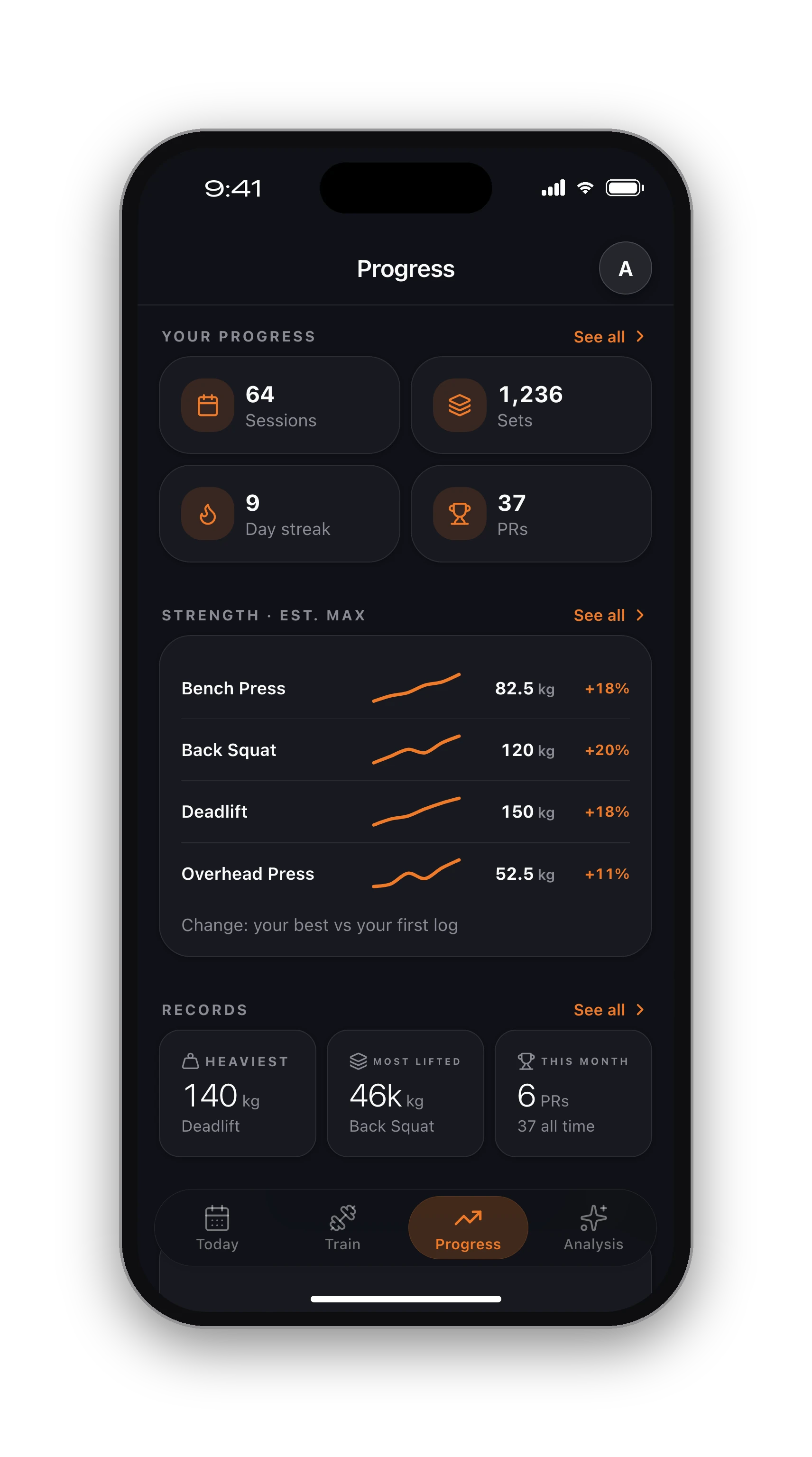
Every lift gets its own estimated max, and the Progress tab draws it over weeks and months. A line that climbs means you are getting stronger, even in a block where you never touch a heavy single. Check any number by hand with the free one-rep max calculator.
Records that count.
Each exercise keeps its records: heaviest weight, best estimated one-rep max, best set and best volume. At the end of every session the summary lists each lift where you went heavier than before, with the margin. Your best set also sits under the exercise while you lift, so you know what a record attempt looks like before you load the bar.
Records ignore obvious typos, so a 1,000 kg squat entered by mistake never becomes a bar you cannot beat. More detail on the PR tracker page.
How strong are you, really?
Numbers mean more against a reference. The free strength standards tool rates your squat, bench, deadlift and five more lifts for your bodyweight, from untrained to elite, and who is stronger compares two lifters of different bodyweights fairly. In the app, Standings shows where each of your main lifts ranks among other lifters.
Plate math on the bar.
Open the menu on a barbell, EZ bar or trap bar exercise and the plate calculator shows which plates go on each side for the weight you are about to lift. No mental arithmetic with chalk on your hands. The same calculator is free on the web as the plate calculator, and the warm-up sets calculator builds your ramp to a heavy top set.
Set types matter in strength work, so mark warm-ups as warm-ups, and give a heavy top set a longer rest than the back-off sets after it.
A program built for strength.
Want strength and size together? The free Upper / Lower Powerbuilding program runs four days a week: heavy, low-rep power days early in the week (bench 4 × 4-6, squat 4 × 4-6, deadlift 3 × 3-5) and higher-rep hypertrophy days later. It is written for advanced lifters; if you are newer, start with upper lower 4 days. Whichever you pick, the bar weights are filled in from your last session, so every heavy day starts from real numbers rather than memory, and the summary tells you the moment a power day turns into a record.
Log the lift, watch it climb.
01
Log your working sets
Weight and reps, with warm-ups marked as warm-ups. The plate calculator loads the bar for you.
02
Read your estimated max
Every working set updates the lift's estimated one-rep max. No test day needed.
03
Check the trend
The Progress tab charts each lift over months; the summary flags each new record.
Know what's free before you sign up.
Free, with no time limit
Log every workout, build your own routines, follow the 8 ready programs, and keep your full history, records and charts. No card needed.
What Pro adds
An AI training plan that adapts to what you lift, full physique reports from photos, form checks inside the app and AI recipes. Trial included.
Straight answers.
With the Epley formula: weight × (1 + reps ÷ 30), from your logged working sets. 100 kg for 5 reps gives about 117 kg. The estimate is most reliable from sets of about 10 reps or fewer, because high-rep sets predict a single poorly.
Not per set today. A week of your plan can carry a target RPE, and AI plans prescribe one, but individual sets record weight and reps (or time). If you want to note how hard a set felt, the exercise notes field is the place.
For training, yes: squat, bench and deadlift with estimated maxes, records and a plate calculator. It is a training log, not meet software, so it does not handle attempt selection, federation rules or meet scoring.
Yes. Bodyweight exercises take added weight, and a logged zero counts as bodyweight. Pull-ups, chin-ups and dips each keep their own records, with the most reps standing as the record when you train them unweighted.
No. The estimated max comes from the sets you already do, so the chart fills in as you train. If you do test a heavy single, log it like any other set and it counts too.
Keep going.
Powerbuilding program
Four days: heavy power days and hypertrophy days.
OpenOne-rep max calculator
Estimate your max from any set.
OpenStrength standards
How your lifts compare by bodyweight.
OpenPlate calculator
Which plates go on each side.
OpenPR tracker
Every record, every lift.
OpenProgressive overload
Know what to lift next time.
OpeniPhone, Apple Watch and Android.
HyperBody runs on iPhone with an Apple Watch app, and on Android. Your workouts, programs and records follow your account, and the web app shows the same data.