Body CompositionNov 16, 202610 min read
Lire en français·Auf Deutsch lesen·Leer en español·Przeczytaj po polsku
Loose Skin After Weight Loss: What to Expect
Worried that losing a lot of weight will leave you with loose skin? Here's an honest look at what causes it, who's most affected, what actually helps, and why you shouldn't let the fear stop you.
Reviewed by the HyperBody team

It's one of the most common fears that holds people back from losing weight: the worry that under the fat is a body draped in loose, sagging skin. It's a real concern, and it deserves an honest answer, not the false promise that a magic cream or the right diet guarantees tight skin, and not the fear-mongering that scares people out of getting healthy. Here's what the evidence actually says about loose skin after weight loss.
First, Who Actually Gets Loose Skin?
The important context: significant loose skin is largely a phenomenon of massive weight loss, the kind seen after bariatric surgery or losing a very large amount of weight. In that population it's extremely common. One study found that 96% of gastric-bypass patients developed surplus skin1, and more than 70% of bariatric-surgery patients are affected2.
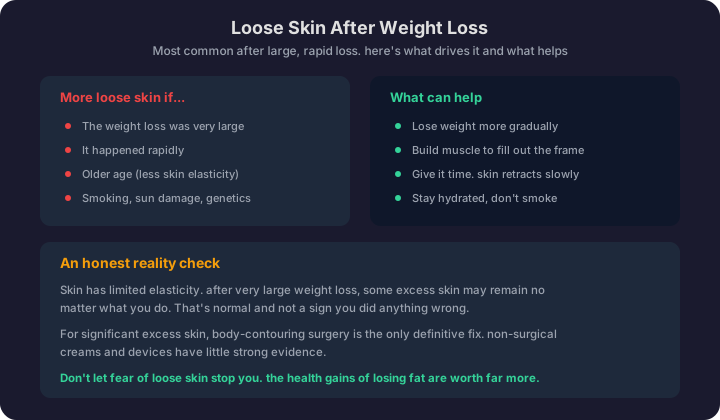
Crucially, excess skin is specific to obesity and massive weight loss. It's rare in people who were never severely overweight3. So if you're losing a moderate amount of fat, say 5 to 15 kg to get lean, significant loose skin is far less likely to be an issue. The dramatic "loose skin" photos you see online almost always follow the loss of 40, 50, or more kilograms.
Why It Happens
Loose skin comes down to your skin's structural proteins, collagen and elastin, which give it firmness and the ability to snap back. When skin is stretched over a large fat mass for a long time, and then that mass disappears, the skin can't fully retract. Analysis of skin after massive weight loss shows fragmented elastic fibers and significantly reduced collagen density and thickness, explaining why it retracts poorly4.
The single biggest predictor is the magnitude of weight loss: the more weight lost (and the higher the starting BMI), the more excess skin tends to remain2. Beyond that, factors like older age are linked to how much the excess skin bothers people2. Other commonly cited factors, smoking, sun damage, and the speed of weight loss, are biologically plausible given the collagen and elastin mechanism, but they weren't isolated as predictors in these studies, so treat them as reasonable mechanism-based cautions rather than proven causes.
What Actually Helps
Here's where honesty matters, because a lot of what's sold as a loose-skin "fix" isn't well supported. Setting realistic expectations:
Losing weight more gradually and building muscle may help, as sensible measures, not guarantees. Resistance training during weight loss is proven to preserve lean muscle mass while you lose fat5, and having more muscle helps fill out your frame under the skin. Slower loss is also consistent with giving skin time to adapt. But be clear-eyed: no study has directly proven that gradual loss or added muscle reduces measured loose skin. These are reasonable, mechanism-based recommendations, likely helpful, not certain.
Give it time. Skin retraction is slow, happening over many months to a couple of years after weight stabilizes. What looks loose at month three may tighten noticeably by month eighteen.
Support your skin generally. Staying hydrated and not smoking are sensible for skin health, even if their specific effect on loose skin isn't quantified here.
The Honest Reality Check
For significant excess skin after major weight loss, there's one thing that definitively works: body-contouring (surgical) removal. It's the definitive treatment, and studies show it meaningfully improves quality of life: physical function, body image, and psychological wellbeing6. Non-surgical devices (radiofrequency, ultrasound, and the like) offer only mild tightening and do not match surgical results for large amounts of excess skin7. So be skeptical of creams, wraps, and gadgets promising to "tighten" substantial loose skin: the evidence isn't there7.
And here's the most important point: after very large weight loss, some excess skin may remain no matter what you do. That's normal, it's not a sign you did anything wrong, and it doesn't erase your accomplishment.
Don't Let the Fear Stop You
The biggest mistake would be letting the fear of loose skin keep you from losing fat you'd be far healthier without. Excess skin can cause real issues: rashes, discomfort, and its quality-of-life impact is real16. But those are addressable, including surgically if needed. The health consequences of staying obese are far more serious and far less fixable.
If you're losing a moderate amount of weight, loose skin probably won't be a major issue for you at all. If you're losing a large amount, some may be unavoidable, but you'll be healthier, and you have options. Neither scenario is a reason to stay where you are.
The Bottom Line
- Significant loose skin mostly follows massive weight loss (like post-bariatric); it's uncommon after moderate fat loss132.
- The magnitude of weight loss is the biggest driver, via collagen and elastin that can't fully retract42.
- Building muscle and losing gradually likely help: sensible measures, though not proven to eliminate loose skin5.
- Give it many months to retract, and support skin health generally.
- Surgery is the definitive fix for major excess skin. non-surgical gadgets don't match it67.
- Don't let fear of loose skin stop you from getting healthy. the trade is worth it.
If your goal is a leaner, more muscular body, the best strategy is exactly the one that also minimizes loose-skin risk: lose fat at a sustainable pace while building muscle. A smart coaching plan built around resistance training does precisely that.
References
Footnotes
-
Kitzinger HB, Abayev S, Pittermann A, et al. (2012). After massive weight loss: patients' expectations of body contouring surgery. Obesity Surgery, 22(4), 544-548. https://doi.org/10.1007/s11695-011-0551-6
-
Baillot A, Brais-Dussault E, Bastin A, et al. (2023). Factors associated with excess skin after bariatric surgery: a mixed-method study. Obesity Surgery, 33(8), 2324-2334. https://doi.org/10.1007/s11695-023-06698-w
-
Biörserud C, Nielsen C, Staalesen T, et al. (2013). Sahlgrenska Excess Skin Questionnaire (SESQ): a reliable questionnaire to assess the experience of excessive skin after weight loss. Journal of Plastic Surgery and Hand Surgery, 47(1), 50-59. https://doi.org/10.3109/2000656X.2012.731001
-
Sami K, Elshahat A, Moussa M, Abbas A, Mahmoud A (2015). Image analyzer study of the skin in patients with morbid obesity and massive weight loss. Eplasty, 15, e4. https://pmc.ncbi.nlm.nih.gov/articles/PMC4311578/
-
Binmahfoz A, Dighriri A, Gray C, Gray SR (2025). Effect of resistance exercise on body composition, muscle strength and cardiometabolic health during dietary weight loss in people living with overweight or obesity: a systematic review and meta-analysis. BMJ Open Sport & Exercise Medicine, 11(3), e002363. https://doi.org/10.1136/bmjsem-2024-002363
-
Toma T, Harling L, Athanasiou T, Darzi A, Ashrafian H (2018). Does body contouring after bariatric weight loss enhance quality of life? A systematic review of QOL studies. Obesity Surgery, 28(10), 3333-3341. https://doi.org/10.1007/s11695-018-3323-8
-
Mazzoni D, Lin MJ, Dubin DP, Khorasani H (2019). Review of non-invasive body contouring devices for fat reduction, skin tightening and muscle definition. Australasian Journal of Dermatology, 60(4), 278-283. https://doi.org/10.1111/ajd.13090
More field notes.

How Fast Can You Safely Lose Fat?
Crash diets promise fast results, but speed has a hidden cost: your muscle. Here's the science on how quickly you should actually lose fat to end up lean and defined, not just smaller.

Body Fat Set Point: Why Your Body Resists Weight Change
Ever lost weight only to have it creep back? That's not a lack of willpower. It's biology. Your body actively defends a weight range. Here's how that system works, and how to shift it.

Body Fat Percentage Chart: Healthy Ranges by Age and Sex
What is a healthy body fat percentage? See the ranges for men and women, how they shift with age, how to measure yours, and how to lower it without losing muscle.
More on HyperBody