Body CompositionOct 8, 202610 min read
Lire en français·Auf Deutsch lesen·Leer en español·Przeczytaj po polsku
How Fast Can You Safely Lose Fat?
Crash diets promise fast results, but speed has a hidden cost: your muscle. Here's the science on how quickly you should actually lose fat to end up lean and defined, not just smaller.
Reviewed by the HyperBody team

When people decide to lose fat, they usually want it gone yesterday. The appeal of a crash diet is obvious: dramatic results, fast. But there's a catch that the "lose 10 pounds in a week" crowd never mentions: how fast you lose weight determines how much of it is fat versus muscle. Lose weight too quickly and you'll end up lighter but soft: the dreaded "skinny fat" outcome. Lose it at the right pace and you'll reveal a lean, defined physique.
Here's what the science says about how fast you should actually cut.
Faster Isn't Better. It Costs You Muscle
The cleanest evidence comes from a study that had athletes lose the same amount of weight at two different speeds. One group lost slowly (about 0.7% of bodyweight per week), the other quickly (about 1.4% per week). The results were telling: the slow group actually gained lean mass (+2.1%) while the fast group gained none, despite both losing similar fat1. The slow losers also came out with better strength and power1.
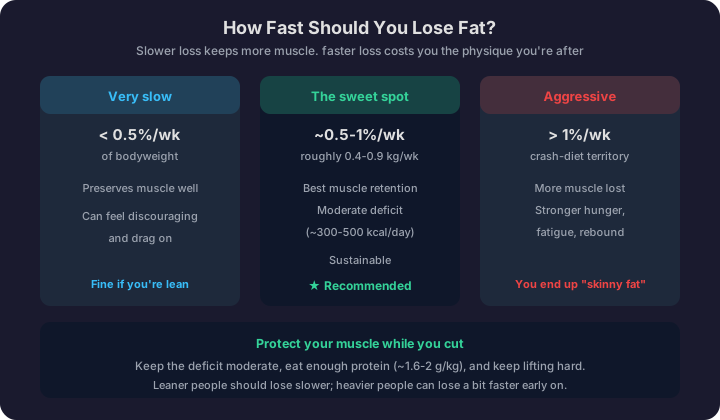
Read that again: same fat loss, but the fast approach cost the muscle and performance the slow approach preserved (and even built). Speed isn't free. You pay for it in the exact tissue you're working so hard to keep.
The Evidence-Based Sweet Spot
So how fast should you go? The widely cited, evidence-based target for preserving muscle is a moderate deficit that yields roughly 0.5 to 1% of your bodyweight per week2. For most people that's somewhere around 0.4 to 0.9 kg (about 1 to 2 pounds) per week.
There's even a concrete threshold for how big your deficit should be. A meta-analysis found that energy deficiency impairs muscle gains, and that deficits greater than about 500 calories per day were the point above which lean-mass gain was prevented3. Interestingly, that same analysis found strength was largely spared even in a deficit, so the main casualty of aggressive cutting is muscle size, not strength3.
A sensible rule of thumb: leaner people should lose more slowly (they have less fat to give up and more muscle to lose), while people carrying more fat can lose a bit faster early on.
Protect Your Muscle While You Cut
The rate of loss is one lever; the other two are protein and training. To hold onto muscle in a deficit:
- Eat plenty of protein. A systematic review found that higher protein intakes during caloric restriction, on the order of 2.3 to 3.1 grams per kilogram of fat-free mass, help preserve muscle in lean, trained people4. In practical terms, keep protein high while cutting.
- Keep lifting hard. Resistance training is the signal that tells your body to keep the muscle. Paired with adequate protein, it's the core strategy for losing fat while staying muscular4.
A moderate deficit, high protein, and hard training is the trio that turns "weight loss" into "fat loss."
Why Crash Diets Backfire
Beyond muscle loss, aggressive dieting triggers your body's defenses. Severe energy restriction causes metabolic adaptation: your resting metabolism drops more than your smaller body size alone would predict, driven by hormonal changes that increase hunger and reduce energy expenditure5. Your body actively fights to slow the loss and drive regain.
The most sobering illustration comes from a follow-up of contestants from an extreme rapid-weight-loss competition. Six years later, their resting metabolism was still suppressed by around 500 calories per day, and most had regained the weight they'd lost6. That's the long tail of crashing: a slowed metabolism and a strong pull back toward your starting point.
A Smarter Tool: Diet Breaks
If you have a lot to lose, you don't have to grind a deficit indefinitely. Research on structured diet breaks is encouraging. In the MATADOR study, alternating two-week blocks of dieting and maintenance produced greater fat loss and better long-term maintenance than continuous dieting of the same average intensity, partly by blunting the drop in metabolism7. Planned breaks at maintenance calories can make a long cut more effective and far more bearable.
The Bottom Line
- Losing weight too fast costs you muscle. at equal fat loss, slower dieters kept (and gained) more muscle and strength1.
- Aim for about 0.5-1% of bodyweight per week, with a deficit generally under ~500 calories per day23.
- Protect muscle with high protein and hard resistance training4.
- Crash diets trigger metabolic adaptation and regain. the fast route often loses in the long run56.
- Use diet breaks for longer cuts to preserve metabolism and sanity7.
Patience genuinely pays here. The goal isn't to be lighter; it's to be leaner, and that means keeping the muscle that gives your body shape. Go at a sustainable pace, and you'll like what's underneath the fat far more. A periodic physique analysis lets you confirm you're losing fat and keeping muscle, not just watching a smaller number on the scale.
References
Footnotes
-
Garthe I, Raastad T, Refsnes PE, Koivisto A, Sundgot-Borgen J (2011). Effect of two different weight-loss rates on body composition and strength and power-related performance in elite athletes. International Journal of Sport Nutrition and Exercise Metabolism, 21(2), 97-104. https://doi.org/10.1123/ijsnem.21.2.97
-
Helms ER, Aragon AA, Fitschen PJ (2014). Evidence-based recommendations for natural bodybuilding contest preparation: nutrition and supplementation. Journal of the International Society of Sports Nutrition, 11(1), 20. https://doi.org/10.1186/1550-2783-11-20
-
Murphy C, Koehler K (2022). Energy deficiency impairs resistance training gains in lean mass but not strength: a meta-analysis and meta-regression. Scandinavian Journal of Medicine & Science in Sports, 32(1), 125-137. https://doi.org/10.1111/sms.14075
-
Helms ER, Zinn C, Rowlands DS, Brown SR (2014). A systematic review of dietary protein during caloric restriction in resistance trained lean athletes: a case for higher intakes. International Journal of Sport Nutrition and Exercise Metabolism, 24(2), 127-138. https://doi.org/10.1123/ijsnem.2013-0054
-
Trexler ET, Smith-Ryan AE, Norton LE (2014). Metabolic adaptation to weight loss: implications for the athlete. Journal of the International Society of Sports Nutrition, 11(1), 7. https://doi.org/10.1186/1550-2783-11-7
-
Fothergill E, Guo J, Howard L, et al. (2016). Persistent metabolic adaptation 6 years after "The Biggest Loser" competition. Obesity, 24(8), 1612-1619. https://doi.org/10.1002/oby.21538
-
Byrne NM, Sainsbury A, King NA, Hills AP, Wood RE (2018). Intermittent energy restriction improves weight loss efficiency in obese men: the MATADOR study. International Journal of Obesity, 42(2), 129-138. https://doi.org/10.1038/ijo.2017.206
More field notes.

Body Fat Percentage Chart: Healthy Ranges by Age and Sex
What is a healthy body fat percentage? See the ranges for men and women, how they shift with age, how to measure yours, and how to lower it without losing muscle.

Spot Reduction: Can You Target Fat Loss in One Area?
Endless crunches for a flat stomach, arm exercises for toned arms. It feels intuitive, but the science says targeted fat loss doesn't work the way you'd hope. Here's what actually determines where you lose fat.

What Is a Physique Rating? Body Types, Scores, and How AI Does It
What a physique rating is, from the 9 body types on a body composition scale to AI photo ratings: what the scores measure, how they compare with DEXA and smart scales, and how to turn a rating into training priorities.
More on HyperBody