Body CompositionJul 30, 20269 min read
Lire en français·Auf Deutsch lesen·Leer en español·Przeczytaj po polsku
Spot Reduction: Can You Target Fat Loss in One Area?
Endless crunches for a flat stomach, arm exercises for toned arms. It feels intuitive, but the science says targeted fat loss doesn't work the way you'd hope. Here's what actually determines where you lose fat.
Reviewed by the HyperBody team

It's one of the most intuitive ideas in fitness, and one of the most stubbornly wrong. If your belly is the problem, train your abs. If your arms jiggle, do arm exercises. This is "spot reduction", the belief that working a muscle burns the fat sitting on top of it, and decades of research have quietly dismantled it.
Understanding why matters, because chasing spot reduction wastes enormous effort on the wrong things. Here's what the evidence actually shows, and what to do instead.
The Studies That Killed the Myth
Researchers have tested spot reduction directly, and repeatedly, in clever ways. The results are remarkably consistent.
The classic experiment had people do a month of dedicated sit-up training, then measured fat cells from the abdomen, upper back, and buttocks. If spot reduction were real, abdominal fat should have shrunk more. Instead, fat cells shrank equally across all three sites: the effect was systemic, not local1.
Later studies used even tighter designs. Six weeks of an intensive abdominal program (seven exercises, five days a week), with diet held constant, produced no change in abdominal fat, body-fat percentage, or waist circumference despite improved core endurance2. Researchers had people train a single leg with high-rep resistance work for twelve weeks, and DXA scans showed no preferential fat loss in the trained leg versus the untrained one3. The same held for single-arm training: no consistent preferential fat loss in the worked arm4.
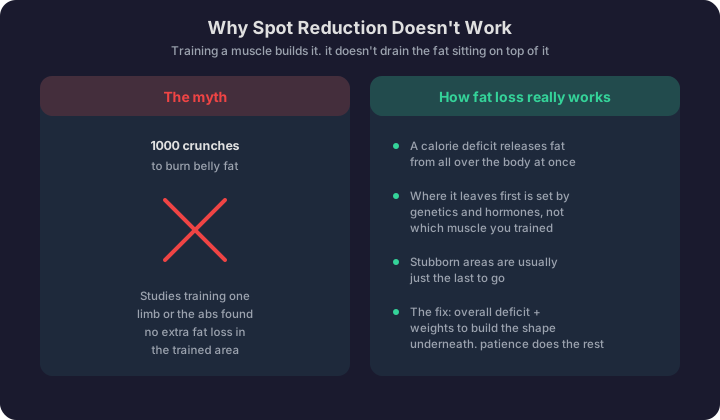
The verdict across all of it: training a muscle builds that muscle, but it doesn't drain the fat lying over it.
Why Your Body Doesn't Work That Way
Fat loss is a whole-body process governed by energy balance. When you're in a sustained calorie deficit, your body mobilizes fat from stores all over, and it decides where to pull from, based on its own rules, not on which muscle you just exhausted5.
Those rules are largely genetic and hormonal. Where you lose fat first (and last) is set by regional differences in how your fat cells respond to fat-mobilizing hormones. For example, abdominal fat cells are roughly four to five times more responsive to catecholamine-driven fat release than gluteal fat cells, and this pattern differs between men and women6. That's why fat distribution, and the order in which it disappears, runs in families and differs so much between individuals. Your "stubborn" areas are simply the regions your body is wired to release last.
The Kernel of Truth (and Why It Doesn't Help)
To be fair and accurate: there is a tiny localized effect. Studies have found that blood flow and fat breakdown do rise slightly in the fat right next to a contracting muscle7. So the spot-reduction instinct isn't completely crazy.
The problem is scale. That signal is far too small to produce visible or meaningful localized fat loss, and it's easily swamped by systemic energy balance and your genetic fat-distribution pattern7. A thousand crunches might transiently nudge blood flow near your abs, but it won't override where your body has decided to hold fat.
What Actually Works
If you can't spot-reduce, how do you lean out a specific area? You do it the only way that works. Reduce your overall body fat, and let genetics reveal your leanest areas first while you wait out the stubborn ones.
- Create a calorie deficit. This is what drives fat loss, systemically, from everywhere at once5.
- Lift weights to build the shape underneath. Resistance training reliably reduces whole-body fat, especially combined with a modest deficit, and it builds the muscle that makes an area look defined once the fat comes off8.
- Get enough protein and stay consistent. Preserving muscle in a deficit is what makes you look lean rather than just smaller.
- Be patient with stubborn areas. The lower belly, hips, or love handles are often simply last in line. There's nothing wrong with you; that's genetics doing exactly what it does6.
The uncomfortable but freeing truth is that you can't choose where you lose fat. What you can control is your overall body fat and the muscle underneath. Crunches build abs, but abs only show when your overall body fat is low enough to reveal them.
A periodic physique analysis is a good way to track your actual body-fat trend and see which areas are responding, rather than fixating on a single stubborn spot, and smart coaching builds the training that shapes what's underneath while you lean out.
References
Footnotes
-
Katch FI, Clarkson PM, Kroll W, McBride T, Wilcox A (1984). Effects of sit up exercise training on adipose cell size and adiposity. Research Quarterly for Exercise and Sport, 55(3), 242-247. https://doi.org/10.1080/02701367.1984.10609359
-
Vispute SS, Smith JD, LeCheminant JD, Hurley KS (2011). The effect of abdominal exercise on abdominal fat. Journal of Strength and Conditioning Research, 25(9), 2559-2564. https://doi.org/10.1519/JSC.0b013e3181fb4a46
-
Ramírez-Campillo R, Andrade DC, Campos-Jara C, et al. (2013). Regional fat changes induced by localized muscle endurance resistance training. Journal of Strength and Conditioning Research, 27(8), 2219-2224. https://doi.org/10.1519/JSC.0b013e31827e8681
-
Kostek MA, Pescatello LS, Seip RL, et al. (2007). Subcutaneous fat alterations resulting from an upper-body resistance training program. Medicine & Science in Sports & Exercise, 39(7), 1177-1185. https://doi.org/10.1249/mss.0b0138058a5cb
-
Hall KD, Guo J (2017). Obesity energetics: body weight regulation and the effects of diet composition. Gastroenterology, 152(7), 1718-1727.e3. https://doi.org/10.1053/j.gastro.2017.01.052
-
Wahrenberg H, Lönnqvist F, Arner P (1989). Mechanisms underlying regional differences in lipolysis in human adipose tissue. Journal of Clinical Investigation, 84(2), 458-467. https://doi.org/10.1172/JCI114187
-
Stallknecht B, Dela F, Helge JW (2007). Are blood flow and lipolysis in subcutaneous adipose tissue influenced by contractions in adjacent muscles in humans? American Journal of Physiology-Endocrinology and Metabolism, 292(2), E394-E399. https://doi.org/10.1152/ajpendo.00215.2006
-
Lopez P, Taaffe DR, Galvão DA, et al. (2022). Resistance training effectiveness on body composition and body weight outcomes in individuals with overweight and obesity across the lifespan: a systematic review and meta-analysis. Obesity Reviews, 23(5), e13428. https://doi.org/10.1111/obr.13428
More field notes.

How Fast Can You Safely Lose Fat?
Crash diets promise fast results, but speed has a hidden cost: your muscle. Here's the science on how quickly you should actually lose fat to end up lean and defined, not just smaller.

Body Fat Percentage Chart: Healthy Ranges by Age and Sex
What is a healthy body fat percentage? See the ranges for men and women, how they shift with age, how to measure yours, and how to lower it without losing muscle.

Water Weight: Why the Scale Fluctuates (and When Not to Worry)
You did everything right, and the scale jumped 1.5 kg overnight. Before you panic, understand this: day-to-day weight swings are almost entirely water and food, not fat. Here's the science.
More on HyperBody