Body CompositionAug 31, 20269 min read
Lire en français·Auf Deutsch lesen·Leer en español·Przeczytaj po polsku
Water Weight: Why the Scale Fluctuates (and When Not to Worry)
You did everything right, and the scale jumped 1.5 kg overnight. Before you panic, understand this: day-to-day weight swings are almost entirely water and food, not fat. Here's the science.
Reviewed by the HyperBody team

You weigh yourself Monday morning. Then again Tuesday, having eaten well and trained hard, and you're up 1.5 kg. It's one of the most demoralizing experiences in fitness, and it drives people to abandon plans that are actually working.
Here's the truth that fixes it: you did not gain 1.5 kg of fat overnight. That's physically impossible. What you're seeing is water and food weight, the normal daily noise that hides the real signal. Once you understand what's actually moving the scale, you'll stop letting it dictate your mood.
Daily Swings Are Water, Not Fat
Start with the big picture. When researchers measured what short-term body-weight changes are actually made of in free-living adults, they found that two-week fluctuations were dominated by fat-free mass, mostly water, not fat1. Your fat mass simply doesn't change fast enough to explain the swings you see day to day.
There's even a predictable rhythm to it. A study tracking daily weights found a consistent weekly pattern: weight tends to rise over the weekend and fall back during the week2. It's so regular that it should be read as normal variation, not as fat gained on Saturday and lost by Wednesday.
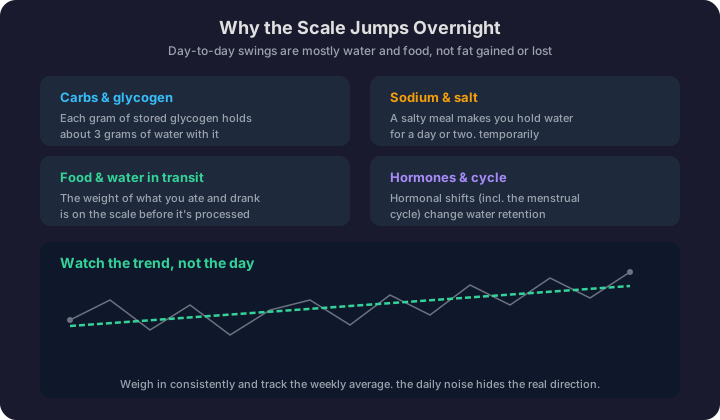
So what's pushing the number around? A handful of completely normal factors.
Carbs, Glycogen, and Water
Your body stores carbohydrate as glycogen in your muscles and liver, and glycogen is stored with water. Direct measurements in human muscle show glycogen binds a substantial amount of water alongside it, commonly cited as roughly 3 grams of water per gram of glycogen3.
This has big, fast effects on the scale. Eat a large carb-heavy meal or a few high-carb days, and you'll store more glycogen and hold more water, easily a kilogram or two, with zero fat gain3. It's also why low-carb diets produce dramatic "weight loss" in the first week: you're draining glycogen and its associated water, which rushes back the moment you eat carbs again. That whoosh isn't fat; it's a water tank refilling.
Salt and Sodium
Sodium influences how much water your body holds, but the story is more nuanced than "salt makes you fat." Controlled research shows that a sodium load drives fluid shifts, changes in how water is distributed, rather than a large, permanent gain in total body water4. The practical upshot is real but temporary: a salty meal can bump the scale for a day or two as your body manages the fluid, then it settles. It's a transient blip, not a trend.
Hormones and the Menstrual Cycle
For women, the menstrual cycle adds another layer of normal fluctuation. Prospective research has documented cyclical fluid-retention patterns across the cycle5, and a study measuring body weight directly found it was about 0.45 kg higher during menstruation. An increase attributable to extracellular water, not fat or adiposity6. Knowing this prevents a normal hormonal water shift from being misread as "falling off track."
The Fix: Watch the Trend, Not the Day
If daily weight is mostly noise, how do you actually track progress? You look at the trend over time, not any single reading. Fat change is governed by energy balance integrated over weeks, with your body actively counter-regulating; the daily numbers are just static around that slower signal7.
Practically:
- Weigh in consistently. Same time of day (ideally first thing in the morning, after using the bathroom, before eating), same conditions. This doesn't stop fluctuations, but it makes them more comparable.
- Track the weekly average, not individual days. Add up your daily weigh-ins and average them; compare this week's average to last week's. That smooths out the water noise and reveals the real direction.
- Weigh often, but hold it loosely. Frequent weighing is associated with better results, because it surfaces the trend and keeps you engaged, as long as you read it as data, not a verdict8.
- Expect the ups. A high morning after a salty dinner, a big carb day, or (for women) a particular point in your cycle is expected. It is not fat, and it will pass346.
The Bottom Line
- Overnight scale jumps are water and food, not fat. fat mass can't change that fast1.
- Carbs, sodium, and hormones all move water weight in completely normal, temporary ways346.
- The scale has a rhythm. weekend-up, midweek-down is standard2.
- Judge the weekly trend, not the daily number, and weigh under consistent conditions87.
The scale is a useful tool, but only when you read it right. Stop reacting to the daily noise and start watching the weekly signal, and you'll spare yourself a lot of unnecessary discouragement and see the progress that's actually there. For a fuller picture than the scale can give, a periodic physique analysis tracks how your body composition is really changing, water noise and all.
References
Footnotes
-
Bhutani S, Kahn E, Tasali E, Schoeller DA (2017). Composition of two-week change in body weight under unrestricted free-living conditions. Physiological Reports, 5(13), e13336. https://doi.org/10.14814/phy2.13336
-
Orsama AL, Mattila E, Ermes M, van Gils M, Wansink B, Korhonen I (2014). Weight rhythms: weight increases during weekends and decreases during weekdays. Obesity Facts, 7(1), 36-47. https://doi.org/10.1159/000356147
-
Fernández-Elías VE, Ortega JF, Nelson RK, Mora-Rodriguez R (2015). Relationship between muscle water and glycogen recovery after prolonged exercise in the heat in humans. European Journal of Applied Physiology, 115(9), 1919-1926. https://doi.org/10.1007/s00421-015-3175-z
-
Heer M, Baisch F, Kropp J, Gerzer R, Drummer C (2000). High dietary sodium chloride consumption may not induce body fluid retention in humans. American Journal of Physiology-Renal Physiology, 278(4), F585-F595. https://doi.org/10.1152/ajprenal.2000.278.4.F585
-
White CP, Hitchcock CL, Vigna YM, Prior JC (2011). Fluid retention over the menstrual cycle: 1-year data from the prospective ovulation cohort. Obstetrics and Gynecology International, 2011, 138451. https://doi.org/10.1155/2011/138451
-
Kanellakis S, Skoufas E, Simitsopoulou E, et al. (2023). Changes in body weight and body composition during the menstrual cycle. American Journal of Human Biology, 35(11), e23951. https://doi.org/10.1002/ajhb.23951
-
Hall KD, Guo J (2017). Obesity energetics: body weight regulation and the effects of diet composition. Gastroenterology, 152(7), 1718-1727.e3. https://doi.org/10.1053/j.gastro.2017.01.052
-
Steinberg DM, Bennett GG, Askew S, Tate DF (2015). Weighing everyday matters: daily weighing improves weight loss and adoption of weight control behaviors. Journal of the Academy of Nutrition and Dietetics, 115(4), 511-518. https://doi.org/10.1016/j.jand.2014.12.011
More field notes.

How Fast Can You Safely Lose Fat?
Crash diets promise fast results, but speed has a hidden cost: your muscle. Here's the science on how quickly you should actually lose fat to end up lean and defined, not just smaller.

What Is a Physique Rating? Body Types, Scores, and How AI Does It
What a physique rating is, from the 9 body types on a body composition scale to AI photo ratings: what the scores measure, how they compare with DEXA and smart scales, and how to turn a rating into training priorities.

Body Fat Percentage From a Photo: How It Works and How Accurate It Is
AI can estimate your body fat percentage from photos. Here is what the estimate is based on, how it compares to DEXA, calipers, and smart scales, and how to take photos that make the number trustworthy.
More on HyperBody