Body CompositionOct 19, 202610 min read
Lire en français·Auf Deutsch lesen·Leer en español·Przeczytaj po polsku
Body Fat Set Point: Why Your Body Resists Weight Change
Ever lost weight only to have it creep back? That's not a lack of willpower. It's biology. Your body actively defends a weight range. Here's how that system works, and how to shift it.
Reviewed by the HyperBody team

You diet, you lose the weight, you celebrate, and months later, it's back. This frustrating cycle is so common that people blame themselves for it. But the real explanation isn't weak willpower. It's that your body has a powerful biological system designed to defend a certain weight range, and it fights hard to pull you back when you drop below it. Understanding this "set point" system is the key to actually changing your body for good.
Your Body Actively Defends Its Weight
Body weight isn't passively determined by your daily choices alone. It's actively regulated. Over long periods, your energy intake and expenditure track each other with remarkable precision, and when you disturb that balance, your body triggers compensatory responses that push you back toward baseline12.
The classic demonstration is striking. In a landmark experiment, people who maintained a 10% lower body weight saw their daily energy expenditure drop by roughly 300 to 400 calories below what their new size would predict, and those at a 10% higher weight burned more3. Your body responds to weight change in both directions, actively resisting the shift. That's the defended-weight system in action.
How It Fights Back
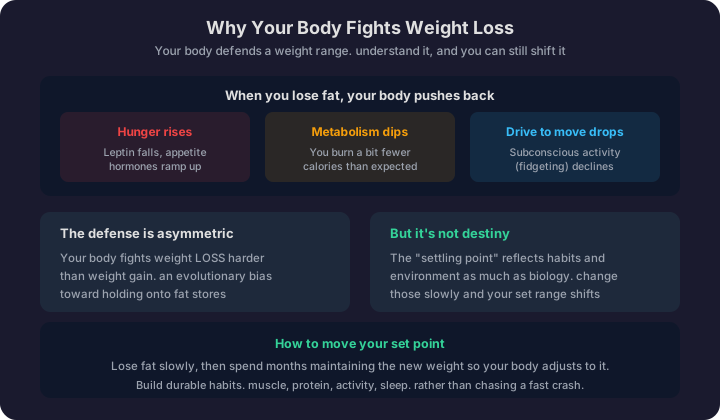
When you lose fat, your body deploys several defenses at once:
Hunger rises. Fat tissue produces a hormone called leptin, and as you lose fat, leptin falls. Your brain reads low leptin as a starvation signal and responds by cranking up hunger and dialing down energy expenditure4. It's not that you lack discipline; your appetite is being biologically amplified.
Metabolism dips. Dieting lowers your resting metabolic rate by more than your smaller body size alone would predict, a phenomenon called adaptive thermogenesis53. You end up burning fewer calories than expected, which slows further loss.
These changes persist. This isn't a brief blip. In one study, the hormonal changes driving hunger, lower leptin and PYY, higher ghrelin, were still elevated a full year after weight loss6. Your body doesn't quickly accept a new lower weight; it keeps signaling to regain for a long time.
The System Is Asymmetric (and Unfair)
Here's the part that feels genuinely unjust: your body defends against weight loss more strongly than against weight gain23. Evolutionarily, this makes sense. Holding onto fat stores was a survival advantage. But in the modern world, it means losing fat is an uphill battle while regaining it is easy. This asymmetry is a big reason diets so often fail in the long run, not because people are lazy, but because the biology is stacked against maintenance.
The most sobering evidence comes from a six-year follow-up of extreme-weight-loss competitors: they regained roughly 70% of the weight they'd lost, while their metabolic rate remained suppressed by around 700 calories per day7. The defense system kept working long after the diet ended.
But Your Set Point Is Not Destiny
If this all sounds hopeless, it isn't. The crucial nuance is that your defended weight is modifiable. Modern evidence fits a "settling point" better than a rigid, fixed set point: the weight your body defends drifts over time based on your environment, diet quality, activity, and habits, not just your genes18. You're not permanently locked to one number.
This reframes the whole game. You can shift your settling point, but you do it slowly, by changing the inputs that determine it, not by crashing your weight down and hoping it sticks.
How to Actually Shift It
Working with your biology rather than against it:
- Lose fat slowly. Aggressive dieting maximizes the defensive response. A gradual, moderate deficit gives your body less to fight against58.
- Treat maintenance as a phase, not an afterthought. Because the drive to regain persists6, you need to spend real time, months, maintaining your new weight so your body can adjust to it as the new normal.
- Build durable habits, not quick fixes. Sustained changes in diet quality, activity, protein, muscle mass, and sleep are what move the settling point over time8.
- Expect maintenance to require ongoing effort. It's not that you failed if it takes attention: the biology means staying reduced is an active process, not a one-time achievement76.
The Bottom Line
- Your body actively defends a weight range through hunger, metabolism, and hormones143.
- The defenses persist for a long time after weight loss and are stacked against you: it fights loss harder than gain26.
- This is biology, not a character flaw. regain is a physiological pull, not just a willpower failure7.
- But the set point is really a settling point. it can shift with sustained lifestyle change18.
- Go slow, prioritize maintenance, and build lasting habits to move it for good58.
Understanding your set point should be freeing, not discouraging. It means the answer isn't another aggressive crash diet. It's a patient, sustainable approach that respects how your body actually works. Tracking body composition over time with a periodic physique analysis, rather than obsessing over the scale, helps you play this long game the right way.
References
Footnotes
-
Speakman JR, Levitsky DA, Allison DB, et al. (2011). Set points, settling points and some alternative models: theoretical options to understand how genes and environments combine to regulate body adiposity. Disease Models & Mechanisms, 4(6), 733-745. https://doi.org/10.1242/dmm.008698
-
Müller MJ, Bosy-Westphal A, Heymsfield SB (2010). Is there evidence for a set point that regulates human body weight? F1000 Medicine Reports, 2, 59. https://doi.org/10.3410/M2-59
-
Leibel RL, Rosenbaum M, Hirsch J (1995). Changes in energy expenditure resulting from altered body weight. New England Journal of Medicine, 332(10), 621-628. https://doi.org/10.1056/NEJM199503093321001
-
Rosenbaum M, Leibel RL (2014). 20 years of leptin: role of leptin in energy homeostasis in humans. Journal of Endocrinology, 223(1), T83-T96. https://doi.org/10.1530/JOE-14-0358
-
Trexler ET, Smith-Ryan AE, Norton LE (2014). Metabolic adaptation to weight loss: implications for the athlete. Journal of the International Society of Sports Nutrition, 11, 7. https://doi.org/10.1186/1550-2783-11-7
-
Sumithran P, Prendergast LA, Delbridge E, et al. (2011). Long-term persistence of hormonal adaptations to weight loss. New England Journal of Medicine, 365(17), 1597-1604. https://doi.org/10.1056/NEJMoa1105816
-
Fothergill E, Guo J, Howard L, et al. (2016). Persistent metabolic adaptation 6 years after "The Biggest Loser" competition. Obesity, 24(8), 1612-1619. https://doi.org/10.1002/oby.21538
-
Hall KD, Guo J (2017). Obesity energetics: body weight regulation and the effects of diet composition. Gastroenterology, 152(7), 1718-1727.e3. https://doi.org/10.1053/j.gastro.2017.01.052
More field notes.

How Fast Can You Safely Lose Fat?
Crash diets promise fast results, but speed has a hidden cost: your muscle. Here's the science on how quickly you should actually lose fat to end up lean and defined, not just smaller.

Body Fat Percentage Chart: Healthy Ranges by Age and Sex
What is a healthy body fat percentage? See the ranges for men and women, how they shift with age, how to measure yours, and how to lower it without losing muscle.

Spot Reduction: Can You Target Fat Loss in One Area?
Endless crunches for a flat stomach, arm exercises for toned arms. It feels intuitive, but the science says targeted fat loss doesn't work the way you'd hope. Here's what actually determines where you lose fat.
More on HyperBody