RecoveryOct 1, 202610 min read
Lire en français·Auf Deutsch lesen·Leer en español·Przeczytaj po polsku
DOMS: Is Muscle Soreness Necessary for Growth?
That deep ache two days after a workout feels like proof you did something right. But is soreness actually a sign of muscle growth? The science says no, and chasing it can mislead you.
Reviewed by the HyperBody team

You crush a workout, and two days later you can barely walk down the stairs. It feels like a badge of honor. Proof the session "worked." This is delayed onset muscle soreness (DOMS), and a huge number of people use it as their main gauge of a good workout. Here's the problem: the science is clear that soreness is a poor measure of muscle growth. You can grow with almost no soreness, and you can be crippled with soreness and grow nothing.
Let's clear up what DOMS actually is, what it does and doesn't tell you, and how to gauge a productive workout instead.
What DOMS Actually Is
DOMS is the muscle soreness that shows up not during exercise, but in the following days. It's caused primarily by unaccustomed and eccentric (lengthening) muscle actions: new exercises, more volume than usual, or lots of lowering under load1. Despite the persistent gym myth, it is not caused by lactic acid.
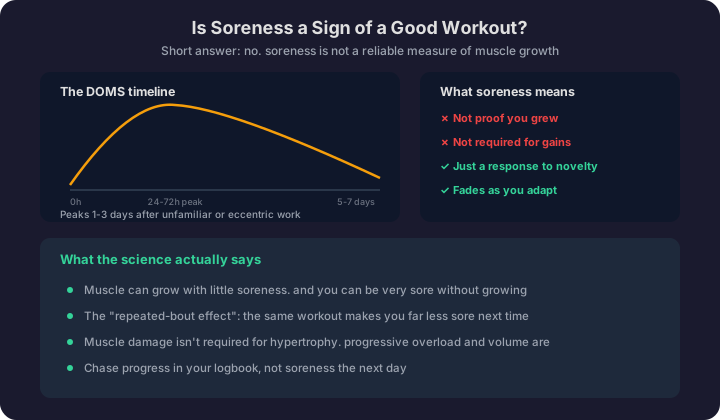
It follows a predictable time course: onset around 12 to 24 hours after training, a peak at 24 to 72 hours, and resolution within about 5 to 7 days12. The underlying cause is thought to be micro-damage to muscle fibers and the inflammatory repair response that follows1.
Soreness Is Not a Reliable Signal
Here's the crux. If DOMS reflected muscle growth, it would be a useful gauge. But it doesn't. A review specifically asking whether post-exercise soreness is a valid indicator of muscular adaptation concluded that it is not. Soreness correlates only weakly with actual markers of muscle damage like creatine kinase, strength loss, and range of motion3.
In plain terms: how sore you feel doesn't reliably tell you how much you damaged the muscle, let alone how much it will grow. Soreness is largely a response to novelty. Do a movement your body isn't used to, and you'll be sore, regardless of whether that session was optimal for growth.
You Can Build Muscle Without Being Sore
The most compelling evidence comes from studies tracking damage and growth over a full training program. In one, muscle damage and protein synthesis were highest in the first week, when soreness is worst, yet that early damage was not correlated with muscle growth. Only later, once the damage had settled down, did protein synthesis actually track with hypertrophy4.
The takeaway is striking: the sorest phase of training, when everything is new, is not when most of your growth happens. Muscle damage isn't a required driver of hypertrophy; growth proceeds just fine as damage and soreness diminish across a training block45. Seasoned lifters often build muscle steadily while rarely getting very sore. That's not a sign their training has stopped working. It's a sign their bodies have adapted.
The Repeated-Bout Effect
This adaptation has a name: the repeated-bout effect. After one exposure to a damaging workout, the same workout done later produces markedly less soreness and damage2. Your muscle gets structurally and neurologically tougher.
This is why the first week or two of a new program leaves you wrecked, and then, doing the exact same sessions, you barely get sore. Many people misread that fading soreness as "my workout isn't hard enough anymore" and start chasing soreness by constantly changing exercises. That's a mistake. The reduced soreness is a protective adaptation, not a weaker stimulus. If you're still progressing in your logbook, the training is working.
What to Actually Track Instead
If not soreness, then what? The real indicators of a productive program are objective:
- Progressive overload. Are you adding reps or weight over time? That, not soreness, is the signature of growth-driving training.
- Your logbook. Chase numbers going up week to week, not aches the next day.
- Consistency and volume. Are you accumulating enough hard sets per muscle per week?
Feeling less sore as you get fitter is expected and good. Don't sabotage a working program to manufacture soreness.
Managing Soreness When You Do Get It
Some soreness is normal, especially after time off or new movements. To keep it manageable:
- Progress gradually. Ramping volume and eccentric load slowly limits how sore you get1, and the repeated-bout effect does the rest2.
- Use evidence-backed recovery. A meta-analysis found that active recovery, massage, compression garments, and cold-water immersion produce small-to-moderate reductions in soreness6.
- Sleep. Adequate sleep supports recovery; sleep loss impairs it and works against muscle repair7.
- Keep moving. Light activity usually eases DOMS more than total rest.
The Bottom Line
- DOMS comes from unfamiliar and eccentric exercise, peaks at 24-72 hours, and isn't caused by lactic acid1.
- Soreness is not a valid indicator of muscle growth. you can grow without it and be sore without growing34.
- Muscle damage isn't required for hypertrophy. progressive overload and volume are45.
- Fading soreness is adaptation (the repeated-bout effect), not a weaker workout2.
- Track your logbook, not your soreness. progress is the real signal.
So the next time you're not sore after a session, don't assume you wasted it. And the next time you can barely sit down, don't assume it was your best workout ever. Judge your training by what it's actually producing over weeks, which is exactly what a periodic physique analysis and a progress-tracked smart coaching plan help you see.
References
Footnotes
-
Cheung K, Hume PA, Maxwell L (2003). Delayed onset muscle soreness: treatment strategies and performance factors. Sports Medicine, 33(2), 145-164. https://doi.org/10.2165/00007256-200333020-00005
-
Hyldahl RD, Chen TC, Nosaka K (2017). Mechanisms and mediators of the skeletal muscle repeated bout effect. Exercise and Sport Sciences Reviews, 45(1), 24-33. https://doi.org/10.1249/JES.0000000000000095
-
Schoenfeld BJ, Contreras B (2013). Is postexercise muscle soreness a valid indicator of muscular adaptations? Strength and Conditioning Journal, 35(5), 16-21. https://doi.org/10.1519/SSC.0b013e3182a61820
-
Damas F, Phillips SM, Libardi CA, et al. (2016). Resistance training-induced changes in integrated myofibrillar protein synthesis are related to hypertrophy only after attenuation of muscle damage. The Journal of Physiology, 594(18), 5209-5222. https://doi.org/10.1113/JP272472
-
Schoenfeld BJ (2012). Does exercise-induced muscle damage play a role in skeletal muscle hypertrophy? Journal of Strength and Conditioning Research, 26(5), 1441-1453. https://doi.org/10.1519/JSC.0b013e31824f207e
-
Dupuy O, Douzi W, Theurot D, Bosquet L, Dugué B (2018). An evidence-based approach for choosing post-exercise recovery techniques to reduce markers of muscle damage, soreness, fatigue, and inflammation: a systematic review with meta-analysis. Frontiers in Physiology, 9, 403. https://doi.org/10.3389/fphys.2018.00403
-
Fullagar HHK, Skorski S, Duffield R, et al. (2015). Sleep and athletic performance: the effects of sleep loss on exercise performance, and physiological and cognitive responses to exercise. Sports Medicine, 45(2), 161-186. https://doi.org/10.1007/s40279-014-0260-0
More field notes.

How Sleep Affects Muscle Growth and Recovery
You can train perfectly and eat perfectly, but if your sleep is broken, your results will be too. Here's the science of sleep and muscle growth.

How Many Rest Days Do You Need? The Science of Recovery
You don't build muscle in the gym. You build it while you recover. Here's what the research says about how much rest you actually need, and how to tell when you need more.

Body Recomposition: Can You Build Muscle and Lose Fat at the Same Time?
Building muscle while losing fat sounds like having it both ways, but for several groups of lifters it is well documented. Here is who can realistically recomp, why it works, and how to tell it is working when the scale refuses to move.
More on HyperBody