RecoveryAug 13, 202610 min read
Lire en français·Auf Deutsch lesen·Leer en español·Przeczytaj po polsku
How Many Rest Days Do You Need? The Science of Recovery
You don't build muscle in the gym. You build it while you recover. Here's what the research says about how much rest you actually need, and how to tell when you need more.
Reviewed by the HyperBody team

It feels backwards, but it's true: the training session is only the stimulus. The actual growth, the repair and rebuilding that makes you bigger and stronger, happens afterward, while you rest. Train too little and you don't grow. Rest too little and you don't grow either, because you never let the building happen. Getting recovery right is half the equation, and most people guess at it.
So how many rest days do you actually need? The honest answer is "it depends," but the science gives us clear principles to work from.
What Happens While You Recover
When you train a muscle, you kick off a repair process called muscle protein synthesis. And it doesn't finish quickly. Studies measuring it directly found that muscle protein synthesis stays elevated for up to 48 hours after a resistance session1, peaking around the 24-hour mark before tapering off2.
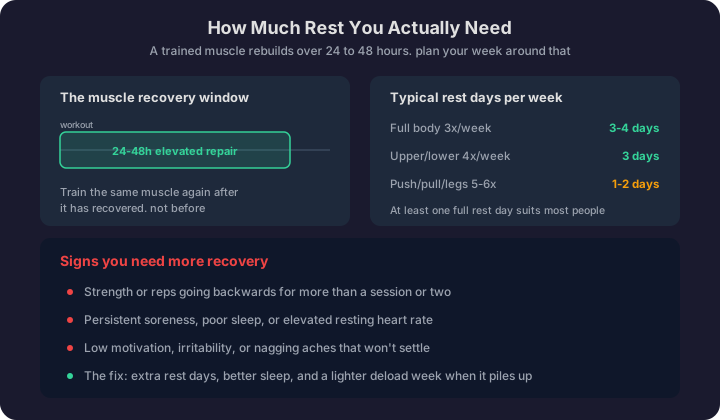
This gives you a concrete recovery window: a trained muscle is actively rebuilding for roughly one to two days afterward. That's the biological basis for the classic advice to leave about 48 hours before hammering the same muscle again, and it's why "rest" isn't lazy, it's when the work pays off.
Rest Days Are Built Into Good Programming
Here's a reassuring finding: you don't need to train every day to make excellent progress. When total weekly volume is equated, training a muscle more frequently doesn't produce meaningfully more growth3, so there's no penalty for building in rest days.
The research supports training each major muscle group about twice a week3, which automatically bakes recovery time between sessions. Even official health guidance reflects this: global recommendations call for muscle-strengthening activity on two or more days per week, not daily4. Rest days aren't a compromise; they're part of the evidence-based prescription.
How many you need depends on your structure:
- Full body 3x/week: you'll naturally have 3 to 4 rest days. Plenty.
- Upper/lower 4x/week: around 3 rest days, with muscles recovering while you train the opposite region.
- Push/pull/legs 5-6x/week: as few as 1 to 2 full rest days, which works only if your sleep and nutrition keep pace.
Most people do well with at least one full rest day per week, but the "right" number is individual. It scales with your training volume, your sleep, and your accumulated fatigue.
When You Don't Rest Enough
Ignore recovery long enough and your body forces the issue. Fatigue exists on a spectrum. Push a little too hard and you get functional overreaching: a short dip in performance that you bounce back from (and even supercompensate). Keep pushing without recovery and it becomes non-functional overreaching, then full overtraining syndrome. Months of underperformance, hormonal and immune disruption, and mood disturbances5.
Overtraining syndrome is exactly what it sounds like: a maladaptive response to excessive training without adequate rest6. You don't want to visit it. The warning signs are worth knowing:
- Performance going backwards for more than a session or two despite trying hard5.
- Persistent soreness, poor sleep, or an elevated resting heart rate.
- Low motivation, irritability, and nagging aches that don't settle.
If several of these show up together, the answer isn't to push harder. It's to back off.
Recovery Is More Than Days Off
"Rest day" doesn't have to mean lying on the couch, and recovery is more than just not training. Two levers matter as much as the calendar:
Sleep is the ultimate recovery tool. In a study of college athletes, extending sleep to around ten hours in bed improved sprint speed, shooting accuracy, reaction time, and mood7. If your recovery is lagging, sleep is usually the first place to look, before adding more rest days.
Active recovery beats total inactivity. A rest day is better spent lightly active, a walk, easy cycling, mobility work, than fully sedentary. Light activity even helps clear metabolic byproducts faster than passive rest8, and health guidance specifically recommends reducing sedentary time alongside structured exercise4.
Deloads handle the deep fatigue. When fatigue accumulates over weeks, a single rest day won't fix it. A planned deload, a week of deliberately reduced training stress, is a recognized way to dissipate that buildup and restore readiness9. A good rule of thumb is a lighter week every 4 to 8 weeks, or whenever the warning signs cluster.
The Bottom Line
- A trained muscle rebuilds over ~24-48 hours. train it again after it's recovered, not before12.
- You don't need to train daily. hit each muscle about twice a week, and rest days are built in34.
- At least one full rest day per week suits most people; higher-frequency splits need tighter sleep and nutrition.
- Watch for the warning signs of under-recovery, and respond with rest, not more effort65.
- Sleep, light activity, and periodic deloads are as important as the number of days off798.
Rest isn't the opposite of training. It's the other half of it. Respect your recovery and you'll not only feel better, you'll actually keep the progress coming. Smart coaching programs recovery in for you, spacing sessions and scheduling deloads so you train hard without digging a hole.
References
Footnotes
-
Phillips SM, Tipton KD, Aarsland A, Wolf SE, Wolfe RR (1997). Mixed muscle protein synthesis and breakdown after resistance exercise in humans. American Journal of Physiology-Endocrinology and Metabolism, 273(1), E99-E107. https://doi.org/10.1152/ajpendo.1997.273.1.E99
-
MacDougall JD, Gibala MJ, Tarnopolsky MA, et al. (1995). The time course for elevated muscle protein synthesis following heavy resistance exercise. Canadian Journal of Applied Physiology, 20(4), 480-486. https://doi.org/10.1139/h95-038
-
Schoenfeld BJ, Grgic J, Krieger J (2019). How many times per week should a muscle be trained to maximize muscle hypertrophy? A systematic review and meta-analysis. Journal of Sports Sciences, 37(11), 1286-1295. https://doi.org/10.1080/02640414.2018.1555906
-
Bull FC, Al-Ansari SS, Biddle S, et al. (2020). World Health Organization 2020 guidelines on physical activity and sedentary behaviour. British Journal of Sports Medicine, 54(24), 1451-1462. https://doi.org/10.1136/bjsports-2020-102955
-
Meeusen R, Duclos M, Foster C, et al. (2013). Prevention, diagnosis, and treatment of the overtraining syndrome: joint consensus statement of the European College of Sport Science and the American College of Sports Medicine. Medicine & Science in Sports & Exercise, 45(1), 186-205. https://doi.org/10.1249/MSS.0b013e318279a10a
-
Kreher JB, Schwartz JB (2012). Overtraining syndrome: a practical guide. Sports Health, 4(2), 128-138. https://doi.org/10.1177/1941738111434406
-
Mah CD, Mah KE, Kezirian EJ, Dement WC (2011). The effects of sleep extension on the athletic performance of collegiate basketball players. Sleep, 34(7), 943-950. https://doi.org/10.5665/sleep.1132
-
Menzies P, Menzies C, McIntyre L, Paterson P, Wilson J, Kemi OJ (2010). Blood lactate clearance during active recovery after an intense running bout depends on the intensity of the active recovery. Journal of Sports Sciences, 28(9), 975-982. https://doi.org/10.1080/02640414.2010.481721
-
Bell L, Darragh IAJ, Travis SK, Rogerson D, Nolan D (2025). A practical approach to deloading: recommendations and considerations for strength and physique sports. Strength and Conditioning Journal. Advance online publication. https://doi.org/10.1519/SSC.0000000000000910
More field notes.

How Sleep Affects Muscle Growth and Recovery
You can train perfectly and eat perfectly, but if your sleep is broken, your results will be too. Here's the science of sleep and muscle growth.

DOMS: Is Muscle Soreness Necessary for Growth?
That deep ache two days after a workout feels like proof you did something right. But is soreness actually a sign of muscle growth? The science says no, and chasing it can mislead you.

Walking for Fitness: Do You Really Need 10,000 Steps?
The 10,000-step goal is everywhere, baked into every fitness tracker. It's also not based on science. Here's where the number came from, and how many steps actually move the needle on your health.
More on HyperBody